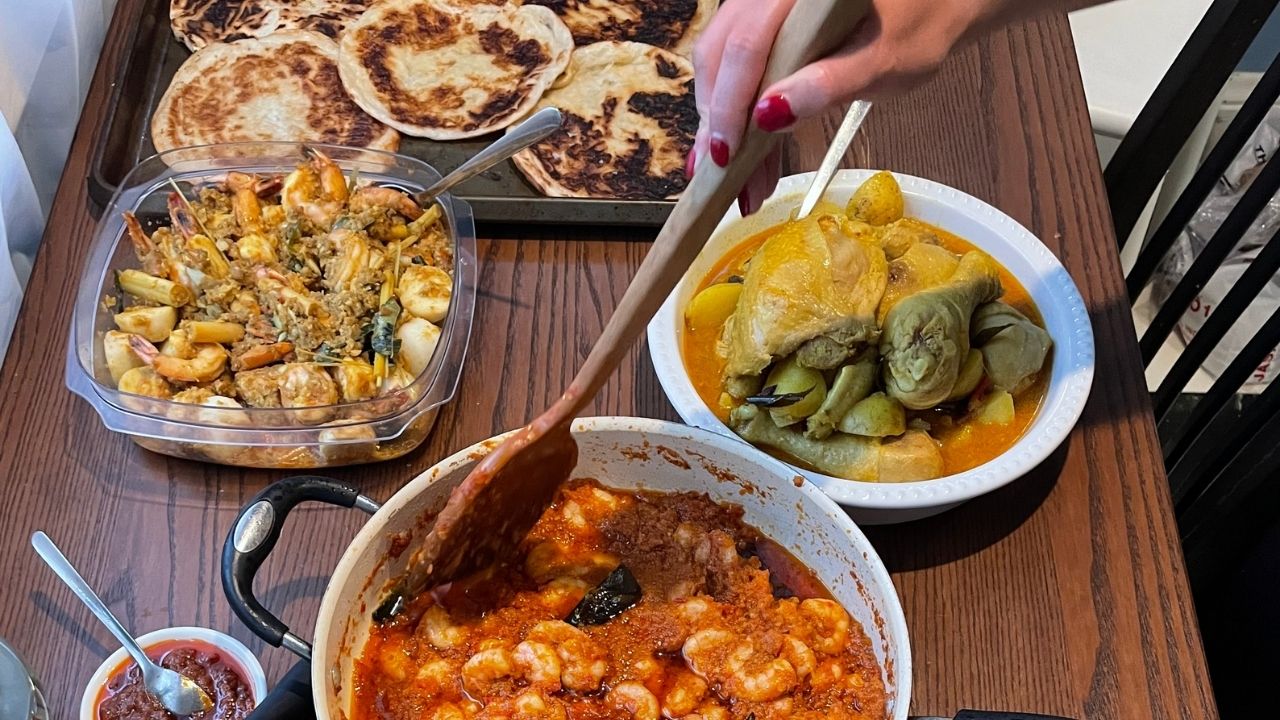
In my earliest days of settling into Portland, my partner and I lived in an apartment that was within walking distance of a Malaysian food cart. I was shocked and excited to see menu items that were so specific to my heritage. I remember enjoying the shrimp sambal because it was made in the same style as my mother’s, a technique rarely seen on this side of the world: giant pieces of shrimp coated in a chili paste sauce seasoned with a slight tang of tamarind. I even ate there before one of my job interviews for good luck.
We were newly married in a new city. I prided myself in knowing places to find good food when I lived in Boston and Washington, DC. In Portland, known for its thriving food and restaurant scene, I foresaw only good things for my palate. Later, the significance of food would extend beyond the novelty of the next trendy restaurant. It would help me understand more about myself as I weathered two life-changing events: motherhood and the pandemic.
With motherhood came an identity crisis I would not know how to process. The experience of raising a child brought a self-imposed pressure of needing to pass down culture and family wisdom that would easily be forgotten if not for me, especially as I live a whole world apart from family. I spiraled as I imagined my children not knowing the culture they inherited from me, like the food I grew up with and our mixed language.
Up to that point, my identity in the United States had been a blank slate. I could pick and choose what to reveal when convenient. I could shape into someone different when it was easier than explaining my true self. But with child-rearing I discovered that there were parts of my core self that could not be changed. These parts of me are from generations of Malaysian heritage. I started to cling hard to who I was as I mothered my American-born children. Every Christmas I make pineapple tarts and involve my kids in the process, the same way my mother did. Every bath time I exclaim, “Time to mandi!” The same words my sister says to her children. We have read a book about Malaysian folk music so many times that it turned to pulp from overuse, but my oldest still knows the same songs I learned in primary school. And in our home, rice is always eaten with a spoon.
With the isolation of the pandemic came a feeling of longing. I wasn't able to make my annual trip back to Malaysia, my usual reset. I realized that facing humid weather, loosening my tongue to speak Manglish (Malaysian-English), and eating heritage food were things I needed to thrive as I now lived abroad. I found myself to be like a wilted plant drained by the elements. Needing water and fertilizer, so to speak, I busied myself in the kitchen.
I started making different varieties of kuih, delectable afternoon treats in Malaysia sold at the gerai, roadside stands attached to multi-colored umbrellas to shield from harsh tropical sun and rain. As I steamed, pressed, and pounded ingredients like pandan and desiccated coconut for each kuih, I reflected on my journey as a mother and immigrant. I also became attuned to pockets of community in the city, especially for people of color, where food and identity took a central focus.
In North Portland, I shopped at a Laotian-owned grocer. It was a small but compact shop that offered essentials for southeast Asian cooking—shelves of pantry items like fish sauce and canned coconut milk; a small but healthy looking section of fresh produce like Japanese eggplant, Thai basil, and limau purut leaves; several freezer chests of fish and meats. Asian grocery stores will always bring me a sense of comfort. I had long known this about myself as an immigrant, beginning with my first trip to one in Seattle over 15 years ago. Here at this shop as I paid for my shallots and lemongrass, the shopkeeper asked how old my baby was, and if she was my first child. She offered a smile so genuine. I asked if business was doing okay. I felt such warmth from this simple exchange on that cold day in May. It brought me the familiarity of home, a place I couldn't travel to at the time due to pandemic restrictions. It was only a small interaction, but my heart warmed knowing that this little shop was doing so much more for me than they could know from this one sale. They were running a business, and they were also helping fellow southeast Asian customers feel a little more visible in this city by providing ingredients for our food.
In the summer of 2024, I came across a screening of Food Foray, a docuseries produced by MetroEast Community Media. The episodes follow immigrants to their favorite international grocer and then as they cook their favorite food from their culture. It was my first time sitting on the rickety chairs in the Hollywood Theater. My chest swelled as I watched how fellow immigrants tap into their memories through two of my favorite things—grocery shopping and cooking. I daydreamed about what I would buy at my grocery store of choice, and what I would cook to share my story. After the screening, I connected with Ivana Horvat, the director and creator of Food Foray who is herself an immigrant from Bosnia and Herzegovina, and she welcomed me with openness. Filled with excitement, I wrote about the experience when I got home.
While experimenting in the kitchen was nostalgic, I found writing to be cathartic. Writing gave me a way to process, to make connections, and to document the stories I wish I had from my elders. When I was given the opportunity to contribute to the first issue of Provecho, a literary magazine exploring food and identity, I was thrilled. The guidance from my editor, Kyle Yoshioka, was simple—write for an audience of one: myself. It was writing advice I hadn't ever received before. I was always imagining an audience who wasn't like me; thinking of ways to explain, sometimes over-explain, my culture; begging the reader to see my uniqueness. When I was allowed to write what mattered most to me, my explorations seemed to land on being a mother, an immigrant, and passing family wisdom to my children. With pride, I attended Provecho’s inaugural issue launch and read an excerpt from my piece to an eager audience, my baby fussing in the background. I beamed at the editorial team for creating space for our stories to exist, just as they are. Currently working on its fourth issue, Provecho continues to publish beautiful stories of people of color.
I chanced upon Feasting on Words one day on social media. I quickly signed up to spend several of my fall weekends with a group of other BIPOC folks who came to eat and write together. For me it was a little break from mothering, and I relished the time away. Except that when it came to it, I was always inspired to write about mothering, the very thing I was getting a break from! Being in-person with others, responding to quick-fire prompts, and listening to the kaleidoscope of stories opened me up to a colorful community. I liked being in this circle. As I got up to share my response to a prompt in our final session, I felt a similar warmth as I did at the Laotian grocer. The feeling of being myself, telling my story, at ease and without judgement.
In March 2024, I had my own opportunity to create a space for sharing food and stories in community, this time for people from my region of Malaysia, Indonesia, and Singapore. Mari Kita Makan, or Come, Let's Eat was a one-night event that I orchestrated with care. We gathered at Pasar, Chef Feny Lim’s award-winning Indonesian restaurant in North Portland, and enjoyed a menu curated by her. In that room of over forty people from similar backgrounds, I hoped that the shared meal and connections would help at least one person feel less isolated in this city. According to one attendee, this was perhaps the first time in twenty years (the amount of time she has lived in Portland) where a space like this opened up just for us.
As I continue to reckon with my identity as an immigrant mother of three, I now know for certain that food is a key part of this journey. Shopping at Asian grocers, making and experimenting with heritage food, and eating and reflecting in community with others are tools that help me discover aspects of my core self that have been hidden or buried after many years away from home. Where I used to feel alone in this path, my experiences in community with others have shown that, in fact, I am in good company.
This became even more apparent as I befriended mothers with similar journeys of being foreign-born mamas. These friendships led to the beginnings of a small village that we hold together in raising mixed-race Malaysian-American children. We share the same heartfelt joy in seeing our children make a big, albeit permitted, mess during the yee sang (prosperity salad toss) for Chinese New Year, eat mooncakes and walk with paper lanterns during the mid-autumn moon festival, and devour pineapple tarts at Christmas. I share my kuih experiments, knowing that these flavors provoke memories of home for others too. We usually end our gatherings with tired, sweaty children, but we mothers are always full of warmth and nostalgia. Our get-togethers give me a sense of what my parents experienced at our large family gatherings when I was a child.
In my most recent short escape from mothering my new baby, I helped make a zine of compiled family recipes called Homecooked Vol 2. The room was buzzing with happy chatter. There was a full table of snacks and another full table of art supplies. I had come prepared to share my own family story and recipe on paper. My firstborn jumped right in and made herself comfortable by grabbing a marker and drawing a flower, while chewing on mango candy. I carefully set down my finished design on a table of completed works by others in the room, a myriad of creative ways to share stories we hold dearly and will immortalize in this way. It was a brief few hours outside of the baby bubble which had consumed me for the past month, and the atmosphere invigorated me again.
Comments
1 comments have been posted.
What a delightful and poignant exploration of grocery shopping & cooking as ways to connect with one's family and heritage. A fascinating and compelling read!
Ruth Erdman | May 2026 | Ellensburg. WA
Add a Comment