
When I was thirteen, I lived in São Paulo on the eleventh floor of an apartment facing a cemetery. The name of the cemetery, Congonhas, derives from a species of evergreen shrub that forms a dense canopy of glossy leaves. The second-largest airport in Brazil, one that I flew in and out of regularly, shares this botanical toponym, as well as two cities in the state of Minas Gerais. Indigenous Tupi peoples called the species ko’gõi, meaning “that which sustains or feeds,” which feels strangely apt for a cemetery.
The cemetery’s website displays a tagline that reads, "infrastructure planned to provide harmony and tranquility” and lists their services without prices. The cemetery has an Instagram too, begun in 2022, that advertises the grounds and encourages folks to visit for spiritual rest and relaxation. The page also contains a multitude of stock images of diverse smiling people, memes, and RIP posts for well-known figures and celebrities like recently departed Pope Francis and Val Kilmer.
At the time of my residence in São Paulo, the city held over twenty million people, which meant that death was commonplace. It was common to see funerals from my window. It was even more common to watch people visit and place flowers by their deceased loved ones’ gravesites. The grass was kept short, matching the elevation of the flat gravestones, and the flowers were kept in containers that held them upright. From my window, the landscape resembled a meticulously kept garden.
I moved to Brazil three summers after a big and unexpected death in my own family. It was my first funeral; closed casket. Despite my later adoration of this new home, the tumult of grief, puberty, and moving continents deeply affected me. Fourteen years later, I find myself in Portland, most content at my community garden, in the woods, and at the river, growing and collecting shoots, herbs, fruits, and flowers.
My farmer friends remind me that bringing life into the world also invites death. Some deaths are accidental: the egg that doesn’t hatch, the coyote that finds his way into the hen house, or potato blight fungus infecting an entire crop. There are also planned deaths: the end of a cover crop, the cabbage moth squished between your fingers, or the annual pig slaughter.
Two Junes ago I spent five days at a raw milk dairy farm in McMinnville learning different methods of natural cheesemaking. At Sour Milk School, I tasted a lot of things I hadn’t tried before, nor ever thought I would: warm raw milk I squeezed out of a cow named Trudy; chunky milk we clabbered from the same animal; milk and meatballs from yaks who were raised by a fellow student; and dry, coagulated milk from a young lamb’s stomach, something akin to very funky cheese.
Sheep, cattle, and goats are all types of ruminants, even-toed undulates who chew cud, the partly digested or fermented food from their first stomach chamber called the rumino-reticulum. This incredibly slow process of digestion helps them extract nutrients from the plants they consume. Young ruminants, however, only consume their mothers’ milk, which skips straight to a stomach that can digest fluid matter, the abomasum. Before they begin grazing, these young ruminants contain an enzyme in their abomasums called chymosin that turns their mother's milk into a cheese-like substance. This stomach, or rather, this enzyme, is the most important organ to a cheesemaker. Trevor Warmedahl, our nomadic teacher at the school, tells us that “milk wants to become cheese,” even in a calf’s stomach—especially in a calf’s stomach.
When I became interested in cheesemaking, I was turned off by the process of producing rennet. To harvest chymosin, the animal must be killed before they start grazing—sometimes as early as fourteen days after they are born. I wanted to absolve myself, so I searched for alternatives to coagulate milk, finding cultural usages of stinging nettles, fig sap, and even the stamens of thistles like artichokes. I spent two years foraging these ingredients and documenting my unscientific findings, field recordings, and short writings on a website I called Research Poems.
It’s a fascinating experience to watch these plants transform milk into cheese. It creates wonderfully specific flavor profiles as well. However, my original reasoning for this project was rooted in naivety. While a large-scale dairy farmer may not slaughter a cow for their meat, their practices of obtaining said milk are often violent, and all animals seen as extraneous to this singular goal (any animal that doesn’t produce dairy) are treated as refuse. All industries that deal with life deal with death.
During my week at Sour Milk School, I sat in a white rocking chair and took notes. Draped over the back of the chair was the hide of a young lamb, one whose stomach we would use to make rennet. Every time I think about the size of this lamb’s curls, I think about my own curls, and my siblings’ when they were young. I think about the impossibility of explaining to this lamb’s mother what we have done.
When using rennet to make cheese, you must cut the curd. Trevor taught us what he learned from his travels, that this process should be a ritual of gratitude. We begin with the cross: making one vertical cut all the way to the bottom of the pot and one horizontal, meeting in the middle where the whey starts to fill the space. It’s a small gesture, but it acknowledges and thanks the animal whose milk we are using, the animal whose abomasum we are using, and each other, for spending time together, learning about and eating cheese.
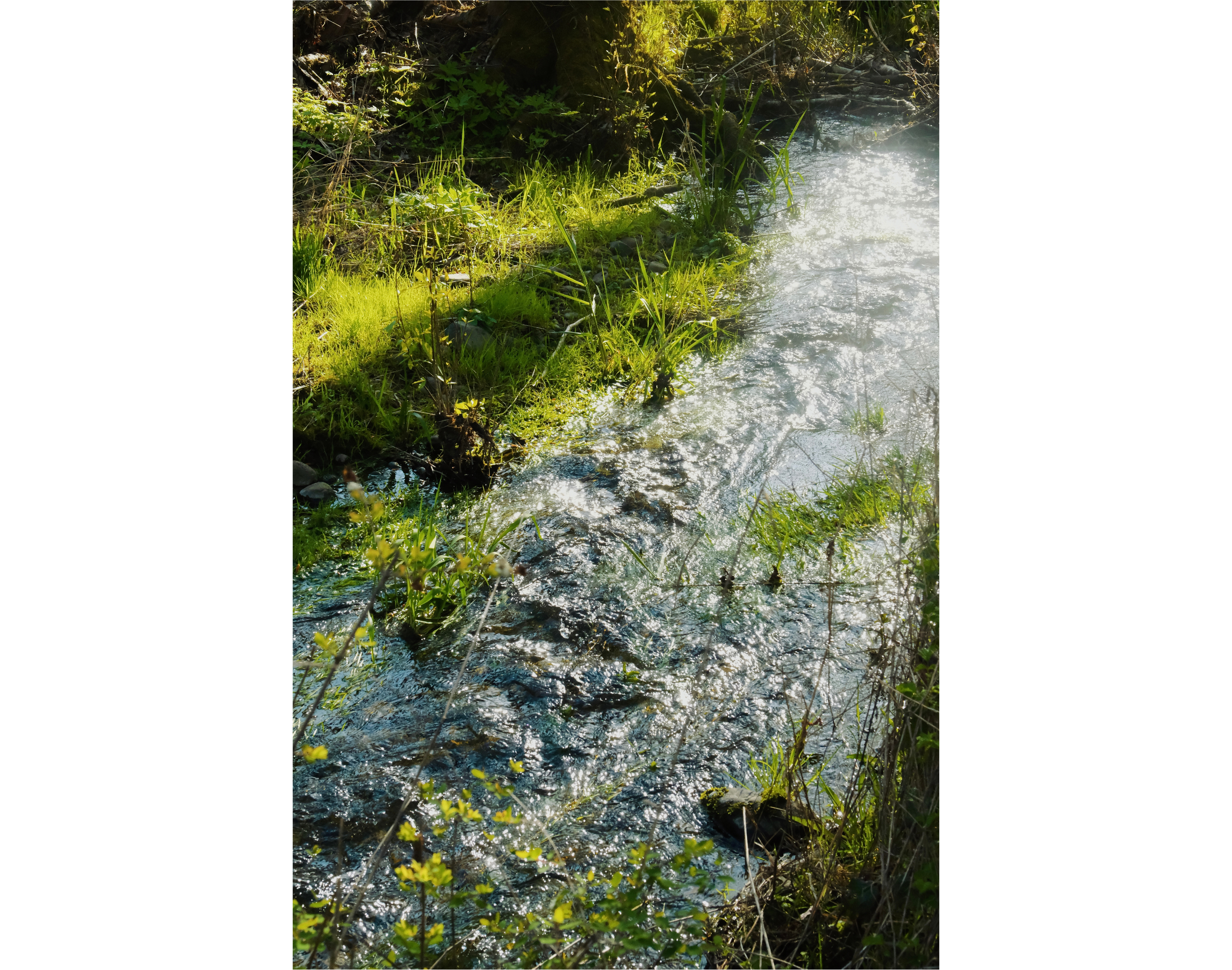
Jordan plays ambient music when we drive together. We’re headed to a spot along a river that we’re told is filled with nettles and morel mushrooms. It’s early spring, the right time of year for both. The park is tucked within miles of winding roads with tall trees and goat farms. There’s lots of wildlife, like the squirrel we almost run over, but don’t at just the right moment. In the parking lot, a large cinnamon roll sits on a paper plate near the entrance. From the car it still looks somewhat pristine—its white icing glistening in the sunlight—but as I start to see it up close, I notice it is indeed covered in dirt and bugs.
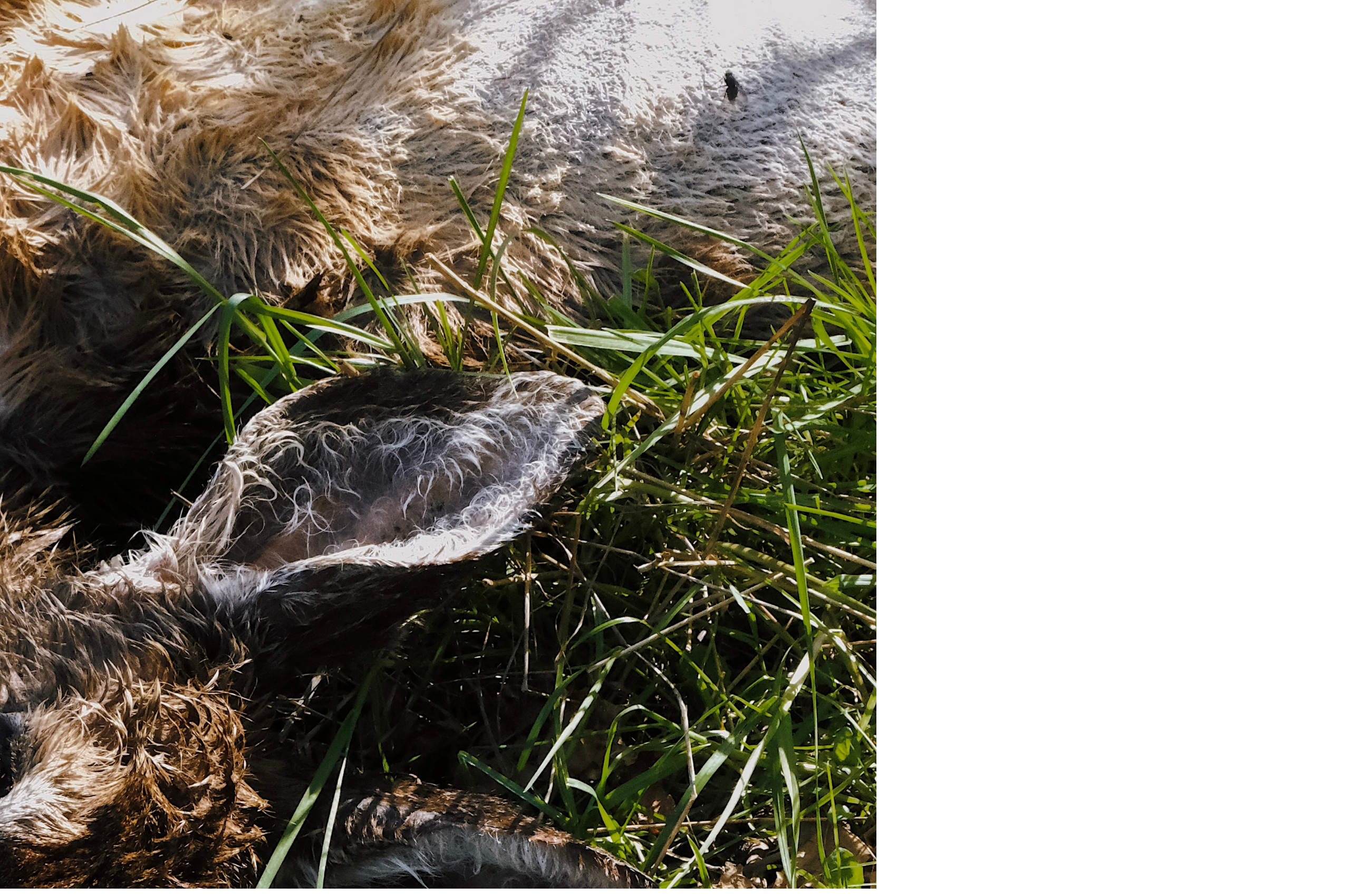
Jordan walks a few steps ahead of me, then stops, abruptly. I walk over to see what they see—a dead fawn with their eyes open, sweaty fur curling all over her body. She is long dead but in this light, she feels so close to being alive. The flies haven’t even started dancing around her yet. We look at each other, then back at her, staring and saying nothing for a while. I expect her to smell like something but it’s too faint to tell. The air just smells like spring green and car exhaust. We agree that this death must still be very fresh and, recognizing how rare and beautiful this encounter is, slowly we each decide to take a photo of her body.
We stay with the fawn for a little while longer, not yet able to venture into the woods ahead of us. Once it feels okay to leave, we begin our search, immediately encountering hundreds of nettle plants. Jordan tells me they’ve forgotten their gloves, so we share a pair between the two of us, each picking with our dominant hands. During the harvest, we stop to chat, take photos, and record the sounds of the river rushing beside us. It’s early April, but the sun is strong on my skin. I begin to sweat as I try to avoid being stung by the nettles, failing at this attempt twice.
The longer we search for morels, the more we start to realize we won’t find any today. Instead, I find what’s left of a red car discarded for some reason in the middle of the forest. Cleavers and nettles grow inside where the sunlight hits the interior, and spiders have made a few weak webs in the doorway. On the ground, deer tracks encircle where I stand. I think of the fawn, and what will happen to her body as it’s left here too to decompose.
My seventh-grade biology teacher was a horse girl who loved to hunt deer for sport. We were all too young to drive but she told us to “never veer for deer.” In Michigan, where we lived, deer would often leap out of the woods onto the road. She told us that swerving could cause us to crash into a tree or oncoming traffic. I think the fawn we met must have met her fate like this—leaping forward in the wrong place at the wrong time. I think of the driver, holding the small heavy fawn in their outstretched hands. It’s late, and the car’s headlights illuminate their bodies as they approach the entrance of the trail together. They would’ve walked farther in, I think, if the woods weren’t so dark.
I call Jordan over to check out this auto body I’ve found sinking into the ground, and they find me with a rainbow over my head. We decide to give up on our morel forage and give gratitude to the forest for our nettles. As we walk out the way we came, we realize the fawn needs flowers. Jordan searches for something in the brush and returns with a blossoming Oregon grape cluster they place next to her head. We breathe goodbye, knowing the next time we return she will have become the forest. As we pack up the car to leave, a couple approaches the path, and we watch as they encounter the fawn just as we did—gasping, looking at each other, staring, then pulling out their phones to take a photo.
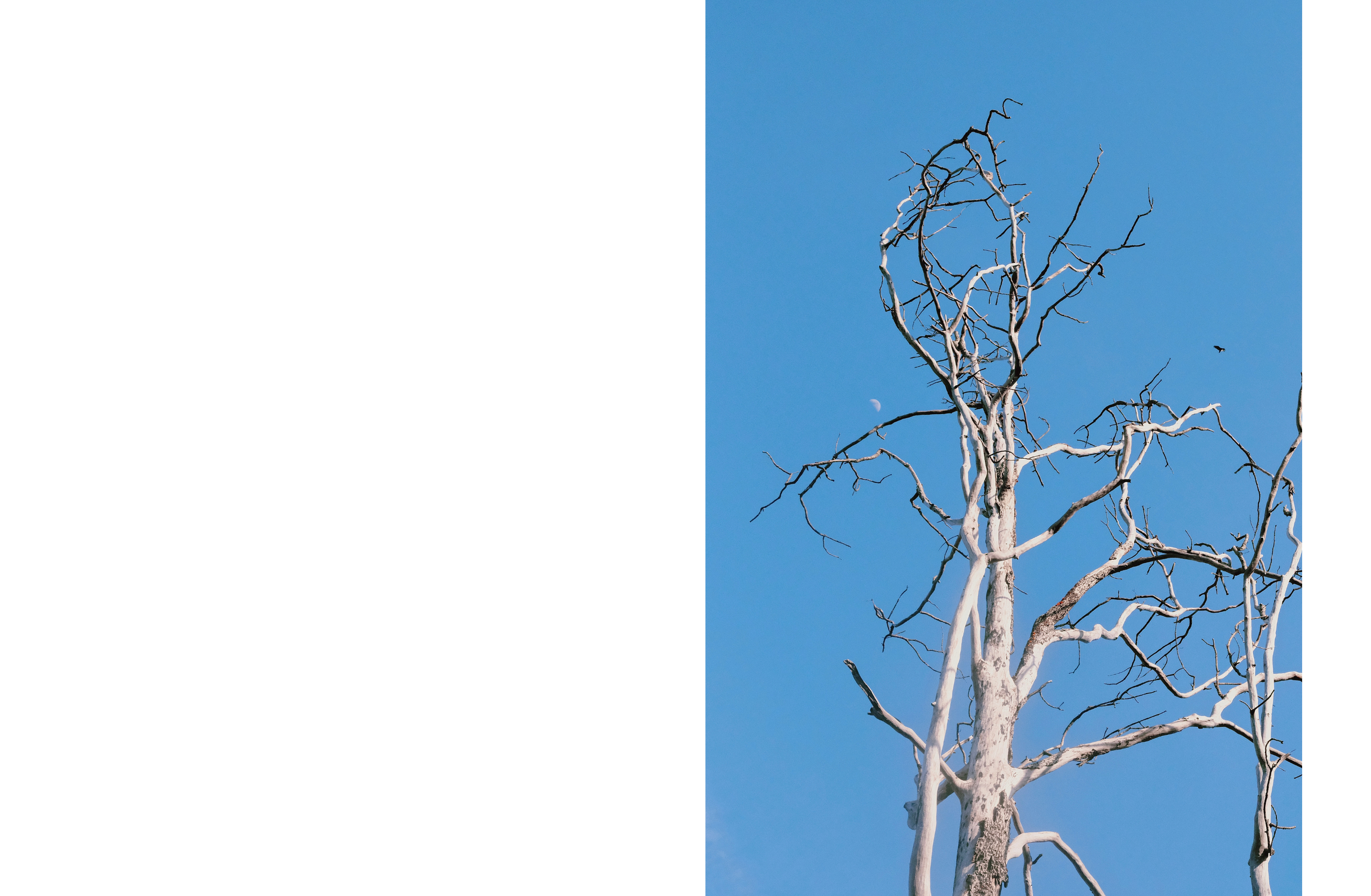
We drive a bit farther down the road. Jordan knows of a house-turned-forest fire that happened recently near this area. We find the spot, marked by a vulture staking their territory in a burnt tree. The tree’s long limbs have turned into spindly skeletons glowing bone-white against the blue sky. A few more vultures circle above us, and we wonder if they’ve spotted what we saw just a few minutes away. Jordan, always a few steps ahead of me, gasps and tells me another deer has died. This carcass is different though. It is no longer deer, just bones and small bits of offal. This body had been picked clean. Jordan disappears into the brush and I follow, averting my eyes as I pass the blushing purple intestines.
The brush is thick with brambles that start to hook into my pants and poke small holes in them. I look for spaces in between the thorns so that I can move the branches away from my face and body. Finally, I step into a clearing. Ahead of me, a chimney juts out of a concrete foundation, the only parts left of the house from the fire. Jordan tells me they left the car open so we head back, slightly quicker and less careful this time. I feel the faint scratch of skin breaking but venture forward anyway.
On the drive home, the spots on my arm where I was stung by the nettles are starting to well up. My right calf is covered in long, thin cuts. I ask Jordan if they’d ever encountered bones on a hike and they tell me about a fully intact deer skull they found while visiting their family. They successfully brought the skull, wrapped in a plastic bag, through airport security. I tell them about the head-sized pomelo I brought back from Los Angeles after a nice old woman told me to pick it from her tree. The tree was far too tall and the fruits too large for her to pick them anymore.
Jordan says that when they went to unpack their suitcase, they opened the plastic bag holding the skull and the shiny dark body of a black widow spider crawled out, causing them to drop the skull on the ground. When black widows bite, they emit alpha latrotoxin, a neurotoxin that is said to be lethal. While female black widows engage in the somewhat intense practice of devouring the male spider after mating, their lethality to humans is somewhat misunderstood. Bites are quite uncommon, and the excreted venom is more likely to cause shock, pain, nausea, and dizziness rather than death.
Back in Portland, I water my garden plot at sunset. As I glance down, a rainbow appears in the dirt when I look at it a certain way. A tepid man stops by the fence of the garden with his dog, smiling at the red poppies I’ve grown as I smile at his companion. He cannot see my rainbow from where he stands. Right now, I am somewhere else—somewhere where the light conspired to reveal something fleeting and true—practical magic suspended in the space between me and everything else. I cannot take this for granted. I will remember this dirt, this water, and this light forever.
Comments
1 comments have been posted.
This essay is an incredible gift.
Gabriel | August 2025 | San Juan Islands, WA
Add a Comment