I’m not proud to admit it, but on more than a few occasions, I’ve tangled with TSA over the question of whether my red-handled pruning shears are weapons.
Yes, they have eight-inch carbon steel blades. And yes, most pruning tools look violent before their purpose is understood. Then again, you could say that about most instruments of meaningful change.
“Better to behead water sprouts,” I explain, but it’s 5:00 a.m. at the Eugene Airport, and the officer does not look amused. She just had to double check my ticket’s final destination: Ulaanbaatar.
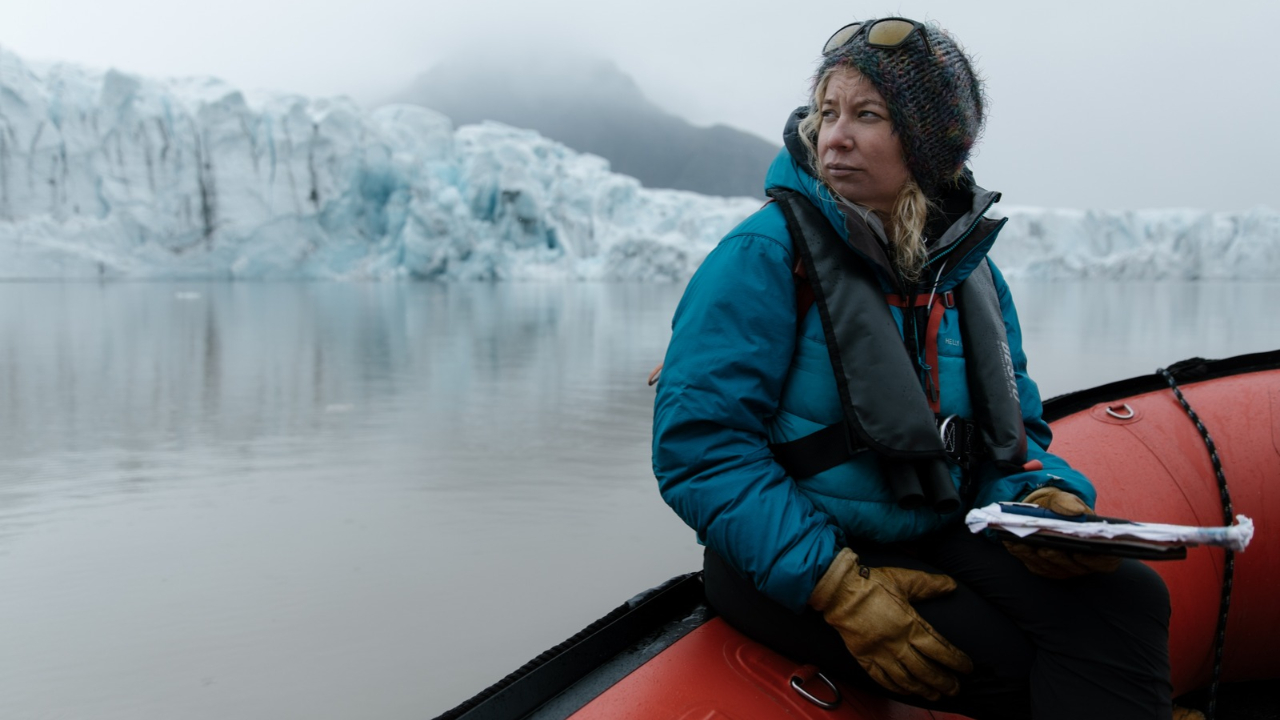
I work as a writer and glacier scientist, often traveling on assignment as a National Geographic Expert to translate glacial and snowy environments for diverse audiences. I love science communication—it parallels my primary work of understanding how ice shapes how people live.
Regardless of where my work sends me, be it Svalbard, South Georgia Island, Iceland, or Mongolia, I always pack my pruning shears. They are not a glacier tool per se, but they are a critical tool for me. It has become my private rule that if I am going to spend any amount of time talking-talking-talking about ice change and climate anxiety and ecosystem loss and misinformation, I should also endeavor to do one ordinary and tangible thing wherever I am.
For me, that’s pruning. Anything from a wee clip to a complete tree renovation.
I do this in part because, ever since I was about seven years old, I’ve pruned apple trees. First, with my mother on our farm orchard high in the mountains in Washington State, then on neighboring farms for lunch money, and then later for adventure cash. Now, in between fieldwork and book tours and all the associated busyness of curating one’s career, I prune mostly for the excuse to have a coffee and chat about a tree.
Plus, it’s increasingly rare to meet people who know how to properly sharpen shearing blades, look at a neglected orchard and understand where to begin, or guide a tree towards a specific goal. I’ve observed that we talk often about glacier loss, biodiversity loss, or environmental loss, but much less about skill loss, the loss of ordinary knowledge once passed hand to hand without much fuss until, suddenly, no one nearby knows how to do what still needs doing.
Professionally, I work in the highly cerebral space of trying to get people to understand and care about a thing—glaciers—that they may never interact with directly in their lifetimes. There are hundreds of thousands of glaciers remaining on this planet, found on all continents except Australia. But even though glaciers impact most people in most places in myriad ways, very few communities express feelings of deep connection to glaciers. Even in Oregon—where thirty-five glaciers were once mapped, half of which are now gone, nearly gone, or critically endangered—glacier loss is still seen as something that happens high in the mountains, seemingly removed from the business of everyday life. It registers instead as a thinner snowpack, altered rivers, hotter orchard summers, smoke settling into valleys where winter once felt dependable.
My work is about trying to get people to care about something most can’t see, and pushing for results—slowing glacier mass loss and growing glaciers back—that, if they happen at all, will unspool incredibly slowly. This work can feel almost offensively abstract at times: asking people to care now for results that may not fully arrive for generations. No instant click and dopamine rush, no library built, no whale or forest or river saved. Just the hope that a century or two from now, glaciers will still be here, growing and thriving, long after those of us who fought for them are gone.
Perhaps this is why I find myself increasingly drawn to trees, to pruning, where the distance between an actionable clip and a restored tree is measured in hours rather than generations.
As I’m getting older—my four-year-old just called me “elderly”—I’m starting to understand that not every form of service must be grand. Some of it is simply knowing the why of something, what to cut, when to wait, and how to leave it healthier than you found it. And so, I prune, with a pair of red-handled shears I “borrowed” years ago from my husband.
To me, there is something exceptionally physical, almost sensually tactile, about shaping a fruit tree. To prune properly, every part of the tree must be touched, assessed, its future evoked and vividly imagined. It is labor intensive to crawl up, under, and around a tree. The work is completely resistant to automation, to speed, to abstraction. It depends on judgment over rules: envisioning what might matter later, what should never have grown this way, what must be cut so something else survives. All this, plus, the goals of the person holding the clippers—do we want fruit? flowers? a smaller tree?
It begins the moment I walk towards the tree, when I scan the landscape to understand the conditions from which it springs. I kneel to taste soil. I look for things close, things far. Everything is a variable. I lay my hands on the trunk, feel for bark health while scanning for disease, press to assess strength. Then I make the easy cuts: water sprouts, suckers, anything shooting skyward from the trunk or root. Next, scaffolding: prune competing leaders, malformed branches, limbs growing along the same plane. Remove what crosses—my mother once told me crosses belong in churches, not orchards—look for what is broken, diseased, growing inward, crowding, or surging after water stress.
My mother, again: “Pruning looks destructive before it looks successful.” A healthy tree often requires the pruner to cut away growth—limbs reaching hard for light, branches crowding others, shoots drawing energy upward while fruiting wood is weakened below. This is similar to much of the work required to keep a place, a community, functioning: clearing fall fields for future food, reimagining new ways to live together, undamming blocked rivers, removing what no longer works so something new has room to thrive.
I can spend an entire day in the branches of a single heirloom apple, deciding—branch by limb by sprout by fruit spur—which future this particular tree can afford. Recently, I’ve been struck by how similar this work is to parenting my child. I’m giving daily corrections whose outcomes might remain invisible for a lifetime. Don’t hit. Respect life. Do not put stuffies in the freezer.
Perhaps that is why pruning has begun to feel to me like a small education in revolution: not revolt for spectacle, but the quieter recognition that inherited structures do not remain good simply because they are old and have always been there. A tree cannot keep every branch it has ever made. Neither can societies, professions, or ways of living under changing climates.
When I’m surveying glacier systems from the sky, some look to me just like a nicely pruned tree—regular dendritic patterns sourcing from steep headwalls and flowing into main trucks and stems and spurs and outlets. But perhaps I see trees in glaciers simply because I love trees. Imagine, then, the moment I discovered glaciers with trees growing on them. Full circle.
I’ve yet to find an apple tree with her roots dug deep into ice. But I don’t discount the possibility, as I haven’t laid boots on each of this planet’s glaciers. We’re still discovering them today, even as we’re losing them.
My colleagues say we’re entering Peak Glacier Extinction, a time stretching from roughly now through the end of this century, when we—you, me, all of us—will lose many of our world’s individual glaciers: Alaska’s Mendenhall and Exit Glaciers, Breiðamerkurjökull and Jostedalsbreen and Aletsch and Urumqi, the clutch of ice atop Kilimanjaro, the Baltoro Glacier and the Gangotri at the headwaters of the Holy Ganges, the Perito Moreno and Grey Glaciers, the Heaney on South Georgia Island. Glacier systems I’ve known my whole life, glaciers I’ve watched retreat even as I’ve run towards them. This is not simply loss; it is a planetary rearrangement of water occurring within a single human lifetime.
Glaciers grow in the polar regions, in the tropics, atop volcanoes and underneath sediment layers so thick we still haven’t found them all. They come in a variety of shapes and sizes, as ice caps and valley glaciers and piedmonts and glacierets and rock glaciers—a diversity somewhat paralleled by the estimated 7,000–15,000 varieties of apple trees known worldwide.
Some years, I try to schedule open time in my calendar or refrain from booking trips during the pruning window in Oregon, from February through March, when the trees are dormant. There’s also the high-summer disease prune that happens increasingly now in July and August across the Pacific Northwest. When I first learned how to prune, we only made cuts in the frigid winter of December, when the tree’s sap wouldn’t run.
Perhaps it was inevitable that I would come to love both apple trees and glaciers.
My mom taught me to prune on our farm in Washington, first on an old ‘Yellow Transparent’ tree that had a trunk thicker than my seven-year-old body. Each of that tree’s eight branches spread off the main trunk like an upended octopus. She tucked clippers into my winter jacket pocket, boosted me into the tree, and instructed: cut low, leave no nubs, and don’t fall. I didn’t.
In the following years, she let me clip alongside her in the giant ‘Bellflower’ trees, the three ‘Gravenstein’ trees, a set she called Carmels but I’ve never been able to find again, and an absurdly tall and hostile crabapple. Not too long after that, I started turning up at neighboring farms to work their trees. Today, friends plant modern varieties—‘Honeycrisp’, ‘Granny Smith’, ‘Pink Lady’, ‘Jonagold’, and ‘Gala’—and I tend them, even though I prefer the neglected heirloom orchards that dot the Willamette Valley, where I live now. I love how they sit half-forgotten under winter fogs, barks greened at the base with moss, old ladders collapsing into grass as ubiquitous blackberry canes work their way through fence lines. Most of these orchards have outlasted the people who planted them, who picked them, who knew exactly how to keep them alive. They’re remnants, after the acreage is divided, after families sell, after pasture becomes hobby property and pruning knowledge disappears faster than the ice.
This isn’t just in Oregon. As farm owners across the American West grow older, or sell, these orchards—many dating to the 1850s, are left to disease, rot, or bulldozing. But some farms, like the Almaty Farm in Molalla, Oregon, have dedicated themselves to cloning and growing heirloom apple varieties—to date they’ve successfully grafted over 5,000 varieties on their farm. Stories like this fill me with hope. They remind me of all the efforts I see today to slow glacier change, to grow new glacier-like structures, to somehow keep safe these things I love.
I’ve wandered into abandoned farms and town parks and quiet backyards to spruce up neglected trees. I’ve spent weeks renovating a private school’s inherited orchard, teaching anyone interested how to bring these old trees back. I’ve pruned all across this planet, even helping a friend’s hydroponic fruit start-up in Iceland. Once, I gave an elderly tree in Oakland such a hard prune I wasn’t sure it—or the owner—would recover.
Nine months after that Oakland prune, the owner texted a picture of a small, respectable apple—the first fruit that tree had produced in years.
Even if global emissions dropped tomorrow, or come spring when the Braeburns are in bloom, the ice I work with will not return in my lifetime. But still, I make cuts knowing that, in most cases, someone else will harvest the fruit. Someone else will know whether I got it right.
Comments
No comments yet.
Add a Comment