There’s an old vaudeville bit where an actor tells a lively story and the audience responds line by line, with “that’s good,” or “that’s bad.” The classic version is simple:
“I learned to fly a plane.” That’s good.
“But I was flying upside down and fell out of the airplane.” That’s bad.
“As I fell, I looked down and saw a giant haystack.” That’s good.
“But there was a giant pitchfork sticking out!”
The story goes on and on.
I learned the schtick from Oddfellow’s Playhouse, in my home state of Connecticut. I joined the theater group the first time I quit using hard drugs, at fifteen years old. It was the place where I finally found safe adults and a place to belong. When I went back east for the theater’s fiftieth reunion last summer, I realized that the skit, and the entire program—a subversive theater and circus troupe run by Wesleyan students—had been training us for the work of hope.
In 2019, I used that training to open Harmony Academy, Oregon’s first recovery high school. Harmony serves youth recovering from substance use and co-occurring disorders. Located in a former orphanage on the idyllic grounds of the now closed Marylhurst University, Harmony, a public high school, invites students who have been marginalized or pushed out of the larger system, hospitalized, adjudicated, or otherwise disengaged. The stories these young people tell us during admissions—stories of isolation, violence, trafficking, loss, trauma, trauma, trauma—are familiar stories to many of us who have chosen this work because we are uniquely qualified by what the behavioral health field calls “lived experience.”
I’m a person in long-term recovery—free from all substances since March 29, 2006. I started using hard drugs when I was thirteen; many of our youth now start at eight or nine. Like them, I was pushed out of my high school because of my substance use. Being pushed out of public school and literally told I was not welcome in public spaces (the audacity of adults to say that to a traumatized teenager) left a mark, especially for a nerdy “Talented and Gifted” kid like me who found hope through reading, writing, and exploring the world. Now I’m on the front lines of the work of educating some of Oregon’s most vulnerable youth.
Oregon currently ranks as the third worst state in the nation for youth with substance use. According to a 2023 research brief from the University of Oregon’s HEDCO Institute for Evidence-Based Educational Practice, 94 percent of the 17,000 young people suffering with substance use disorders (SUDs) in Oregon could not access care. Data from the National Center for Drug Abuse Statistics shows that Oregon teenagers were nearly 38 percent more likely to have used drugs than the average American teen. When surveyed, 34,000 Oregon youth—over 10 percent of kids age twelve to seventeen—reported regular drug use. On the 2024 Student Health Survey, 18 percent of Oregon youth reported unmet mental health needs. Fifteen percent reported having no safe place or person to go to if they need help. It’s no surprise that drug-related deaths among Oregon teens are increasing faster than anywhere else in the country.
Let’s be clear—I am not an optimistic person. Especially in the face of hard data. Optimism is passive and requires a belief that good things will just happen. As my sister recently said, “Why would you think anything good would ever happen?”
I would answer that I don’t. But I join those who enact what is sometimes called “hard hope.” When the darkness has become intolerable, we’ve simply chosen not to tolerate it. That’s different than not believing it’s real. That’s why people with lived experience are essential when working toward justice on behalf of individuals and communities. Hope, like recovery, is a process that aims to transform real suffering into something different.
As a recovery school, Harmony provides an alternative, a small refuge in a bleak behavioral health landscape. It’s a place, graduate Emily Rask told The Oregonian in 2021, “where everyone feels welcome and loved.” Students enter our building under a sign that reads, “Come as You Are.” We provide a safe space for twenty-five to forty young people to show up every day, heal, shout out answers (often mixed with profanity) in algebra class, hit milestones like getting a driver’s license or attending sober prom (SPROM), sob in the hallway, tell the truth about what they’ve seen in their lives—and be seen, known, and loved. Harmony youth defy odds, graduating from high school as the powerful humans they are. They light the way for new and shaky students seeking safety in our halls.
As the first recovery school in Oregon, Harmony blazed a trail in Oregon, followed by Rivercrest in Portland and Discovery in Salem, but it didn’t invent recovery high schools. Andrew Finch, a professor at Vanderbilt University, founded the Association of Recovery Schools (ARS) in 2002 and published its history, Salvaging a Teenage Wasteland, in 2024. When I attended an ARS national conference for the first time, I remember noticing that recovery school leaders were describing impossibly hard work in the trenches of adolescent services—with giant smiles on their faces. I joked that leading a recovery school must be the “toughest job you’ll ever love.”
That has been true for me. I still struggle with PTSD and anxiety. Leading the school has forced me to practice my hope like jiu-jitsu, like blind archery. A 2025 Gallup poll found that what people need from leaders is, overwhelmingly, hope. Hope came in at number one, more than trust, compassion, or stability.
The work is indescribably hard at times and requires an astounding suspension of disbelief. It’s hard to sustain the ideals, the funding, and the energy. After a particularly painful Thanksgiving break last year, during which we tried everything in our power to keep a student alive (and succeeded), I asked our school counselor, Renee Caballero, how she deals with the emotional labor. She was very clear in her answer: it’s about attention. Caballero described her practice of focusing on the small moments of beauty, noticing, savoring, and recalling every good thing that happens. The more difficult the situation, the greater the need to shift perspective, see the whole reality, and use the octopus-like adaptive powers of hope.
One of my favorite stories to savor is about a student who didn’t graduate from Harmony. She did, however, call me the day she got her GED. She was elated. She said that I “told her a poem” once, and that it helped her. Through the receiver, she relayed back to me the seventeenth-century haiku I had heard from my own sponsor: Barn's burnt down—now I can see the moon.
Hope can often sound woo-woo, so you may be surprised to learn that it is a measurable quality. The Herth Hope Index, for example, looks at three interconnected domains: belief in a positive future and related goals; confidence and readiness to take action; and recognition that we are all connected. Those three areas align perfectly with the work that students and staff do in recovery schools. Psychologist C.R. Snyder, who developed Hope Theory back in 2002, defined hope as “the perceived capability to derive pathways to desired goals and motivate oneself via agency thinking to use those pathways.” Positive psychology has tied hope to the health of individuals and communities. Thema Bryant, president of the American Psychological Association, writes in Monitor on Psychology, “Hope isn’t denial of what is, but a belief that the current situation is not all that it can be. You can recognize something’s wrong, but that’s not the end of the story.”
In November 2024, Alexander Banks of the Statesman Journal interviewed Harmony sophomore Brandon Russell, who shared his story of living outside and thinking he wouldn’t live past age fifteen. “It’s pretty nice to have a place you can go to and be safe,” Russell said. “I’m here and I’m actually happy that I’m here.” Brandon is still here. For me, in my role, statements like his let me know that I am carrying forward what I learned at Oddfellows Playhouse, whose mission, I learned at the reunion, has nothing to do with theater, but with simply being a third place for young people to connect with other misfits, show up as they are, and become more fully themselves. At Oddfellows we also found at least one safe adult, which research tells us is the most powerful of protective factors for young people.
The arts continue to engage me to be myself. At Brian Benson’s writer’s lab recently, I shared my school counselor’s ideas about hope. Another writer said excitedly, “She’s talking about glimmers. Glimmers are the opposite of triggers.” Sure enough, “glimmers” is a word coined by Deb Dana, a licensed clinical social worker and polyvagal theory expert. In a world full of triggers, she offers a counterpoint—a word describing the tiny shiny moments of connection, love, belonging, and goodness that we can experience and share. Glimmers are an important antidote to burnout. While triggers take us into fight or flight, glimmers switch us over to rest and digest. Glimmers let our nervous system know it’s okay. When shared, they can help others regulate. They can help our nervous systems recover from compassion fatigue and vicarious or secondary trauma, conditions that are burning through the behavioral health field.
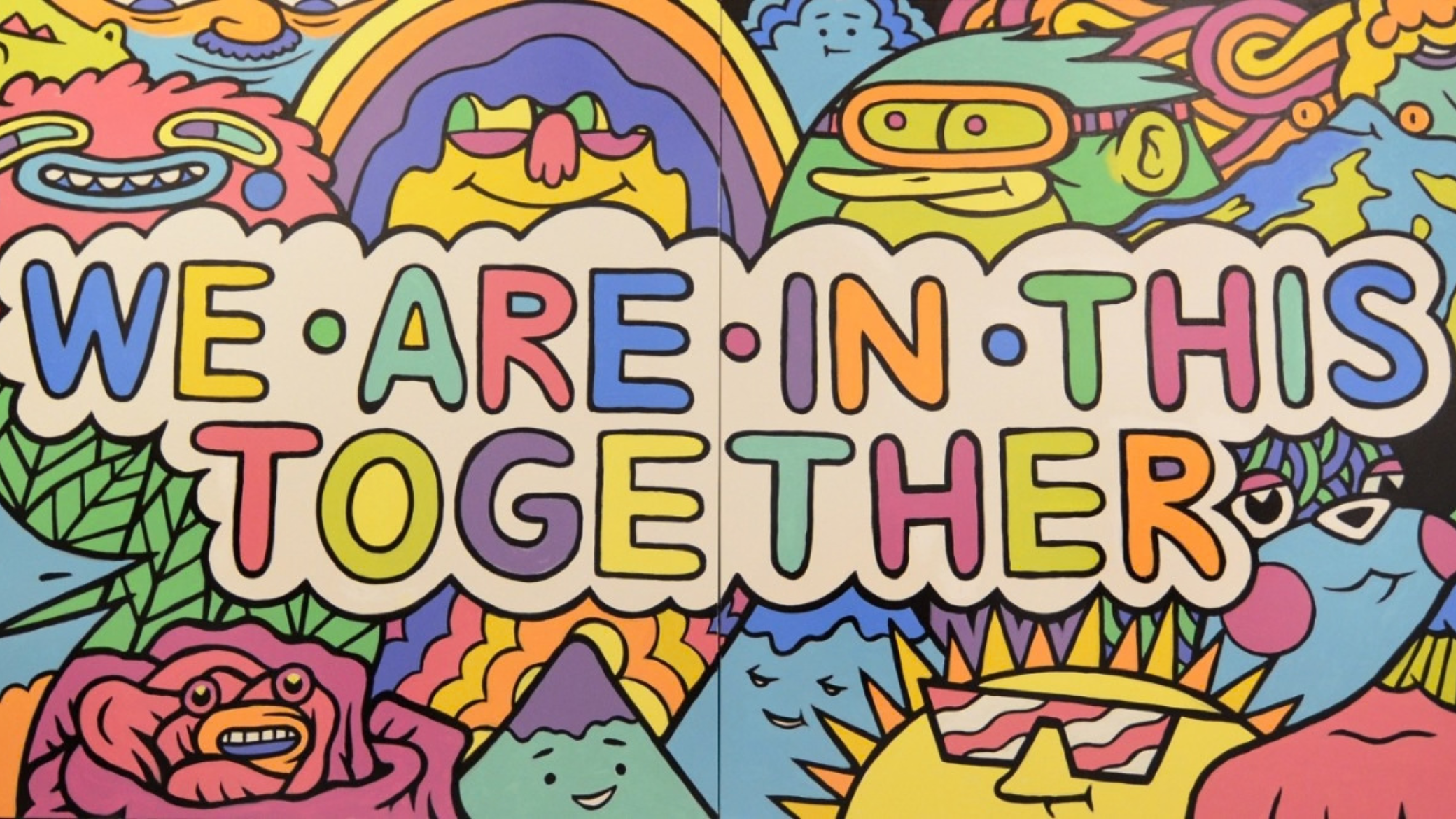
To find joy in the labor, to train in the hope required to even imagine a recovery school, is a practice. The work develops muscles in places I didn’t know I had muscles. The exercises, however, are surprisingly simple. We celebrate small wins. Any win. Every win. We break the monumental work into momentary work. We protect each other through community and connection. We build trust by being real. We fight the algorithm by sidestepping the doom and rage with a yes, and… after yes, and…. We choose curiosity. We commit to action even when the path isn’t clear, throwing out stones like Indiana Jones to cross the chasms of despair. Perhaps most importantly, we remember that there is a “we.” The painting in our hallway says, “We are in this together.” As part of the work, we also rest. Rest is a necessary weapon in the behavioral health field, where labor can be exploited, especially for people with lived experience.
The larger field of behavioral health is hungry for hope as well. Last November, I ate dinner with Christina Bethell, a professor at Johns Hopkins, who was the keynote speaker at the Oregon Conference on Opioids + Other Drugs, Pain + Addiction Treatment (OPAT). Bethell wowed the crowd with her work on Positive Childhood Experiences as a counter to Adverse Childhood Experiences. While the narrative around those of us with high ACEs is that we will surely develop health problems like addiction and die young, Bethell is studying how the introduction of positive PCEs—like recovery schools, theater groups, or recovery mentors can change the trajectory for young people.
Every day at Harmony, we work to help kids take authorship of their own stories and to navigate their own asteroid fields. Against ugly odds, we are a non-stop active improvisational troupe in the play of “good luck, bad luck.” In high school, I learned from the theater folks that the silly acting exercise traced its origin to the Parable of the Chinese Farmer. In the Taoist tale, a farmer deals with life events: his horse runs away (“that’s bad”), then returns with wild horses (“that’s good”). His son breaks his leg trying to ride one of the wild horses (“that’s bad”) but his injury saves him from conscription into the army (“that’s good”), thereby saving his life. The moral of the story is obvious: while the story is still going, there is still hope. The farmer ends the story with, “Good luck, bad luck…who can tell?” Indeed—especially when a person is fourteen or fifteen, with, hopefully, a whole life in front of them.
The stories of what happens to the young people I serve are often literally unspeakable, harrowing, or just cause for plain grief or anger. However, these stories leave all the room for hopeful action, because they are not really their stories. They are what happened to them. Hope, on the other hand, is a defiant exercise of agency. Within our small spheres of influence, we each have immense power to enact improbable endings. For me, that is recovery school, a place where, with any luck, our students will happen to the world in a wave of defiant glimmers.
We received a letter from the mother of the first graduate of the 2025–26 school year. The mom, who is also in recovery, wrote, “Because of you, I didn’t just get my daughter back. I got to watch her grow into a warrior. A young woman with a fierce heart for justice, a voice for others, and the courage to rise after every fall. That transformation happened because you showed up, day after day, believing in her when I didn’t always know how.”
Glimmers become brilliant in their accumulation of micro-moments—a student looking up for the first time, visits from students’ dogs, a graduate reading poetry for the first time at Literary Arts’ Slamlandia. Sometimes in this work, I have to be a human first and a professional second. I laughed when, at a recent conference, I skipped the self-care session to go walk by the river. And, of course, humor is one of our greatest weapons and highest values at Harmony.
“The frogurt is also cursed.” That's bad.
“But you get your choice of toppings.” That's good!
The best humor belies the fact that this is dead serious work and that the "goods" don’t come about by accident or by wishing. Optimism is squishy, while hope has bloody fingernails from clawing its way up the cliff. Society gives up on adolescents too easily in Oregon, or it ignores them and waits to clean their adult wounds and offer safe use kits. As long as a person still breathes, we shouldn’t give up on them, and if they are not breathing, we offer Narcan. Max Preminger, principal of Salem’s recovery high school, told Fox 12 that for the adolescents we serve, recovery school “isn’t a second chance, it’s a first chance.” And adolescents, unlike adults, have brain plasticity. They are figuring out who they want to be and how to find the safe places where they have agency to transform. Changes happen glimmer by glimmer, like magic.
Luckily, the work isn’t just theatrical or poetic—it’s also borne out by data. According to recovery school researchers like Oregon’s Emily Tanner-Smith, recovery school attendance is associated with decreases in drug use, increased graduation rates, higher attendance, and greater life satisfaction. Research by Jordan Jurinsky of Tufts shows that youth who stay in recovery schools have an improved quality of life and score higher in measures of positive youth development, specifically in caring. For those wondering about the cost effectiveness of the public programs: families, communities and society save between $16,000 and $52,000 per student when these youth find help and safety in recovery schools. For every one dollar spent, society can expect three to seven dollars in return. At least.
In 2023, Oregon passed HB 2767, which mandated opening nine recovery high schools over three biennia. I remember members of the education committee in Salem crying as Harmony students testified about how recovery had changed them. The response from communities in the application process was overwhelming. Southern Oregon, Lane County, Eastern Oregon, and the coast all did the heart work of unifying their communities around hope for their most vulnerable youth. Unfortunately, the Legislative Adopted Budget cut over $5 million from funding for recovery schools in the second biennium; and the fourth, fifth, and sixth schools approved to open by the Oregon Department of Education are still at a standstill, unfunded. I was quoted in a newspaper saying that I was “devastated” by the cuts. I wish I had said, “We won’t lose hope,” or “We adapt and overcome,” or “Good luck, bad luck, who can tell?”
Tony Vezina, one of the founders of Harmony, wrote an opinion piece for The Oregonian about the cuts to adolescent behavioral health, saying, “I know what it’s like to be a young person struggling with addiction and to feel like no one is coming to help. I also know what’s possible when help finally arrives: families find hope, meaning, and discover the silver lining on the other side of addiction.”
One of our Harmony students, Kiah Jackson, recently submitted similar written testimony to the legislature in support of behavioral health services for youth: “I'm writing this not as a policymaker or an expert but as someone who once genuinely believed my life was already over before it even began. [...] Harmony Academy changed that for me. In my school, relapse isn’t treated like failure. It's treated like a moment to get support. Teachers understand trauma and the classmates sitting next to you understand addiction. We aren’t punished for struggling, we’re supported through it. This school hasn't just helped me maintain my sobriety. It helped me stay alive.”
The work is not over. Last December, we launched a new group called CARE, or Coalition of Advocates for Recovery Education. Our students have taken on the work as well. Some have joined the Oregon Youth Addiction Alliance, a group that was collaboratively founded by youth leaders and commissioners from the Alcohol and Drug Policy Commission. Others share a message of hope at recovery events like the Oregon Recovery Summit or Hands Across the Bridge. Some just keep their friends buoyant.
It is the responsibility of all of us to keep hope alive. For me it is a debt repaid to the people who mentored me when I was young—including the director of Oddfellows, who was still in that role when I returned last summer. It is also an act of justice for my younger self. I see hope as a collective responsibility, the reason we need an audience to keep the story going, keep balance and equanimity, and remember that we are all actors and storytellers—and warriors, if we choose. We share the responsibility to keep fighting, to keep countering bad luck with good, relentlessly.
Kiah’s letter, which is public record, ends powerfully: “I am living proof that when young people get real support, we don’t just survive. We rise and rebuild. We become something better than what the world expected from us.
"But I shouldn’t be the exception,” she concludes. “And no kid should have to rely on ‘luck’ to stay alive.”
Comments
No comments yet.
Add a Comment