In celebration of International Workers' Day and in conjunction with the "Labor" issue of Oregon Humanities magazine, this episode of The Detour explores how work shapes our lives. What is work for? Are work and labor the same thing? And what, if anything, makes work meaningful? To get at these questions, we talk with three people who spend a lot of time thinking about labor and work. First, we speak with Lydia Kiesling, author of the novels The Golden State and Mobility. Next, we talk to Nicholas Hengen Fox and Jorge Herrera Caro about Working Class Literature, the only class explicitly about class at Portland Community College.
Show Notes
About Our Guests and Further Detours
Lydia Kiesling is a novelist and culture writer. Her first novel, The Golden State, was a 2018 National Book Foundation “5 under 35” honoree and a finalist for the VCU Cabell First Novelist Award. Her second novel, Mobility, a national bestseller, was named a best book of 2023 by Vulture, Time, and NPR, among others. It was longlisted for the Joyce Carol Oates Prize and a finalist for the Oregon Book Award. Lydia is the recipient of a 2025 Miller Foundation Spark Award. Her essays and nonfiction have been published in outlets including The New York Times Magazine, The New Yorker, The Nation, and The Cut.
In the "Labor" issue of Oregon Humanities magazine, Lydia revisits W. Somerset Maugham’s 1915 novel Of Human Bondage, reflecting on "his descriptions of struggling to find your place in the world—and, crucially, the central role that work plays in this determination."
Last year, Nicholas Hengen Fox and Jorge Harrerra Caro both took part in Working Class Literature, the only class explicitly about class at Portland Community College. In a collaborative piece for the "Labor" issue of Oregon Humanities magazine, they reflect on some of the impactful books, stories, and poems they read and discussed in that class, including:
- We Want Everything by Nanni Balestrini
- “Something That Needs Nothing” by Miranda July
- How Beautiful We Were by Imbolo Mbue
- Microchips for Millions by Janice Lobo Sapigao
- The Undocumented Americans by Karla Cornejo Villavicencio
- How Not to Drown in a Glass of Water by Angie Cruz
During the episode, Nick reads "B Sharp Blues" from Today in the Taxi by Sean Singer. Adam reads "A Red Palm" by Gary Soto.
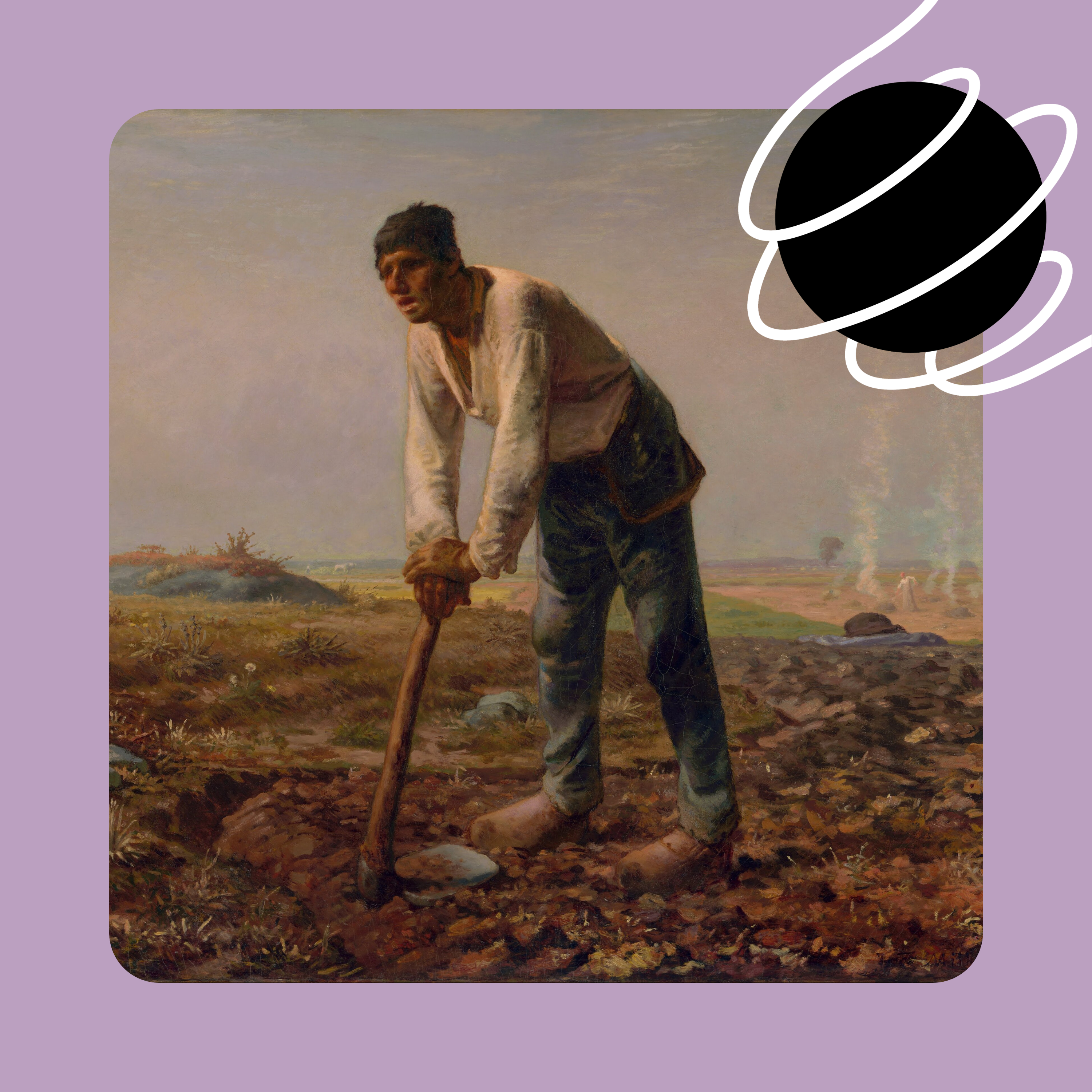
The cover image of this episode is Jean-François Millet's painting Man with a Hoe. The painting was an international sensation when it debuted in 1863. Edwin Markham, Oregon's first poet laureate, wrote a poem inspired by the painting that ran in newspapers across the US.
Transcript
Lydia Kiesling: I fall a little in like disgusting love with whatever job I have even if I hate it.
Adam Davis: Just about all of us work. To make our way in and through the world, we labor. Maybe young kids don't, and maybe people fortunate enough to retire don't. But for most of us, most of the time, labor is a big part of what we do with our lives. Work may be so central for us that its significance in shaping our lives can become difficult to see.
And that's what we're exploring in this episode of The Detour, released on Mayday, in conjunction with our publication of the Labor Issue of Oregon Humanities Magazine. What is work or labor? And how do we distinguish it from other activity in the world? What is work for? And how do its terms get set? Are work and labor the same thing?
And what, if it's not too naive to ask, makes work meaningful? To get at these questions, we talk with three people who put a lot of their lives into thinking about labor and work. First, you'll hear from Lydia Kiesling, who has published two novels, The Golden State and Mobility, and many articles and essays that get us thinking about different aspects of work.
Then we talk with Nicholas Hengen-Fox and Jorge Herrera-Caro. Nick has taught a course on working class literature at Portland Community College for 15 years. And Jorge was a student in that class this year. Writing from Lydia, Nick, and Jorge appears in the labor issue of Oregon Humanities Magazine.
Here's Lydia now. I want to start by asking you about jobs and maybe some early jobs you had.
Lydia Kiesling: First I'm jumping all the way back to being a fifth, sixth grader. I was pretty entrepreneurial at that time. And I had a lot of those kinds of young person coded, and especially I think, girl coded, jobs like babysitting, camp counselor.
My grandmother had a used paperback bookstore, and so when we would visit, she put me to work. I think my first job out of college, I worked in a restaurant. I was a hostess. And, I was pretty swiftly aware that I didn't wanna be doing that for a long time. And so I got one of those crappy online teach English as a second language degrees from the internet that really did not qualify me for that work, but I got the certificate and I worked in Turkey for a year at a school teaching English to kindergarten students.
And then I moved back to the States and I had a very random assortment of jobs.
Adam Davis: As you think about even those first jobs, pet sitting, kids sitting, counselor
...
hostessing, what did you want from them?
Lydia Kiesling: Money was a big thing. I remember I was very specific for the babysitting and pet sitting. I wanted to be able to buy my own clothes and things like nail polish and stuff that my parents were not gonna buy for me.
I was in no way suffering from being deprived. But I think independence was a big part of it beyond the money because it felt cool to be able to go around to different houses and I felt responsible and important.
Adam Davis: You remember both I want some money and the feeling of independence.
As you moved into those jobs in your 20s, maybe that you started to point to, were you looking for similar things, money, independence ... What, like what, as you got more familiar with having jobs, what were you explicitly hoping to find?
Lydia Kiesling: I went to a small liberal arts college in upstate New York.
And so a lot of people moved to New York City and were pursuing careers in finance or just stuff that seemed very official to me. And I, meanwhile, felt really confronted with the fact that all of the classes that I had taken and the skills I had developed in school, which was primarily close reading novels and writing about them, those had no application that I could discern in job listings.
And I also just hadn't learned to think about a career in a holistic kind of way. And I really wasn't like strategic. I was just, ‘I need someone to pay me to do stuff pretty soon.’ And, the teaching English, that was something that I set out to do because my goal was to live somewhere else.
But after I had done that for a year, I felt like I needed to move and be closer to family, and I came back to California where a lot of my family was. And then, yeah, I was completely at sea. And I would find that I would get these jobs, again, very miscellaneous. And when I was in them, I did have this automatic desire to do well in them.
So I would quickly become– ‘important’ is not the right word, but relied upon in a variety of different job settings, which would then make me feel tied to the job, even if all I wanted to do was something else. So that was a pickle, I think. And I was drifting.
Yeah, I wasn't very focused and and didn't know how to think about work and my own goals,
Adam Davis: So you just used the past tense, you said you didn't know how to think about it. Do you know now?
Lydia Kiesling: In a sense, I do. I still have lots of conflicts within myself about how I use my time and just the meaning of work, like what is paid work and what is not paid work.
I have been very lucky in that I haven't had a full-time job, like a full-time office job since 2016. At that point, I was working at a research center at UC Berkeley, so it was like a fancy admin job that I was very lucky to have. But that's also when I was starting to get better bylines as a writer and earn more money as a writer, certainly not enough money to live, but I was married to someone who had a decent job in health insurance and we had, just had, our first child.
And so the experience of having a baby, having a full-time job, commuting, and then also trying to do my writing, I was very quickly, ‘Okay one of these has got to go. Like obviously it's not the baby.’ And the writing is, even though it's not as remunerative, like that's what feels important and also starting to feel more possible and that if I do actually spend time and make a formal kind of commitment to it, it could lead somewhere.
And so I made a negotiation with my husband and we said, "Okay, I got a part-time online web editing job that paid me $1,000 a month, our childcare was $1,200 a month." And so we agreed that for one year we could operate at that deficit and his salary would have to make up the rest and I would try to write a novel.
And that is when I wrote my first novel and I was able to sell it for real money and publish it. And so that was very life changing. And so now I do see writing as my job and my vocation and the fact that they're the same is a huge privilege that's also made possible because I do live in a two person household and don't have to provide my own health insurance.
Adam Davis: And you said your job and your vocation.
Can you just say one more word about what you mean when you put those two? It sounds like you could have those be separate, but here they're together. What do you mean?
Lydia Kiesling: I actually don't know what the like dictionary definition of vocation is, but in my mind, it's something that is a calling, something that you know, when people say those platitudes of "If you love what you do, you'll never work another day in your life."
I do think writing is big enough and fluid enough that I can call it a calling and that's also something that I can earn money from and be able to help support my family. But yeah, I was certainly not, it was not my vocation when I worked at a baby and child consignment store and ran the cash register.
It was fine, but I didn't wanna do that every day for the rest of my life.
Adam Davis: Yeah. So if I'm hearing the distinction right, it's around a job might be because it leads to something else that you need. Like money or some other external good and
...
a vocation or a calling is good in itself?
Lydia Kiesling: It's what you would wanna be doing even if no one paid you.
And because when I started writing, I wrote on a blog, I wrote like a book blog and no one paid me. I have a certain ambitious streak within me, but it was very vague and unfocused. So I do think there was something inside that said, ‘You gotta do this and you gotta work on these blog posts after work, even though nobody's gonna read them.’
So I think I was working towards something in a way that I wasn't quite admitting to myself, but I do know that the first time someone offered, "Why don't I publish your blog things on my blog?" And he was talking about money. He said, "I don't really have any money but I can pay you some of our ad revenue. It's $11." And I remember thinking like, ‘Oh wow, I never expected money from this.’ So the fact that I was doing that at the time, in my mind knowing that it would not pay me speaks to the vocation piece of it for me.
Adam Davis: I think I wanna put two thoughts together here and ask another question.
And that is in the first book, you talked about in Golden State how Daphne at one point is told or says "I knew I had a world historically good job, a world historically, an objectively great job." It doesn't feel great to Daphne..
Lydia Kiesling: So that novel is very autobiographical in terms of the work piece.
So yeah, we had basically identical jobs in the sense that it was well paid, like very well paid for what it was, plus you get the UC retirement system, their healthcare, and, it just was not that onerous. It became onerous because of all of the academic politics and bureaucratic politics and like I think any workplace where you spend time, especially in– I guess everything is an institution– but like institutions, yeah, they have their own set of challenges.
But when I step back and think about how I had my own office, it was in this stunning copper walled building that had been renovated before I got there. And so it was a very attractive place to work. It was quiet. I had a window, it was on a beautiful campus. That, that was great.
Adam Davis: That is the conditions of your daily work- the pay, all of that was good.
Lydia Kiesling: Yeah.
Adam Davis: It felt increasingly onerous.
Lydia Kiesling: Yeah. I think there was part of me that felt compelled to continue to try and advance in that job to say, this is a career now and it makes sense because there's a sort of narrative logic to it that I had seen other people have and felt like I was lacking and I had craved it.
And so applying what I had learned and gone to school for to the work I was doing, not exactly, but close enough. And that's what I had thought was the dream. And so there was part of me that was really striving in that job and I got my title changed after a certain point, my salary went up, I could see a lot of directions for it to go, but I was just like, ‘But I actually don't wanna do this. I wanna write my weird book."
Adam Davis: So you just said that was the dream and then it sounded like actually no, I have this other dream.
Lydia Kiesling: Yes.
Adam Davis: Do you know where your dreams about work might have come from?
Lydia Kiesling: I had different models about work on either side of my family and they were very rooted in class.
One side of the family had a little bit of generational wealth at play where nobody was a millionaire anymore in part maybe because of some of the ideas about work. But on that side of the family more people pursued passions and there were some writers on that side of the family.
And then the other side of the family lived comfortably middle class, but it was very, ‘you have a job, like you gotta work. Where are you earning money?’ I have both of those impulses within me. There's a little bit of, ‘Oh, I wanna do the thing that I wanna do,’ but there's also ‘no, you gotta work.’
Adam Davis: And you got some of both of those from within your family.
Lydia Kiesling: Yes.
Adam Davis: Okay. I think also In Golden State is a grandmother that says always have a job. Always have a job. Like I heard a ‘damn it’ at the end of that.
Lydia Kiesling: Yeah, and I think for women especially, it's like you see the consequences and we live in a society that is still patriarchal and it's set up and cis hetero relationships are the kind of the default, the school day ends at 2:30, summer is nine weeks long, like who's home?
Of course that is changing a lot and there are many families that are challenging that in lots of different ways. But so much of our society is set up with the expectation that there's someone at home and usually that's like mom, but that work, which is work, there is no wage attached to that and there is no social security payment that you're setting aside for that work.
So that's one of the contradictions I think about in my own life a lot and it's, it's not like answerable in a, in an individual household because it's a societal thing, but one of the things that I believe is the greatest privilege of my work now, my work as a writer is that I do have that flexibility.
And so it isn't an emergency when the nurse calls because I can be home. And it's a pain in the ass and I get resentful about it, but I still can do it. And that's a luxury, but also it's a luxury that is like assuming that my time has no value in a sense or no monetary value.
Adam Davis: Because you're talking about your kids, it's made me think about my kids and also it's made me think about what I hope they think about work.
Like you talked about the two strains in your family. How do you want your kids to think about work? What should they hope for from the work they go on to do?
Lydia Kiesling: There's a practical side of things where I do think it's really important that they be able to go out and get a job. And of course so much about ‘go out and get a job’ is there's a lot of things that are out of your hands. And so I don't wanna make that sound like a kind of bootstraps mentality thing because I'm a socialist and I believe that we need radical change to the way our society is set up and that is not solved by everyone going out and hustling.
And teenagers and young adults need to figure out how they can feed themselves to the extent that they are able and if my kids don't have something immediately impeding them, it's important to me that they be able to do that. But I don't want them to have to spend their whole lives doing work they don't like.
I want them to be able to build lives that even if the thing that they're earning the money that they need to live isn't what they wanna spend all their time doing– it's not their favorite thing in the world–they have the tools and live in the kind of community where they can find other sources of fulfillment because not everyone's gonna always get everything they need from their work.
And I want them to be able to find meaning somewhere, whether it's from that work or not.
Adam Davis: So it's interesting. It actually took us a little while to get to the word ‘meaning.’
And it's a question I have, I actually don't have it for myself. I do have it for my kids. Like I want my work to feel meaningful to me.
Lydia Kiesling: Yeah.
Adam Davis: And I believe there's a relationship between it's feeling meaningful for me and my belief that it's meaningful for other people in the world. I'm not sure I wanna saddle my kids with that expectation because it's hard to find jobs that feel that way and because maybe they should think in more mercenary ways about work.
Lydia Kiesling: Yeah, I agree. Maybe I do need to parse out how many cultural and received ideas I hold onto of ‘Oh you gotta pay your dues by having jobs that suck.’ But I don't think it's just that. I think it's important to do a lot of different kinds of work, especially for young people to just understand what work means.
And we all are born with a little bit of main character syndrome because that's just like what our perception is, and realizing that other people have a whole full existence that is just as full as yours, part of that is like how do people spend their time? And having different kinds of work is important for that.
And then also just what can you stand to do and what can't you stand to do and if the thing that you're doing is one of the things you can't stand to do, then how are you gonna figure out how to do something different?
Adam Davis: That just put me in mind of your more recent novel Mobility, where Bunny or later Elizabeth—Again, the conditions of the work seem to get really good. She is good at doing the work, but has questions about the meaning of the work. How much should we hope that our work does good stuff in the world?
Lydia Kiesling: It's funny to talk about Mobility because that whole novel is a response to the dawning realization that everything you learn in your education has no apparent bearing on what the jobs available to you are.
And of course, she, like many people, finds a way into work and eventually does actually use her training, but in a completely perverse way that's not exactly how she thought it would be. And for the listeners out there, Bunny ends up working accidentally and then digs in and spends her career working for an oil and gas company as, climate catastrophe becomes increasingly undeniable.
Of course there are all the kind of like truisms, like there's no ethical consumption under capitalism, like maybe there are no ethical jobs as well, but I do think at some point there has to be a line and the problem with Bunny is that she continues to find a silver lining in her work or to think that because she is in a struggle within her field, which is very male dominated, and so women are like excluded in that line of work.
And so she does have a fight within what she does that feels just to her, but that ignores the broader context of the work. And so she continues to move forward in this job, even while it's so clear that it's never going to deliver the kind of promises, which are lies, which she's helping to tell that oh, this company is, actually driving the quote unquote energy transition.
Yeah, I think in her case I wish that she would do something else. Then again, if you go to a place that is really characterized by an oil and gas economy like Houston where some of the book takes place, there are many people who have other kinds of jobs, but when I talked to and I interviewed people, I went to like different kinds of events there.
I did research there and it would be pretty easy to believe that everyone you met had some economic and work connection to the oil and gas industry in some way or another. One of the challenges and exciting things about writing the book, and for some people this has really landed and other people find it incredibly unsatisfying, but I think most people we're all like navigating certain compromises that we make in one way or another and hers are more explicit in a way.
It was energizing to write this book and to just sit with her and care about her enough that I wanted to spend this time with her and make her an interesting character for other readers to spend time with while fundamentally disagreeing with the choices that she ends up making.
Adam Davis: Yeah. I like how you said that and I found her enjoyable to spend time with in the same way.
But partially it was because it made me wonder, and this conversation is making me wonder, how do I decide what I am willing to put up within my work and what I most want in my work?
We're talking about a book that you wrote with a character who helps explore this. Are there books you've read that you feel like, huh, this character really helped me think about what I want for my work?
Lydia Kiesling: A very formative book for me in high school was The House of Mirth by Edith Wharton, which is, you know–you're gasping.
Adam Davis: I love- A fellow fan. ... crushed by that book. Yeah.
Lydia Kiesling: Yeah, just such a wonderful novel. And it sounds silly to compare myself and my sort of situation with the main character, Lily Bart.
And at the time I read it it really hit me because there's so much about gender and how you support yourself as a woman in a society where marriage is the only path if you don't have generational wealth. And so I remember strongly identifying with her, not because I thought my life was actually gonna be like that, but because I could still see the echoes of how that reality remains in our society.
So I, yeah, that's a book I remember like maybe overly tragically identifying with. But yes, because it is 100% about the money is so at the forefront of that book and just the daily kind of ... and actually the book that I wrote about for the magazine, Of Human Bondage, it's like when you actually see the accounting, I love that in books where you can feel the financial anxiety of the character as though it's your own.
Adam Davis: You love that anxiety.
Lydia Kiesling: It's just, I feel honored by it. I think because it deserves attention. It's like the state that most people spend a lot of their mental space and I have a life that I'm profoundly lucky for. It's not like I'm having this hard-scrabble existence. but I still have my credit card balance, and it's always hovering like a little cloud over me.
And there have been times where that's more pressing times when you feel like the relief of, ‘Oh, I've just signed a contract and someone's gonna pay me and the cloud goes away for a minute.’ And then of course it returns as soon as you spend all your money. But I love writers who talk about that or convey that feeling in their work.
Adam Davis: I like the idea of a job as a thing that can help you deal with those clouds. And we've talked about different kinds of clouds. There's a sort of financial anxiety cloud–there's a kind of moral complicity cloud.
There's maybe a freedom of time cloud. Are there other big clouds that you think work might help you with or might not help you with?
Lydia Kiesling: I think depending on what the work is, if you're a person who, for example, feels strongly about doing things that forward the collective health of your community and however you define that, and you have a job that allows you to do that work. I'm sure it's complex because again, once you have the actual job that does the thing that you say you wanna do, sometimes you realize that's not actually what it's doing or, you have a coworker that's so terrible that it's ‘I don't even care anymore about my desire to help my community.’
But yeah, I think some of those more interior goals or commitments, human commitments that we make, sometimes work can help to satisfy them but I think it's very rare that it's a one-to-one correspondence.
Adam Davis: Yeah. What you were saying before about really appreciating when books or characters really foreground some of the–even the accounting challenges– made me think that there's a kind of inevitability for almost all of us about work.
Like it's a very rare person who's not going to work. And so then the question is, ‘okay, I probably can't fight the fact that I have to do it, but maybe I can shape the conditions of it.’
Do you think about work and labor as the same thing or as distinct? I'm just curious about that.
Lydia Kiesling: I was not accustomed to thinking of myself as a worker or as part of a labor movement or as anybody who had agency to change the conditions of my work, especially I didn't have that sense as a writer because I just am very ignorant about sort of the history of labor organizing and thought about it as like a solitary profession.
And so it took a while for me to connect the dots and think, "Oh, actually, I am a worker as a writer." And then I started to think about myself more as part of a bigger conversation that other writers and freelancers were having. So I'm trying to adjust some of my thinking and that's a continual process.
And so now like I am a member of two labor unions, although I'm very inactive in them, I just pay my dues and for now that's what I can contribute to this. But I think part of that is just like, it's continuing a practice of thinking of yourself not in isolation, but as someone who is part of labor broadly, even if you were not taught to see the type of work that you do as labor in that sense.
Adam Davis: If you push back a little bit from our conversation, then I ask you like a moment in a job– when you were like, ‘Yeah this feels really good.’ Can you describe what that moment was and what led to it?
Lydia Kiesling: Okay. So I have different ones depending on the job, but because like I said I fall a little in disgusting love with whatever job I have even if I hate it.
So for example, I for a while hated this job so much, but I got a lot out of it. But I worked at an engineering company in Monroeville, Pennsylvania, and I was a temp and this job does appear in the novel Mobility pretty closely parallel. But, you see something like that has not been functioning well.
Like we don't have a system in place and people aren't using it correctly. And so I would have moments where it's like you're part of the solution to that or you redo the spreadsheet or you make the new style guide and get such a sense of satisfaction of things now being better, I think it's maybe a little bit of a type A thing that takes over you.
So I've had those. It's amazing to me how satisfying they can feel, but then they just dissipate because you're like, ‘Okay, I'm still here though.’ And then there's the ones that I've had in my writing work, which is so much thornier to think about what is pleasure and what is accomplishment.
But, and I had one of those moments a couple weeks ago actually, where I realized that I'm working on a novel right now. I've been saying that I'm halfway through, but realistically I'm probably a third of the way through. And when you're writing a novel, in my experience, all you wanna do is get it over with in a sense.
That's what you're trying–to get the draft done. And then I had just such a silly light bulb moment that literally was like an afterschool special where I thought, okay, now you actually have some momentum on this and you're gonna miss it when it's gone. And actually this is the part that is, this is the part that you enjoy, even though it's also torturous because you don't know if it's gonna work out.
You don't know if you're gonna be able to land the plane of the book or that anyone will then wanna read it, buy it. I just kinda had to hold onto that and be like, ‘Oh yeah, this is the thing. This is the work. And so you better love the struggle because yeah, I will miss it when it's gone.’
Adam Davis: This leads me to maybe one more question. Last one. This activity, is this work?
Lydia Kiesling: First of all, I love every question that you've asked. This has been so fun to talk about because I love to talk about these things. So yeah, I, actually I was thinking about that on the bus on the way here, because this just happened to be a day when I did a lot of stuff that is work that I have made for myself for no reason.
There's reasons, but it's like taking my friend to his doctor's appointment. It's like stuff that is like very strong personal commitment, but also deeply inhibits my ability to get my actual work done. My days are full of things like that. And I remember feeling proud because I'm like, ‘I'm finally doing a work thing that I'm supposed to be doing.’
And then I was laughing because it's like, of course I'm not gonna get paid to do it, but it is part of the work. And also, this is what I mean by feeling so lucky because most people dream of sitting in front of a microphone and just having someone ask them questions about their opinions.
So I'm so lucky. So it is work, but it's also a privilege and I'm not getting paid but maybe someone will buy my books because they heard this conversation.
Adam Davis: Thank you for doing this work with us. Thank you. I really appreciate it.
Lydia Kiesling: Thank you so much. Yeah.
Adam Davis: You're listening to The Detour. You just heard from author Lydia Keesling. We continue the work of this episode with Nick Hengen-Fox and Jorge Herrera-Caro. Nick teaches a course on working class literature at Portland Community College. Jorge was a student in that class. Our conversation took place during the first ever strike at an Oregon community college led by PCC's faculty union, the Federation of Faculty and Academic Professionals.
So even if some of what we talked about with Nick and Jorge was theory, it was and is, as you'll hear, much more than theoretical.
Thanks. Jorge and Nick for joining us here in the Oregon Humanities Office. For the teachers I want to start by asking you when you hear the word labor, what comes to your mind?
Jorge Herrera Caro: When I think about labor, I think of unions and the power that unions have through their labor. When I think of labor, yes, it's wage labor, but there's also unpaid labor.
Nicholas Hengen-Fox: Yeah. There's all these invisible forms of labor that we don't think about as labor. In my mind, I didn't come here to work, but in some ways this is part of my labor as well.
Adam Davis: You mean here, literally have this conversation?
Jorge Herrera Caro: Yeah. I joked with my partner today. I was like, "Oh, okay, I'm going to work." Because it is a form of work and labor. I did put some time and effort into rereading some of the texts. Yeah,
Adam Davis: it's interesting what you said. It made me want to ask about how you distinguish between activity that's work or activity that's labor and activity that's not. Like I know that on Sunday mornings, I go play basketball and I'm not getting paid.
There are all these things that show me whatever's happening on that court. It's not work, even if I'm trying hard.
Nicholas Hengen-Fox: There's a really good ... In the Miranda July story that we read in the class, there's a really good ... I can read a lot of this. She defines it really hilariously and beautifully. Actually- Seemed like you were smiling for a reason there, so I had a plan, yeah. So this is this story called Something That Needs Nothing. It's an early Miranda July story.
“Once we were hired as furniture sanders, we could not believe that this was really what people did all day. Everything that we had always thought of as the world was actually the result of someone's job. Each line on the sidewalk, each saltine, everyone had a rotting carpet and a door to pay for. Aghast, we quit. There had to be a more dignified way to live. We needed time to consider ourselves to come up with a theory about who we are and set it to music.”
And I think there's kind of an irony about how she's describing that realization that these young people are having, but also it does feel like a really profound observation about the way that labor is woven through everything in the world, and to be able to see other people's labor has produced so much around us, I feel is a really valuable tool. So I don't, I have a hard time drawing the line between what is work and what isn't work for me as somebody who teaches literature, when I'm reading anything, I'm constantly going, "Oh, this could go into this, " you know?
So it's hard for me to have that line. I find it pretty grim to think about there being no outside of capitalist reproduction like being on strike when I wasn't standing in the pouring rain on the side of the street for hours a day, I was like, "I need to go for a run because I need to do that for my mental health," which on one hand is like self-care and on the other hand is so I can keep churning out,gutting it out, and I think I appreciate what you were describing about basketball as a way to say, "I'm not doing this thing." I think we should try to think about those things that way, as opposed to “I'm on my self-care grind here so that I can go back and hustle harder.”
Adam Davis: How much do the conditions that maybe compel you towards work also define the extent to work which feels like work might feel like yours or something you gotta do. Like I can try to make it concrete. My first job when I lived in Chicago when I was early in high school was I worked at a small music video store and like I got paid in cash at the end of the day.
I was getting $6 an hour. They were getting essentially a lot of very low level labor out of it, but I also didn't feel like a cog at the time. I didn't feel like I was participating in a system. I felt like I'm gonna put these records– and they were records when I started, and then they became CDs before even those phased out–I'm gonna put them where they belong, and if somebody happens to ask me a question, I'm gonna tell them about this musician. And I had pride about it–all of that stuff. So I'm wondering about those feelings.
Jorge Herrera Caro: Yeah. My partner is a professional artist, painter, and she is currently teaching as well at a program at a pretty prestigious art school, and she was excited about it.
She's passionate about it. She lives for her art. And when we discussed how much she was gonna get paid, we did the numbers and we found out she was making about $8 an hour. This is a school who is making money off of her. She knows her value, she knows what her time is worth, she knows what her skill and knowledge is worth, but she knows we need that money.
She knows she needs that job. And so it's still worth it for many reasons. There's a passion like selling records and talking about music. But when it comes to value and money, it's just– the reality sets in real quick.
Nicholas Hengen-Fox: I just was thinking while you were saying that about the–we didn't read this in the class– but Sarah Jaffe's book, Work Won't Love You Back, which came out a couple years ago.
And I think she really beautifully, repeatedly articulates the way that our passion for work can also lead- you know, people see that as a way to lead us to be exploited too, right? Like I feel like I'm, statistically, I'm in a tiny minority of faculty members who have tenure and have likelihood of continued employment for the rest of their lives at a good salary or a fair salary, I think.
But a lot of arts, I think, and care economies are set up around, "Can we get a little more from you? " You really love these students, right?
Adam Davis: The classic like, ‘Oh, good. You love your job? Great. We can get more out of you.’ On the other hand, you love your job. So then you wonder, should I just love it or should I be aware that I'm a rube in loving it?
Nicholas Hengen-Fox: I was gonna, I was gonna actually say, you were pointing to the, in your examples of work, like the pleasure that many people feel. And I read a little bit from July before, but there's a part in that where after the character first works at a peep show for the first night, she's got money and she's ‘I'm incredible.’
“Like I'm on a city bus and I'm flying, you know, probably need to edit it for a family podcast a little bit, but I hated my job, but I liked the fact that I could do it. I had once believed in a precious inner self, but now I didn't, I had thought I was fragile, but I wasn't. It was like suddenly being good at sports.”
I didn't care about football, but it was pretty amazing to be in the NFL. And I think like that, it's a thing that we see in a lot of these texts that even that, that there's a dual emotion there of being exploited in some way. And I would say personally I don't feel super exploited by my job.
There are moments where I do but also like these moments of pride and I think a lot of these texts really beautifully describe the joy that people feel in being able to do a thing or make a thing or have that control and agency that comes even with a wage.
Adam Davis: Nick's gotten to read two passages. I don't know, is there one that's popping to mind for you? I know you, you got a good pile over there that no one else can see except those of us in the room, but is there one passage that's leaping out you wanna start with?
Jorge Herrera Caro: Yeah. Something from the Undocumented Americans by Carla Cornejovia Vicencio she describes day laborers who stand on corners, say at Home Depot and a car shows up and they all flock around the vehicle and compete to try to get that job.
This is from page 10, quote, "The typical place they find work is a street corner where a delicate choreography takes place. One guy told me the exchange goes something like this. A man pulls up in a truck and says, ‘I need X done.’ If a person has that skill, he'll ask for a quote, ‘How many hours, in what location, how much per hour?’ Sometimes while you are negotiating, two other workers willing to do the job for less, jump into the truck and the employer shrugs and drives away. Sometimes the group piles onto the sides of the truck and the employer gets spooked. They don't know us, it's the group that scares them.”
Adam Davis: And so it's the competition that you're hearing there so much.
Jorge Herrero Caro: Yeah.
Nicholas Hengen-Fox: And she really, one of the things in this chapter that she talks about, really I think powerfully, is she visits this place on Staten Island called which is like a, basically a collective for day laborers. She's showing this sort of hope and the reason I wanted to point to that is because as I've taught the class over the years, I've tried to build a class more and more that we look for spaces of hope and resistance and solidarity as part of thinking through this.
And so I think, while this is a chapter about exploitation and the deep loneliness that many of these undocumented workers feel, it is also about ways that people can kind of come together.
Find solidarity and care for each other.
Adam Davis: Yeah. And you've been teaching this class for a number of years.
Nicholas Hengen-Fox: Yeah, like 15.
Adam Davis: That's a number.
Nicholas Hengen-Fox: Yeah.
Adam Davis: Do you remember what you were thinking about when you decided to give it a try the first time?
Nicholas Hengen-Fox: Yeah. So all of the work that I've done as a scholar has been about how people use texts in the world or trying to get beyond sort of my own personal take on what I read.
And so when I came to PCC, I looked at what was existed that was like places that felt like a good match for that, this class, which I teach once a year typically it tends to be a really good spot because it allows us to think about what I think is one of the best lenses to understand the world through, I think.
Adam Davis: The lens of?
Nicholas Hengen-Fox: Of class, yeah. And I will just say it's changed a lot. People have a class analysis I think now that's really changed, especially with young people.
Adam Davis: Were you, before you took this class, were you talking a lot about class, not about class the way we just used it, but class the way Nick used it a minute ago?
Jorge Herrera Caro: Yeah. I'm interested in theory, but I think where I've learned more about class and developed class analysis is in my own perspectives, in my own existence as a person within the working class category– from the jobs I've taken to some of the efforts I've been involved in and to my observations.
And so yeah, I had done some reading. I was excited to take working class literature. I thought it was going to be more theory, which I was like, ‘Cool, that, that sounds fun.’ But when these texts came around, fiction, nonfiction, poetry, essays, it was very exciting because there is so much working class literature and class analysis in other forms that aren't strictly theory.
We all come from different backgrounds. We have different perspectives. There was a former union organizer in the class. There were people who did not see themselves or identify as working class. There were many people who identified as working class. Two of them were retirees and it's complex.
Nicholas Hengen-Fox: There's a lot of discussion and I think we try to structure it in ways that those can be productively surfaced, right? And I do think one of the things that literature is really good at is if you haven't had an experience, right? You can't have an experience because of who you are and where you're located, like you get access to that experience, right?
That's one of the gifts, I think, of literature for all of us. Then when you're doing that in a room, with a diverse group of people and talking about it, not everybody can always hold the reality that this might exist differently for different people in the room. So I've definitely had cases where in that class where someone's unintentional or unknown class bias will show up and somebody else in the room will be like, "Whoa, whoa, whoa, whoa, whoa."
And I think it's really valuable and it's really hard to talk about. We're deeply conditioned not to talk about class in society, you know? But I actually would say in the optimistic vein more people feel more able to talk about class, I think, than in the past within my classes.
Adam Davis: Is class something we should be paying attention to all the time, or would it be better if we paid less attention to it? And then the question ... So it's interesting thinking what if while we're trying to move towards a better world, we need to pay more attention, but the better world would mean we could pay less attention.
Nicholas Hengen-Fox: That'd be nice.
Adam Davis: What are you thinking over there?
Jorge Herrera Caro: I'm currently taking ... one of the classes is Black studies, and the professor discussed ways it can perpetuate this idea of class if we continue to focus on class analysis versus focusing on, in the case of Black studies, focusing on Black perspective and Black histories instead of Black oppression.
And it is something I think about a lot. In the case of Latin Americans in the US, it's do we, do I wanna continue to consider myself a minority or do I want to switch that perspective into a more, I guess, humanist ideology of I am human and I deserve dignity and so does any other human at the moment. This is our reality and I think class, focusing on class is very, very important.
And I think it does give us tools to create a better world.
Adam Davis: You used the word dignity early in that comment, and you used it also early in our conversation. And I guess I wanna ask the sort of large question to both of you about what is the relationship between work or labor and dignity.
Nicholas Hengen-Fox: I wanna say there feels like there's a perverse equation between them and the world that we live in and they don't need to be interdependent, right?
I wanna live in a world where people have dignity and flourish regardless of their job, but I think for a lot of people we do find meaning and dignity in our work and being able to do our work well is part of that, I think, for a lot of people. But I guess I'm, I would like to pull them apart, acknowledging that a lot of us do find dignity in doing our job well.
Adam Davis: But ideally, it sounds like you're saying we would feel that sense of dignity irrespective of what our work was. What is dignity as you understand it?
Nicholas Hengen-Fox: I wonder if maybe a way to think about it is we used the phrase being seen or making visible a few times, but I think I would go a little farther and just say being seen and being known and acknowledged in ways that I think many people and many working class people don't experience.
Adam Davis: Thanks. Jorge you're flipping through the pages, so you got something.
Jorge Herrera Caro: Yeah in Undocumented Americans Vicensio talks about dignity. And I think in the case of work and compensation dignity can be a form of being seen for the value that you bring into the job but then it's important to consider who determines that value.
Is dignity everyone making the same amount of money no matter what? Or is dignity not only making the same amount of money, but also working the same hours? What kind of job is more dignified than another? Can we equalize that by the amount of money? Can a garbage worker make the same money as, say, the president of a college?
And does the dignity have a monetary value, or is dignity based on the actual job that you do? Or is dignity, whether we all have a safe home, a full fridge, and a kitchen to cook the food in? And I do have that quote saved. She says, "Does this happen? Are we in gangs? Do we steal social security numbers? Do we traffic our own children across the border? Is this book nonfiction? Can we imagine that he was capable of kindness even as he was drinking, that he was capable of courage even as he was wounded? What if this is how in the face of so much sacrilege and slander we reclaim our dead?" And is dignity, you know, uh, truth?
Is it going beyond these stereotypes? Is it just like seeing each other? Is seeing each other enough to feel dignified, feeling validated? Is that enough to feel dignified? I think it's a little complex, I guess is what I'm getting at.
Adam Davis: I agree. I think the idea of dignity is sometimes complex, and especially when we're trying to tie it to not only what we do, but what we get paid for what we do or where that places us relative to other people then it starts to get very complicated.
That said, I guess I was thinking back to this question about activity in the world that is seen as labor or seen as work in activity that's not, and it seems like meaningful activity. Geez, I hope meaningful activity is possible no matter the system we're in. I hope that's the case. I, Nick, you're nodding.
Nicholas Hengen-Fox: I believe for overall, yes, definitely.
Adam Davis: Yeah.
Nicholas Hengen-Fox: I mean the idea, in that early Marx, that we make history under the conditions of our inheriting, right? Like we don't choose the history that we live in or the moment that we live in, but we are not without agency, you know? So I, yeah, I think we do good things even in bad times and in our bad systems.
Adam Davis: I have a request for, if we could move towards closing maybe by each picking one more passage to read.
Jorge Herrera Caro: Yeah, this is from How Beautiful We Were by Imbolo Mbue. This book is about an American oil company who goes to an African village, begins their oil refinery and the village is getting sick, people are dying, children specifically are dying.
The leaders of the company called Pexton, the oil company, come to the village occasionally to talk to the people, the workers, to check in on them. It goes, quote, "Like every family in Kosawa, the Nangi family wanted liberation from their pain. We were all hopeful that night. We hoped even as we feared, tomorrow the soldiers will arrive and we might be dead by sunset.
Tomorrow, Pexton will surrender and we might live to see our world age. We tried not to think about our future. We wanted to hold onto that night for as long as we could. Savor this optimism that had descended upon us, the faint promise of triumph. We wanted to be overcome with madness like Konga and relished the fleeting ecstasy raw of fearlessness, anticipating our new lives as Kongers. They'd proclaimed victory over us prematurely. That night, we declared war on them, and the next morning, we awaited their arrival. They should have known we were not easily defeated.”
Nicholas Hengen-Fox: I'll read a poem also in a more hopeful vein. This is from Today In The Taxi by Sean Singer. So Sean Singer drove Uber in New York City and wrote a whole book of poems about driving the taxi.
This one is called “B Sharp Blues.”
“Today in the taxi, I drove two jazz musicians to La Guardia, the singer and her husband, the pianist. I recognized them right away. We talked about Duke Ellington. We drove by Marcus Garvey Park and it twinkled like his plume hat and gold epaulets. The pianist lifted his hand like an axle and the singer skinned the angles of the road.
We moved east. We were people who loved music. We were not bothered as long as we heard its copper or two-way flowing matter through mirrors breathing air. Ellington was a beauty. He fired Mingus by saying, "I must say, I never saw a large man so agile. I never saw anybody make such a tremendous leap. The gambato over the piano carrying your bass was colossal.
Imagine being fired by your idol. You might curl into yourself like the ear with its glossy snail and white stirrup lost in the dark until something familiar beamed back into it."
And I think that's a moment you were maybe like what you were thinking about before, Adam, where you're working for wage, but there's this other thing happening too, and it gives it meaning and heft and maybe dignity.
Adam Davis: Thank you. There's also a poem by Gary Soto. It's called “A Red Palm.”
“You're in this dream of cotton plants. You raise a hoe, swing, and the first weeds fall with a sigh. You take another step, chop, and a sigh comes again. Until you yourself are breathing that way with each step, a sigh that will follow you into town. That's hours later. The sun is a red blister coming up in your palm. Your back is strong, young, not yet the broken chair and an abandoned school of dry spiders. Dust settles on your forehead. Dirt smiles under each fingernail. You chop, step, and by the end of the first row, you can buy one splendid fish for a wife and three sons.
“Another row, another fish. Until you have enough and move on to milk, bread, meat. 10 hours in, the cupboards creak. You can rest in the backyard under a tree. Your hands twitch on your lap, not unlike the fish on a pier or the bottom of a boat. You drink iced tea. The minutes jerk like flies. It's dusk. Now night.
“And the lights in your home are on. That costs money. Yellow light in the kitchen. That's 30 steps, you say to your hands now shaped into binoculars. You could raise them to your eyes. You were a fool in school. Now look at you. You're a giant among cotton plants. Now you see your oldest boy also running.
“‘Papa,’ he says, ‘It's time to come in.’ You pull him into your lap and ask, ‘What's 40 times nine?’ He knows as well as you and you smile. The wind makes peace with the trees. The stars strike themselves in the dark. You get up and walk with a sigh of cotton plants. You go to sleep with a red sun on your palm, the sore light you see when you first stir in bed.”
That's what I was thinking about coming in today.
Jorge Herrera Caro: The poem mentions a topic that we actually didn't even get into. The poem mentions rest. We did not even get to rest or slowing down. And that's a whole other conversation and that's ... Yeah. Speaking of dignity, like playing basketball. They're forms of rest.
Thank you for sharing that poem.
Adam Davis: Like you, and it feels like you're pointing out rest is a good place for us to stop. Call it good. Can I just say thanks to both of you for coming in and thinking about this together and bringing your work into this conversation?
Nicholas Hengen-Fox teaches English, writing, and social justice courses at Portland Community College. Jorge Herrera Caro was a student in Nick's working class literature class. Lydia Kiesling is the author of The Golden State and Mobility. You can read more from Lydia and Nick and Jorge and the labor issue of our magazine and at OregonHumanities.org.
Thanks for listening to The Detour from Oregon Humanities. Anna McLain is our producer, Ally Silvester, Karina Briski, and Ben Waterhouse are assistant producers. This is Adam Davis. See you next time.