Wherever people live in Oregon, you are certain to come across churches. Sometimes you'll find mosques, synagogues, and other houses of worship, but as you'd expect in a majority Christian country, church buildings especially are everywhere. All these structures were built for a specific purpose, but with fewer and fewer people going to church, fewer and fewer are people using and paying for the upkeep of these buildings. In March of 2026, Brandon Rhodes, Amy Jane, and Frank So explored what's happening with these buildings in a conversation in La Grande, Oregon.
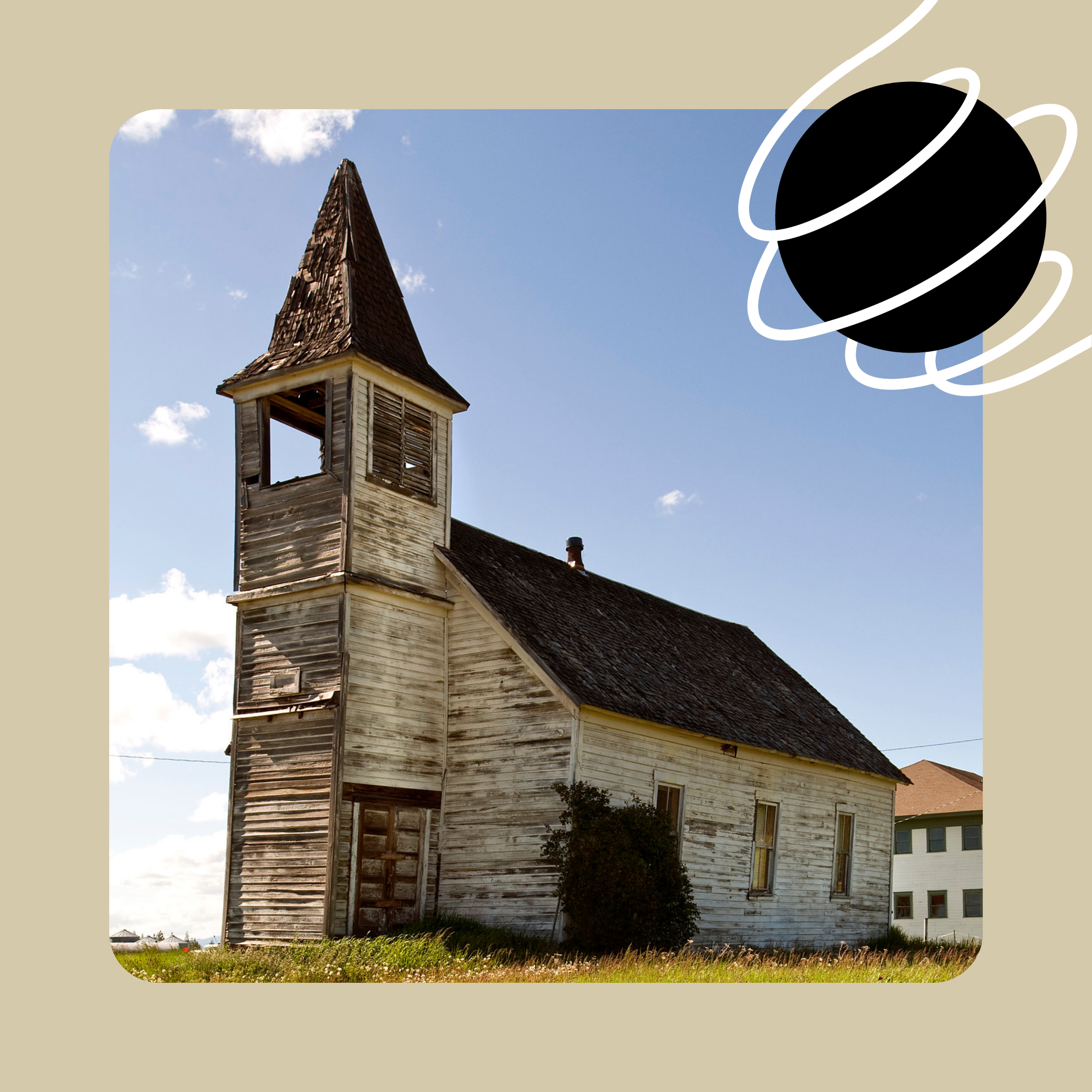
The cover image for this episode is a photo by Curtis Gregory Perry of a church in Flora, Oregon.
Show Notes
This conversation was edited from a Consider This event on March 31, 2026 in La Grande. A full video of the event is available on YouTube.
More writing about faith and community from Oregon Humanities:
- "A Temple Between Us" by Shane Burley - on finding sparks of holiness in marital strife
- "Eid al-Adha, Festival of Sacrifice" by Nada Sewidan - on family, home, and reconciliation
- "Second-Chance Family" by Marion Goldman - on Rajneeshpuram and the ties that bind
About Our Guests
Rev. Amy Jayne is the executive director and resident pastor at Ascension School Camp and Conference Center, a ministry of the Episcopal Church in Cove. She holds a master of divinity and master in nonprofit administration and is passionate about community organizing for equity, justice, and radical welcome in her small, rural town.
Brandon Rhodes, D.Min. has spent his life getting into good trouble at the intersections of localism, food justice, walkable church, ecology, and decolonizing theology. An award-winning author in an earlier life, Brandon is now the executive director of the UMC-affiliated community center Coburg Commons, and is the cohost and producer of the Found in Translation podcast. Brandon lives with his partner in Coburg.
Frank So is currently serving as the executive director for Ecumenical Ministries of Oregon (EMO). Prior to joining EMO, Frank served in the Obama and Biden administrations. For over a decade, Frank also served as a US diplomat in Latin America, the Caribbean, and Northern and East Africa.
Transcript
Adam Davis: Hello, and welcome to The Detour from Oregon Humanities. I'm Adam Davis. Wherever people live in Oregon, and wherever people live across the country, you are certain to come across churches. There are, in some places, mosques and synagogues and other houses of worship. But as you'd expect in a majority Christian country, church buildings especially are everywhere.
So we have all these structures built for a specific purpose, and we also have fewer and fewer people going to church, which means fewer and fewer people going into and using and paying for these buildings. In March of 2026, Brandon Rhodes, Amy Jayne, Frank So, and I explored what's happening with these buildings.
And it turns out that when we change what religious buildings are used for, we necessarily think about what communities most need and about what the sacred is and about where we find and make meaning in our lives. And we also end up thinking about money, tradition, and how difficult and beautiful it can be to reckon with change.
Before diving in, I want to mention that this episode of The Detour is unusual and that faith is spoken about more explicitly and more centrally than is often the case on the show. But even if the specific vocabulary and references are a little different, more clearly Christian than in earlier episodes, the depth of the conversation and the breadth of the thinking align in all sorts of ways with what The Detour always tries to do, which is to explore hard questions about how we live together and to do so in ways that invite more wondering, more listening to each other and ourselves, and often fresh thinking and more hope.
Reverend Amy Jayne is the executive director and resident priest and pastor at the Ascension School Camp and Conference Center in Cove, Oregon, just a few miles from where this conversation took place in La Grande. Brandon Rhodes directs Coburg Commons, a position he was selected for by the leadership of the Oregon-Idaho Conference of the United Methodist Church.
And Frank So was, when the conversation took place, the executive director of Ecumenical Ministries of Oregon. Here are Amy, Brandon, and Frank talking about buildings that meant something to them when they were younger.
Amy Jayne: I'm currently an Episcopal priest, and I'm located out in Cove. Um, and my background is actually in the evangelical church, and I went to church for the first time when I was a teenager.
It was in a community center. You know, it didn't have a building per se. It was a church plant. And what I remember about the physical space was that we actually had to set up everything ourselves and take it all down every single time we went, and then we had to clean everything, which was, uh, quite a chore for a bunch of rowdy teenagers.
So I think from the beginning, I just didn't really ... I didn't connect church necessarily with the ownership of a building, but rather, like, these are the people that bring it to life.
Adam Davis: Great. Thank you.
Amy Jayne: Mm-hmm.
Adam Davis: Yeah. Brandon, what are you thinking?
Brandon Rhodes: So I grew up also Evangelical, in the Foursquare Church, and what I remember about the building we worshiped at is that there was nothing memorable.
They had a lot going on, and there was such an austerity to it that when I then later on would explore traditions that had a bit more of an engaged imagination for how to use these buildings, it popped something open in me, and being able to experience God, why we're here together through art and architecture, it was a revelation, but it wasn't until I was in my 20s.
Frank So: Thanks.
Brandon Rhodes: Yeah.
Adam Davis: Frank,
Frank So: Yeah. One of the joys, I think, for me in a church setting was really in my college experience. I had the opportunity to, as a Catholic, go to mass at this small chapel called St. Ignatius at Seattle University. The building was beautiful, as a very modern chapel, but I think, like Amy said, the most beautiful part was the people and the community that you felt by being with people who had the same values.
And you'd come together not just to be with your friends, but really to hear a message about what it means to be a part of this group of people, what it means to have a place to gather and talk about ideas like social justice
Adam Davis: So maybe as a way of getting further into what each of you do, maybe I should just ask, what are you up to when you're not here?
And how much does the place where you're doing it matter, the literal place where you're doing it?
Brandon Rhodes: So I am the executive director of Coburg Commons, which is an experiment in how to reimagine a property, a church property in Coburg. It's just a few minutes outside of Eugene, and we are a community bookstore and event venue.
So the about 30 by 30 fellowship hall is the bookstore. A big wall opens up to the old sanctuary that's now the event venue, so we can have separate uses of the building in that way. And to your question of what role does the building and the grounds have, I mean, everything. I believe that our social architecture is informed by our physical architecture, and so I kind of have an incarnational imagination for what kind of connecting energies do we wanna have happening in this building?
Well, it's determined really by the strengths and limits of that space. And so I had imagination coming into that building that included a variety of other things, and there's a lot of properties out there that have classrooms and a smaller chapel and all kinds of things. It came down to just the really simple thing of let's give nonprofits and citizens and a yoga group and a choir a space to play and have fun that they didn't normally have access to, and a bookstore, which is just already a natural connection space, in towns and neighborhoods of all sizes.
Adam Davis: And it used to be a space where worship was happening?
Brandon Rhodes: Yes, it was the historic home of Coburg United Methodist Church, and they closed a year prior to this beginning.
Adam Davis: Okay. Super helpful to think about. Thank you. Yeah, Frank, why don't we go to you?
Frank So: Well, I have the privilege to work for an organization called Ecumenical Ministries of Oregon, in which there's a lot of mainline Christian denominations and the Catholic archdiocese that participate.
And we have many programs, from helping refugees resettle to immigration legal rights for our immigrant community to operating the oldest independent HIV AIDS day center in the United States, which when forty-one years ago, people were scared of it or even said, "We don't wanna talk to those people."
Many members of different churches came together and said, "We're gonna care for the sick." [applause]And thank you. And so we operate that program in the basement of a church, for example. Uh, we also... if some of you know the Cully neighborhood of Portland, we have a long-standing, over thirty years, food pantry that began with community members coming together, especially the Lutherans, saying, "Hey, we see our neighbors might need a little bit of help. Let's see what we can do." And what started as an emergency food program that was supposed to last six months to help about forty families, has now grown as the city has grown, and we now feed over twenty thousand people a month in that neighborhood. And that might be the size of one of the cities here in Eastern Oregon, but the need is great.
That program also operates in the basement of a church, a church that sadly went through what is called holy closure and decided to close. But the church council said, "What is our legacy? This church came from the people. How do we give it back to the people?" And it's a really beautiful story because it took years to conceive what the church would be used for afterwards.
And right now, it still continues to feed thousands of people a month, and now we're hoping to bring our HIV day center to that same space. A lot of what EMO does, Ecumenical Ministries of Oregon, it does through its member churches. But as we're seeing these churches come to close, we're also seeing how this church, how do we give back to the community what the community gave us?
Amy Jayne: I'm Amy, and I am the executive director of Ascension School Camp and Conference Center out in Cove. I'm kind of the resident priest there, too. As executive director, I also am an employee of the Episcopal Diocese of Eastern Oregon. I sit on the bishop's staff. So I have kinda two different roles.
Ascension School is a thin place, if you've heard that phrase before. Just a very thin veil between the real and the sacred, and it's just a really special place, and it has been since time immemorial. It's about 100 acres with 20 of that taken up by our main facility. And it's not a traditional church, but it is the center of the Diocese of Eastern Oregon.
It's what they would actually call their cathedral. And it has a beautiful chapel. And probably two of our most significant shifts in the last decade or so is the first taking of 80% of the land holdings that we have in Cove and putting them into habitat restoration in perpetuity. And we did this in partnership with an Indigenous-led organization called Caretakers of the Land, and they not only managed the project, but also really shifted into using the main campus as a center for Indigenous cultural revitalization.
So we now are the home of Camas Camp and Tule Camp and all of these beautiful opportunities to revitalize Indigenous culture. With Christians landing there 150 years ago, occupying the land, displacing Indigenous people, it's beautiful to see it come home, and have it be a place of celebration and gathering again.
The other piece is that more recently, and still in process, is a community annex. So we've taken about seven acres of land and dedicated it to the Cove community in perpetuity. It includes a community center as well as a pool that's going to be built in the coming year. So that's really exciting, and other fun things like playgrounds and sports courts are in the works.
So this is so much larger than just many buildings. We are really thinking about how every single one of those buildings needs to serve the community in some way, whether it's a chapel hosting concerts or an extra commercial kitchen having a bakery, or an empty building hosting science classes or an art studio forming.
Whatever it is, making sure that buildings aren't just sitting there rotting, which was, yeah, certainly the case with some of the buildings. So yeah, my role as part of the diocesan staff in working with the bishop who really oversees all these churches in Eastern Oregon, is helping with transitions and conflict, and particularly closures, which we have been closing approximately two churches a year, for the last five years.
And what does it look like to discern those churches and their future and try to get ahead of those closures so we're not just selling off properties, but rather reimagining what they could be like. It's very inspiring to hear what Brandon's doing.
Adam Davis: So there's so much already in what each of you said, so much that it's a challenge to know exactly where to go next.
But I think maybe I wanna put myself for a minute in the head of someone who wasn't part of thinking about this and going, "Huh, the activities that the three of you have most described sound like community center activities or community organization activity. They don't sound necessarily churchy."
So I wanna ask the impolite question. Like what makes them churchy if they are churchy?
Brandon Rhodes: So the word, ‘church’ in the Greek, is ecclesia, right? I grew up hearing it means ‘gathering,’ or ‘assembly,’ which is not that morally inspiring. It's just like, okay, cool, we're together. More specifically, what it meant was one of the layers of its meaning was the citizens getting together in a town to seek the common good.
So when people come and ask me, "Is this building still a church," I kind of read if I wanna go there with that kind of smart answer with them or not, and sometimes it clicks that, like, the paradigm is how are we coming together? Coming together for fun is good. Coming together for worship is good. Seeking the common good is really what worship in so many traditions is ultimately about.
So creating church as a fabric of care, I'm here for.
Frank So: I-- let me just also add to that. I fully agree with that. It's one thing to go to a church on a Sunday or a synagogue on a Friday or a mosque. It's another thing what we do, right? And I think just like we like to talk about, you don't have to be a person of faith to do good.
But if you are a person of faith, you should have the discipline to carry out those things if you're a believer. And so I think in the Jesuit tradition that I was brought up in, it's to be a servant leader. It's to be the hands and feet of Christ. It's not merely to tout a Bible, tout a Bible and a constitution. It's not merely to tout a Bible and say, "This is what the Bible says," but it's actually to do like Jesus. Um, and so the action requires an organization to do something about it. And it can be individuals, but when you do have people that believe in those same common values, and it feels good to do good, then do more good.
And that is why I think organizations like ours aspire to do more than just have a building. And I think as we're looking to the leadership, whether you're a Methodist, whether you're an Episcopal, whether you're a Lutheran, uh, I can definitely speak to those three denominations being very progressive about how we use church space, not just churches that have closed, but churches that are still active.
And just in Portland alone, we know there's over six hundred acres in the city limits of Portland of unused church property. The Oregonian statistics say there are over three thousand up to five thousand acres of unused church space in the state of Oregon. And so it's not just when you do something, it's when you're not doing something that we need to actually think about.
And these conversations sometimes that I have with, uh, the Methodist bishop, Cedric, who's very progressive, who's trying to say, "What do we do? What do we need? Do we need to build more affordable housing?" The Lutherans have done it. The Baptists have done it. These are good examples of what it really means to live out your Christian values because they're not for profit.
The whole point of it is to give to the community, especially the community in need. There could be many nonprofits. The question is, how are you led? And that's what distinguishes some of the faith-based nonprofits to do more with sometimes a lot less.
Amy Jayne: In our office we like to say, "Oh, church," in a very loving and compassionate way. The church can be pretty problematic and difficult. And so yeah, I think of church as a people, and it needs to crumble in some ways. It really does. It can be a source of much pain, and I'm obviously an Episcopal priest.
I follow Jesus, and I think Jesus is in the business of restoring people to society and bringing people from the margins, and radical inclusion and hospitality. And so I think that every single resource at our fingertips should be used for that purpose. I mean, Jesus didn't say, "Worship me," he said, "Follow me."
So that's what we gotta do.
Adam Davis: Hmm. So it's interesting talking about closures and holy closure and discernment and tough decisions, it sounds like. Tough decisions and also decisions that depart from, at least in some significant ways, from inherited traditions and inherited uses. Who, who makes decisions about when, for example, a church is no longer a place of worship?
Who makes those decisions? How do they get made? How do you operationalize a decision like that?
Brandon Rhodes: The community decides together. Sometimes they are nudged very, very hard to make that decision together, and sometimes there are executive decisions made from far away.
Adam Davis: But someone said, “good answer,” and I don't know if that meant 'cause it was tactful or… I wanna push on it a little bit. It would seem like the beginning of an answer. In your cases, as you're working on changing uses of these spaces, what do you gotta do to make that happen? Who, whose buy-in do you need? How do you get that buy-in?
Amy Jayne: I mean, in the Episcopal Church, the church is a responsibility of the people in the church. And what we're finding is by the time— the diocese, you know, you got the churches, the diocese with the bishop—by the time they're being called in, there's like five people left. And they haven't been given the resources or the imagination or anything to rethink that space or rethink their identity before they're dead or on hospice, right?
We're just kinda going in, and really we are putting them on hospice. Yes, you're not called to be successful. You're called to be faithful, and I think that many of them have been. I mean, I haven't experienced one where I'm not sitting across from people who have been faithful. But they haven't been given the opportunity, the permission to think imaginatively.
I mean, the Episcopal Church is typically pretty high church, just entrenched in tradition, and, I mean, people are just holding on for dear life in some cases, right? Like, "Don't change anything." Yes. And so that is inhibiting them, and they haven't been taken through a process. I mean, it's like their vestry, their board that's responsible for doing that.
And so instead, their church is closing. The people are closing, and all that land comes back to the diocese. And the diocese is just selling off land and putting all of that money into a property policy, right, where they're divvying it out to different things, and then we're losing a touchpoint in that community, like Klamath Falls, 40,000-square-foot building sitting empty– Episcopal Church in Klamath Falls.
What are we gonna do, you know? But when we went in there six years ago, there were six people. Six people left in a 40,000-square-foot building, so.
Brandon Rhodes: Wow. You used the word hospice, and I think that really is the energy that is often needed. It feels like a combination of... I mean, so when you're in that home stretch, you get your affairs in order.
You have heavy conversations, tearful conversations, laughter, grief, the whole range of human experience that comes with hopefully gratitude for a life lived, and then that needs to be paired as well in these church spaces with the other end, I guess, like midwifing. Like, okay, how do you want the legacy without controlling it?
What do you want the legacy of this space to be going forward, and can you release and stay curious and supple to what I think the divine is always wanting to do–good mischief, even with old mildewy buildings. And if those two things, hospice and midwifery, can kind of live together, I think that's the jungle gym move.
Adam Davis: Frank, you were just jotting something down. What are you thinking?
Frank So: Well, I, having worked with several denominations, I can say there's, obviously, different processes, and different hierarchies, which is absolutely correct. We recently, when we acquired Luther Memorial in the Cully neighborhood to maintain the food pantry, I attended some of the church council meetings, and in the Lutheran Church, that particular church belonged to the individuals.
It wasn't part of the larger ELCA. It was part of their church groups, but it didn't... The title wasn't necessarily with the ELCA, the Lutheran Church. So I think, you know, when you say let's dive in a little bit more, I think this is the part where I wrote down three things because they're the three things that stuck with me the most when you hear of a church, or at least what I observed, when this church was going through holy closure. I remember there were only about 18, maybe 20 people left in the congregation. No one was under the age of 80 And to feel that a place that you've grown up in is closing, it's more than a cinema, it's more than a restaurant. These are the three things I wrote.
This is where I was baptized.
This is where my parents saw me get married.
This is where I came when I needed help and I was alone.
Subsequent conversations, and I think this is what's difficult, and I felt a lot of emotion thinking, "How am I gonna be responsible for a building, a structure that has so many memories?" When an older lady came up to me and she said, "Where's my funeral going to be?" That really hit home, because to her, this is where her life began, and this is where she wanted her family to receive her when she left this world. Christians believe in Jesus rising up, like there's another life, like when you go from this world, you go into another realm. And thinking of a building being another realm, there's almost no transition.
It just, the building turns from one function to another. When we acquired Luther Memorial, we said we want to pay tribute to the legacy of the church by maintaining the food pantry, that it wasn't going to be toppled immediately and sold to the highest bidder. That was never gonna be the case, and it hasn't been.
Moreover, we told the church, "For the next three to five years, let us know how you need it, whether you're still doing Bible groups or whatever you need. Let us know," because we knew there had to be a transition. But that conversation about the church being sold was already happening over the last eight years.
So now we've extended that transition for another three years. It's very emotional. And churches, since their beginning, have been in a positive light. Places where they've set up schools, daycares, maybe AA classes, now ANA classes in their basements. They're places where people have gone to get services.
They have been the place for many who have felt alone in the community to run to, whether your church is open and affirming, whether you're going there because you maybe have been rejected by your family. And so to see some of those places transformed, it's not, "Wow, look at this great new building, and we've done all these things with it."
There's also an emotional cost.
Adam Davis: I wanna sort of put what I think is a too provocative question back in response to the last few comments you've made, and that is it, it sounds like as these buildings are shifting their use, and in a way the organizations are shifting the functions that they're providing in some cases, like I wonder, is it an attempt to say there's room for the sacred in a different form than it's had before, and we can expand our picture of where the sacred stuff is gonna happen?
Or is it something like, well, this has been doing something sacred, now we're gonna do something important but not sacred in the same way?
Amy Jayne: Everything is sacred. That's what... I mean, I would say it's all holy work. I don't know. The thought of kids swimming in a swimming pool all summer and laughing with joy, that feels sacred to me.
Hearing kids running out of the preschool, it's not a Christian preschool, but just hearing them every day, that's sacred. Teenagers learning something new about water quality, that's sacred to me. It's a theological shift for the church, and it does take some training for a Christian church to, in our case, to shift their understanding of land and land use, right?
And that we are going to dedicate and potentially–hopefully–someday give back, 80% of the land that has been sacred for so long. But also giving it over to a use that isn't, ever gonna be Christian, that just releasing that power over, releasing your power over the land which is sacred on its own and was sacred before we touched it.
Adam Davis: Yeah, and that... I mean, you started by saying everything is sacred, and then I think you put an even finer point on it by distinguishing, I think, at the end between the idea of the sacred which might be everywhere and the Christian. Yep. That's a... And I assume for many people that's a hard shift.
Amy Jayne: Really hard.
Adam Davis: This is The Detour. You're listening to a conversation about the changing role of religious spaces with Amy Jayne, Brandon Rhodes, and Frank So.
It's funny. I should say I think ‘church,’ the word we've been using, ‘church,’ stands in for any house of worship, and I will just say one more, autobiographical word that is, like I grew up without the word church. I was raised Jewish in Chicago. So I was having a little moment of just thinking this is so funny in a way, and I'm in the church twice a week to play basketball in a falling down, no longer churchy church in Southeast Portland, and I will say to my friends that the activity is sacred.
But I kinda doubt that the people who used to run that church would agree with me. So how do you take their belief in what that building is for, really seriously, and take really seriously the argument that everything is sacred? Which is what all of you are doing, taking that really seriously.
So yeah. Brandon, what are you thinking over there?
Brandon Rhodes: There's sunlight everywhere, but sometimes you need a magnifying glass to just hone it in and have these places that catch fire where I've... Yeah, everything is sacred, and when in a world that tears itself apart and loves to exploit and just pour violence into any difference between us, to create spaces where we're overcoming that violence, that's holy.
Like, you read Paul, he's a community organizer across the Roman Empire saying, "If you all can't get along across your differences, who cares if he came back from the dead? It doesn't matter if you can't jump past the differences." So to me, these spaces are also... I think should be Petri dishes of ‘is it possible?’
Is a different way to be human possible? If it's not, everything is still sacred, and we can still do these other things, but, like, for me as a Christian, that's where it really comes together. I think there is space for the sacred. There is space for sacred space. The book Sabbath said Sabbath is like a cathedral in time.
A cathedral is a sacred space in place, but there is space for that, that depth dimension to this experience we have, that Z dimen- that Z axis of what we're trying to do. I have no interest in it looking like what I grew up in, being used to, and I've dabbled in little ways of, like, facing the Z axis together, but my one rule is keep the guitar in the case 'cause we have so much unlearning to do of built-in muscle memory of as soon as the guitar comes out and we sing a song, we're gonna go right back into the old way.
And there are ways, I think, of facing the sacred and remembering the sacred stories that have a lot of resonance with a lot of the core practices of the church, like the Eucharist, but man, we gotta be really actively disciplined on undoing some muscle memory that's gonna incline us to settle respectfully.
Frank So: If you're able to see me, I have a shirt that says, "Do justice, love mercy, walk humbly." You don't have to read the Bible to know famous phrases in the Bible, passages that say, "I was hungry, and you fed me," not, "I took away your food stamps." And I think that when you talk about what is sacred, what is divine, where there is God, God is in all of us.
And where there is divine is where God's love is. Where there is sacred is where God's love is. Jesus didn't build churches. Jesus built people. And that sacredness is that sacredness to follow Jesus, to do as Jesus did. Uh, it's not necessarily to have a church with, you know, golden toilets. That's, that's not what a church is about, and that's not what sacred is about.
Sacred is about how we welcome our neighbor, how we feed the hungry, how we visit the incarcerated, and if our spaces do that, then I do believe that sacred is there, that divine is there, that God's love is there, and that's ultimately the best legacy that we could leave as people of faith.
Adam Davis: Amy, you look like you're…
Frank So: Yeah.
Amy Jayne: Yeah, I, I'm thinking a little bit about the process that you have to go through to say goodbye to something, especially something sacred, and the grief that each individual goes through, but also the collective grief of a congregation and how important it is to actually walk through that process.
And we all know this is how grief works now. We've all learned that's not how ... It's different every day, right? And you actually have to be willing to accept the anger, be willing to acknowledge that people are gonna walk away, and they might not want to be part of the future. And I think this conversation connects to sacredness because the memories are sacred, and we do have the physical thing that makes it sacred, but I think we can develop rituals and processes that help guide people through that grieving process in a way that puts us on the other end and gives new life and that they can then take ownership of the new thing, because they helped build it and develop it.
I mean, here in La Grande, we've got, you know, an incredible situation of Methodists and Lutherans coming together, and one building is waiting for its purpose and the new dream and the imagination. I'm not part of those systems or those groups. Maybe some of you are, but I hear about it, and I think, "What will come of this?"
Um, but man, you gotta take the time. You gotta take the time to let people grieve and go through the process and make the decisions that bring you to the place.
Adam Davis: Yeah, it's ... I was also thinking about hearing about that combining here–and I feel like you're, all three of you are in some ways talking about a kind of open-mindedness and even an open-heartedness, both of which seem to run against some of what we hear are the national trends.
That is, that we hunker down more strongly in the groups we most choose to identify with or believe we're a part of. I mean, the term is ‘polarization’ or something like that, and I think you're arguing for really something that's on the opposite end of the spectrum from that. Like how to help people see that we're more open than maybe we're constantly being told we are.
Frank So: So during every state long legislative session, Ecumenical Ministries of Oregon has a day where we ask folks to come down to Salem and advocate. And what I've found very interesting is even to go even further to what you were asking, Adam, is we have members from different churches and denominations and congregations come and, and when they come together, they come together based on similar Christian values.
Again, whether it's feeding our neighbors, whether it's protecting families in different ways or protecting our new Oregonians. And then there are some who are not Christian who also come. In fact, shortly after the 7th of October and the war in, in the Holy Land, we invited both a rabbi and an imam to join our board, and we have found that it's not just Christian, the mainline Christian denominations, but there are other faiths that have such a strong commonality that that plurality of names, whether you wanna call yourself a Quaker, a Lutheran, a Catholic, whatever– conservative Jewish, or a Muslim, we find that we're actually more and more common on a lot of things.
You know, as we're seeing trends with Unitarians and Quakers actually growing, I feel that the majority of people, even though we hear this, Oregon and Washington are the least church-attended states, we're seeing people who leave maybe traditional churches because there's a lot of work that we're doing that makes people uncomfortable.
But then there's a lot of people who are coming to realize that they do believe in something greater. They're just upset with the structures of organized religion or their denominations or even their particular congregations. But they do want community, and those values are common. And so when we're at a legislative day in Salem, no one says, "I'm a Protestant." No one says, "I'm a Catholic." No one says, "I'm a Jew." No one says, "I'm a Muslim." No one says, "I'm a Sikh." We come together, and we're able to do good together.
Adam Davis: Frank, can I ask concretely, when you're in Salem, what are you asking for?
Frank So: One recent example was to protect food for families that don't have any. We will advocate with the Oregon Food Bank, for example. That is a common thing that we have that we all share in common. We want to help those that are struggling the most, the last, the least, the lost. There's other things that we've had unity on– protecting new Oregonians, and that includes many of our immigrants to this state. And that is highly controversial, but we come together not because of the rhetoric of politics, but because those are the instructions that we're told as people of faith: welcome thy neighbor.
Adam Davis: Part of the reason I was asking is, a word that hasn't come up, and it's a low word. The word is ‘money.’ As you're shifting your model at Coburg Commons or as you're shifting to think about the land going away, how much are you thinking about what strikes me as incredibly high-minded and hopeful things?
How much do you have to think about money?
Brandon Rhodes: A lot
Amy Jayne: All the time
Brandon Rhodes: A lot
Adam Davis: How do you think about it? It's, someone said, it's not real. That's another program.
Amy Jayne: It's a myth.
Brandon Rhodes: It's challenging how much of a piece, the relationship to the denomination, to the conference is mediated by that specific thing just implicitly, in both directions. Um, it is important. I like having health insurance. I like being able to fix things in the building when they break. I like being able to have free events.
The anxiety around money for denominations that are numerically constricting, that anxiety is crippling, and my hope is that is an important conversation, and it can't be the centering one. Otherwise, we're teaming up, like, out of our anxiety, and that... Yeah
Adam Davis: Amy, yeah
Amy Jayne: Oh, money. Well, we're all executive directors. We get used to asking for it. But I think there is a certain obligation to develop a theology of money and around stewarding the resources that we have in a way that are serving everyone that has access to the space or the ... I mean, we're definitely in a… I mean, Ascension School, it's money-strapped. We're always gonna be money-strapped. I don't know what it would be like if we were flush. I think it might actually be more challenging in some ways. I do think that some of these designs we're talking about, though, actually diversify income in a way that frees us so that we're not just dependent on kind of the typical church person who's willing to tithe. 'Cause all of those things are melting away, and individuals aren't necessarily giving to organized religion like they used to. It's actually, it's…
Frank So: actually going down
Amy Jayne: For sure. Yeah. I mean, for sure. But yet they are ... There's this openness to something new and different. I mean, we raised a million and a half dollars in nine months for a swimming pool.
Adam Davis: And can I ask, just, uh, Brandon used the word ‘implicit’ before, and can you make explicit where you're ... Like, did you raise it from foundations or from individuals or-
Amy Jayne: No, we raised it from individuals in our community ...
Adam Davis: individuals in your community
Amy Jayne: Our little baby community of Cove, La Grande- okay,
and, you know, some spots in Eastern Oregon.
Brandon Rhodes: You doing any workshops on how to do that?
Frank So: I'm signing up, too.
Brandon Rhodes: Yeah.
Amy Jayne: But it really just made me believe in ... People want to give their time and their attention and their resources to things that will just bring our communities to life.
Frank So: I love that. You cannot underestimate the power of people, period. You've heard that before, and it's true. When I was told, "Frank, you need to take down your DEI statement," I went back to a couple people who tried to advise me, and I said, "Why? That would not be who we are." And they said, "You gotta take it down, or you'll lose your federal money."
And I said, "That's what makes us different from a regular nonprofit. We're faith-based." So we lost 3.7 million in three weeks, all of our federal funding. And I took down our DEI statement from our About section, and I put it to the front of our website. And, I called out for help. And yes, foundations stepped up.
The cities, the counties stepped up with emergency funding. And then we had people decide, "I can do my happy hour drink, my $15, $20 a month. I can do it and give it to you." That multiplied by a few hundred, and that's constant revenue. And so we were able to survive. And the building that we acquired, we bought. We bought at pennies on the dollar. That also saves us rent, but we also had to figure out, how are we going to maintain that building? So when I went to a foundation to say, "Would you be able to help us acquire this building?" They said, "Sure, Frank." I said, "And I need you to add on, because I may not be here in a few years, or I may get hit by a bus.
You need to make sure that you add a stipulation that you will also add partial funding for a building maintenance person. So make us more accountable to you, make us more business savvy, make us be more sustainable." And I think that's what we all have figured out that we need to do more.
Adam Davis: You're listening to The Detour. We're talking about the changing role of religious spaces with Frank So, Amy Jayne, and Brandon Rhodes. This conversation was recorded in La Grande in March of 2026 with a live audience. Before we concluded, our guests responded to audience questions
Rich from Wallowa County is asking a question based on many smaller churches and increasing splintering during COVID, some of those churches then sort of hunkering down and saying, "We're saving souls while you're out there trying to do social work." What are we gonna do? Did I do some justice to your question?
Amy Jayne: All right. This is a church question, right? Oh, church. I mean, I'm out here in rural Eastern Oregon, and very much aware of what you're talking about, the shrinking churches, but also the rise of white Christian nationalism, which is the greatest threat to the message of Jesus today. So that's me putting it bluntly.
But I was a pastor in the Evangelical church for 15 years before I became an Episcopalian three years ago. So, I've shifted a lot of my beliefs over the years even. And I guess I just ... I'm placing that there, not having any solutions, obviously, but I try to have openness and kindness when I'm encountering people from different traditions, mostly 'cause I come from that tradition.
Um, and I know what it's like to make a journey in a faith system, so.
Frank So: Just real quick, Rich, I just finished a book by John Fugelsang called Separation of Church and Hate. I don't want to get into arguments with people who are staunch believers that there's only one way to God, that I think if you read the Bible, and I think all different types of Christians do or should, you know, Jesus says, "Come, come through me."
Well, we're literally not gonna come through Jesus. We come through the example of Jesus, and there's a difference between ... I don't wanna say it's just the Evangelicals or one type of Christian, but the idea of who we are is based on our ability to follow Jesus, not just thump a Bible. And so you have to ask yourself the question, "Is it worth my time, or is it worth my example?"
And I think what we must do is show love, show love even when things don't make sense to us in the way that we were brought up and what we were taught about the Christian faith or love or God. You have to show mercy. You have to show love, but you also have to educate yourself when people come to you and say something out of the Bible because sometimes it's either taken too literally, or it's just taken and perverted
But that's why I believe we must do justice, love mercy, and walk humbly with our God.
Adam Davis: Great. Thanks. So the question, is it possible that we're looking for meaning in different ways today, and might that be related to the shrinking of some of the congregational stuff?
Amy Jayne: 100%. 100%. I am constantly astounded by the young people that I work with and the ways that they think.
The church is gonna look a whole lot different in the future, and I'm not mad about it. They have challenged me to just open up. And I think the moment you open your doors and you are not exclusive to your faith tradition, you will be transformed by the people who think and believe differently than you.
I have learned more from people outside of my faith tradition about openness than I've ever learned in the church.
Adam Davis: So Micah's asking, can't the church or certain congregations transform before getting to the point where hospice is what's needed? Might that transformation done more proactively bring more people to it and save it in doing so?
Thanks.
Amy Jayne: That's my son.
Frank So: Has he asked you this question before?
Amy Jayne: No. It's a great question.
Adam Davis: It is a great question.
Amy Jayne: Yeah, we're missing, we're missing opportunities. And I often think about what are we so caught up in that we are not getting in there in time? What is the church actually doing that they're not noticing that they're entering into death.
And so I think that, you know, diocese, denominations, they need to actually pay attention to this. But I also think they need to be okay with death. They need to be okay with saying goodbye to what was and making room for what will be, and that might mean the death of a church. They're just, like, clinging to, to the way it was.
Um, so I agree with Micah. I think it would transform, it would transform the church if every single church right now began to think creatively and imaginatively about the future of their facilities.
Frank So: Churches do well when they have purpose. There are also good examples of churches that have preemptively decided, "We're gonna do something to serve the community. We did schools before, we've done daycares. We wanna do affordable housing." There's a small church, called West Hills Covenant Church. It's not a mainline Christian denomination, it's more evangelical, and they approached us and said, "You resettle refugees. We have an old parsonage. We have this old house on our property. We wanna host Afghan refugees.” So, well, that's kinda interesting. Afghans are Muslims. You're more of a conservative Christian church. Are you sure? And they said, "Yes." They got their congregation, their community members, excited about helping, excited... This was during, right after the evacuation of Kabul.
Excited about turning an old building with former congregation members that used to be contractors, that were plumbers, that were people who loved interior design. They fixed up that church parsonage, and until this administration stopped receiving refugees, were bringing in Afghans and welcoming them to their community.
They found more purpose, and more people started coming together. We're seeing in Portland that there are some churches that are starting to take action on this and building affordable housing on empty lots, and that is great to see. So there are some examples of proactiveness. Ecumenical Ministries of Oregon is working with a great organization some of you may know called Levin, and Levin Community is looking at all the areas right now, and that's how they have all the square footage of what's out there and saying, "What can you do with your land?
Can you make it into affordable housing, and how can we help you get there?"
Adam Davis: I think we have time for one more question. So Grace is asking about how these conversations actually happen within different denominations within the church .Whether they're hierarchical, whether they're facilitated, what the method is for having these hard conversations.
Brandon Rhodes: There's a story out of, I think it's Indianapolis, Englewood Baptists. They were real big up into the '80s, megachurch energy, and declined into the '90s, and they had, I don't know, 15 city blocks. They had an establishment of buildings. Fast-forward to now, they've got affordable housing.
They've got social enterprises, incubators, regular meals together as a neighborhood. To fill in the blank between that starting point and now is it began with listening. They had to learn how to listen to each other. I think listen behind the moment for where the divine may be at work and may be aching for something.
Um, but I think a lot of these things just begin with listening. Slow, hard work.
Amy Jayne: I think courageous leadership too. Just having people that are willing to stick it out in those hard conversations. I think it all depends on what the people need and, yeah, listening to what they really want that will actually facilitate their future, not what we think should happen.
Frank So: Boy, the last 250 years have been interesting, haven't they? God knows what waits for us in another 250 more years. I think that we have become, as a society, because of our ability to garner more information, read quick rhetoric, and we have such a desire to have an opinion about everything, that some of our personal opinions are now superseding our opinions of faith, and we're mixing faith to justify our opinions.
And so it's difficult because we have a struggle internally where we have friends that are in the same church, but, "Oh, you're okay with gay people. I'm not okay with gay people, and the Bible says it's not okay." And then someone says, "Well, actually, the Bible never said anything about Jesus not liking gay people."
And so it's polarized, whether it's abortion, whether it's about LGBTQ issues, and that belief of your freedom supersedes that belief of a community. Your individual has now become greater than your community belief. So you find new communities, and we fracture, and that's why we have seen denominations split.
I'm a Catholic. It pains me to see such a hard line against our LGBTQ brothers and sisters. It pains me like you wouldn't believe because I cannot be a good friend to my buddy who's gay and follow the mission of the Catholic Archdiocese at 100%. I cannot do that. I may be able to welcome them, but I cannot accept them because they may sin.
I don't think it's a sin. Does that make me no longer a Catholic? We are afraid to talk about these issues, but we need to talk about them, just like we need to talk about what it means to transform churches as a building, churches as a people. We are no longer the country we were 250 years ago, and we need to create who we will be in the next 250 years.
Adam Davis: So it's interesting as we close, I guess I just want to name that I've had this sort of strange experience during this conversation of thinking about how it sits alongside many of the explicitly civic conversations that Oregon Humanities is involved with around the state, and that it sits really closely.
And I want to ask you to join me in saying thank you to Brandon, Amy, and Frank. Thanks very much
Brandon Rhodes directs the UMC-affiliated community center Coburg Commons. Frank So is the former executive director for Ecumenical Ministries of Oregon. Reverend Amy Jayne is the executive director and resident pastor at Ascension School Camp and Conference Center, a ministry of the Episcopal Church in Cove, Oregon.
You can learn more about Amy, Frank, and Brandon in our show notes at oregonhumanities.org. Thanks for listening to The Detour from Oregon Humanities. Anna McClain is our producer. Ally Silvester, Karina Briski, and Ben Waterhouse are our assistant producers. Our transcript is by Tom Williams, to whom we want to extend a very large thanks.
This is Adam Davis. See you next time