September 8, 2020, Southern Oregon
A massive plume of smoke dominates the southern horizon.
Rancher Joyce Moreno’s truck is dead, and her animals need to be evacuated. She calls her vet, who texts a list of contacts, and within half an hour two people show up with six-foot trailers to load up her horses. The sheep are more difficult to corral. Joyce tries rounding them up, but a few sense danger and scatter. Her phone buzzes—it’s time to go. Joyce will leave the remaining sheep with the livestock guardian dog, but she can’t decide whether to open or shut the gate. Flames are now visible. She leaves the gate shut. The sheep could get trapped in the fire, but opening the gate will surely draw predators in.
Fifty-five miles to the west, homesteaders Mark and Beth get a call around 10:00 p.m. They gather important belongings, mostly tools that would be difficult to replace, and cart them to their two-acre garden, the wettest spot on the property. From the garden, the sky opens up and pulsing reds and oranges are visible on the ridge to the southeast. They have no idea how far away the flames are. Five miles? One? They cross the river and sleep at a friend’s house, where they’re awakened by the sound of police broadcasting “evacuate” over loudspeakers on their squad cars. Neighbors from their tiny enclave of Takilma, population 423, congregate in a parking lot near the gas station in nearby Cave Junction and make plans for getting their livestock to safety. Mark and Beth return home at first light, set sprinklers on the roof, and decide they will stay and defend their home.
Four miles to the northeast, Deb, a farmer and herbalist, gets a call in the middle of the night. Within the hour, she packs a go-bag and lifts her four best milking goats, plus some of their kids, into the back of an open trailer and leashes them to the sides. Two dogs and a cat ride shotgun. There’s no room for the other goats, or the chickens and ducks. Deb and her husband spend the night at a park in Cave Junction, then head up to Grants Pass where a friend agrees to keep the goats in her backyard.
Three miles to the south, Eliot, a community organizer and artist, is playing pinochle on the back porch and eating grilled salmon with his partner, Sophie. They notice smoke smudging the evening sky. Friends start texting about a fire climbing its way toward them from the next valley. The sharp smell makes Sophie, new to Southern Oregon, feel panicky and unsafe. Eliot reassures Sophie, but wonders to himself—What’s the smart decision? How can we be safe?
The trouble with wildfire is that safety is relative and subjective. A go-bag can make us feel prepared. An evacuation plan can provide a bit of comfort. Yet when wildfire approaches rural communities, entirely new questions emerge, and most have no clear answers.
Images of the catastrophic Alameda fire raging through the Rogue Valley dominated social media and news sites in September 2020. Entire neighborhoods incinerated in a single afternoon. Over 3000 structures burned. At the same time, and only a handful of miles away, the South Obenchain fire consumed 32,000 acres and destroyed more than 150 structures. Meanwhile, a third, lesser-known wildfire, the Slater, ravaged the western flank of the Siskiyous, adding to Southern Oregon's ledger of disasters that month. Collectively, these three are known as the Labor Day fires.
September 9
Safe at a friend’s farm in the Applegate Valley, Joyce feels some relief but can’t stop thinking about the sheep left at home. She watches updates online, refreshing every few seconds to follow the fire’s movements in real time.
Fire melts irrigation pipes at Mark and Beth’s place. Frantic to keep everything as wet as possible, they turn off two main valves to isolate the system, then turn on a third valve, higher up in the stream, that pumps out of a pond. Sprinklers resume saturating the roofs and garden. Mercifully, there’s no shortage of water on their property.
Deb buys extra fencing materials and builds a makeshift pen in her friend's backyard to hold her goats. She feels safe enough to go back to the farm and collect the rest of the goats, ducks, and the chickens. She also grabs a stockpile of her herbs and tinctures.
Eliot and Sophie weigh their options, pack their go-bags, and relocate to a friend's house in the next valley over, where they find the smoke almost as thick and the cabin walls about as leaky. Ultimately, they heed their long-distance family's urging and evacuate to the coast with their two tiny kittens.
Disasters, by nature, strip away distractions. What remains are priorities, relationships, responsibilities, and values. The decisions we make are often messy and fraught, convoluted by adrenaline and exhaustion. They involve compromise—and sometimes regret.
Mid-September
Time becomes elastic. It’s hard for anyone to remember if it’s been three days or ten since they first smelled the fire. Dense, orange smoke interferes with sunlight, rendering people confused about the passage of hours.
Joyce’s son returns to the ranch for the rest of the sheep and picks up more things, including Joyce’s spinning wheel and the lamb fleece she processed last week. She bursts into tears when he delivers them. She had thought only of important papers and the animals, not these belongings that touch her heart.
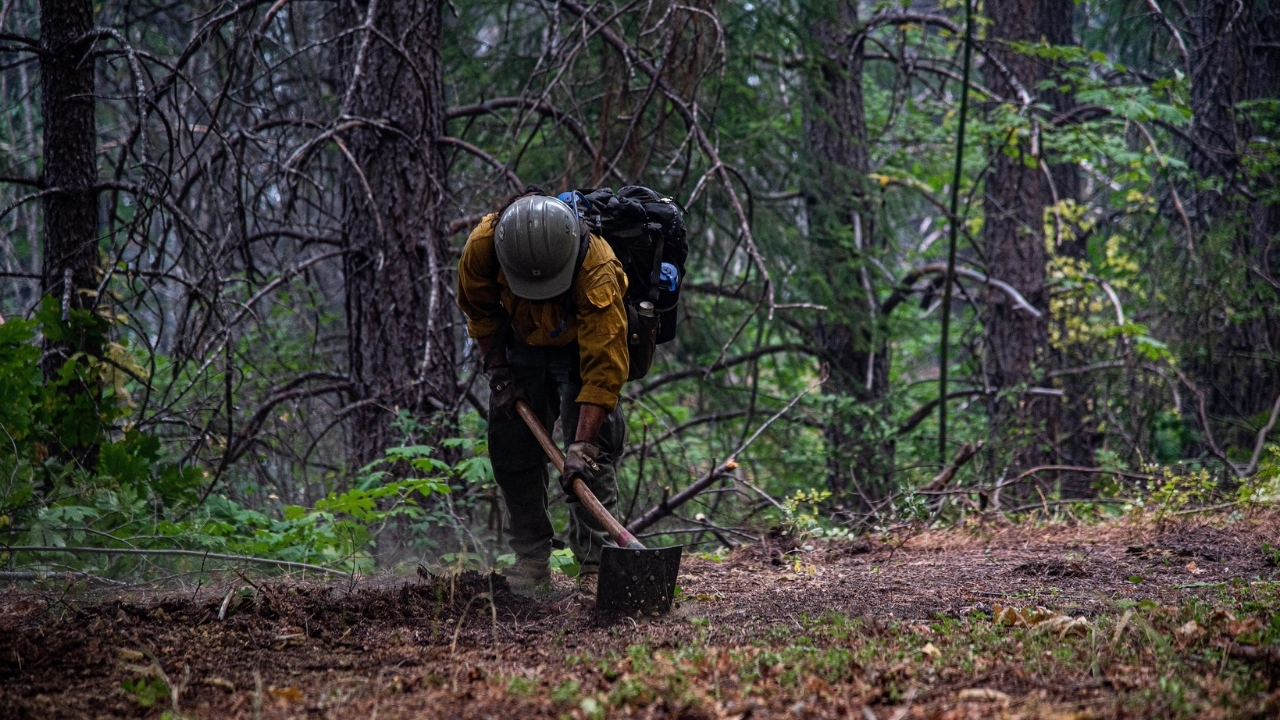
Beth and Mark are on their own. Then a bunch of neighbors show up and begin the heavy work of digging fire breaks with shovels and Pulawskis. Meanwhile, the CDC recommends avoiding strenuous outdoor activities such as exercising or mowing the lawn.
Deb attends a community gathering. Someone offers to cook meals for the firefighters in the Takilma Community Building kitchen. Farmers and homesteaders donate produce, dairy, and foodstuffs. A slate of volunteers emerge to help the cook with food prep. Organizers tally who is staying, who is evacuating. It’s okay to stay, they say, but we want to know what you’re doing and how we can reach you. Older neighbors, and those with disabilities, are encouraged to evacuate “in case the skies turn dark and they can’t see their way out.”
In A Paradise Built in Hell, Rebecca Solnit explores extraordinary human responses during and in the aftermath of disasters. Crisis, she argues, reveals hidden possibilities for solidarity and collective action almost unimaginable in daily life. These temporary “paradises” challenge assumptions about human nature and social order. They also make us wonder why we need disasters to bring out latent impulses of selflessness and altruism.
Checked into a hotel in Coos Bay, Eliot feels displaced and disoriented. He is safe from the fire, but isolated from his neighbors, many of whom are staying put or sheltering in nearby Grants Pass, where they can travel back and forth as fire and smoke permit. Eliot feels “uncomfortable in my own skin about not being there.” He tries to focus on appreciating the clear, cool air. A local coffee shop gives him and Sophie one free coffee each for being evacuees. Someone on Facebook loans them a hot pot. Meanwhile, they watch vacationers eat ice cream and amble the boardwalk, oblivious.
The Slater fire exceeds 100,000 acres. It burns through large portions of the Siskiyou Mountains between Happy Camp and the Illinois Valley. Communities throughout Southwest Oregon remain on edge as crews attempt to hold the fire west of Highway 199 and protect populated areas.
Another day passes
Sparks fly horizontally through stands of bay laurel, Ponderosa pine, and Oregon ash. Mark and Beth have barely slept in seventy-two hours. Afternoon winds are severe enough that firefighters have pulled back. The bulldozers cutting lines have been abandoned for the time being. The fire is above them, just hundreds of feet away.
Beth hikes up to the barn. Mark is there hosing down its shake walls. Her face is smeared with ash, lungs burning from days of hauling belongings in the acrid smoke.
“It’s time to go,” she tells him.
Mark shakes his head.
“We’ve done all we can,” she shouts.
This is torture. They built their house forty years ago, in the months after their last home burned down. Mark is seventy-two years old, not ready to start over again.
Beth understands the situation, she understands Mark, but she’s also pissed. She doesn’t want to die and she doesn’t want Mark to, either. For the past three days, and for a majority of their fifty-year relationship, they’ve been of one mind. Now they diverge.
Beth feels anxious, a growing desperation to flee. “We’re going to have to hope it holds,” she tells him. She’s exhausted from cutting fire breaks and spraying down infrastructure.
“Just go,” Mark says. “Just go without me.” He’s weighed the risks meticulously. Houses burn down when one spark takes hold and no one is around to put it out. Very few people actually die in fires, he reasons, and often those who die are trying to escape on clogged roads. His mental calculus? A small risk of dying in a forest fire or living in a crappy RV for the rest of his life.
“I'm not going without you,” Beth yells. “We'll just have to die here.” She marches down the trail and picks up a hose to spray the side of the house. Fuck, she thinks. We're not leaving.
A few minutes later, Mark’s voice crackles over the walkie-talkie. He’s ready to compromise. “Twenty more minutes,” he says. “Let’s hose everything down for twenty more minutes and then we go.”
Soon, they drive a little way towards O'Brien where they sleep in their van on a friend's property. Just before first light, they drive back to see what remains.
Few forces expose the fault lines of a relationship more quickly than a crisis. Under ordinary circumstances, disagreements can be put off or avoided. In an emergency, uncertainty is impossible. Fire becomes a crucible, concentrating fear, love, obligation, risk, and trust into a single moment where no option feels entirely right.
From a distance, wildfire decisions can appear straightforward: leave or stay. Up close, the choices multiply. Fire reveals that people are attached to more than structures. They are attached to ways of life, animals, gardens, memories, projects, and livelihoods—it can be excruciating to leave. The flames illuminate attachments that often remain invisible during ordinary times.
Joyce learns that one of her horses sheltering at the fairgrounds has colic and is unlikely to survive. Then she hears that Ashland’s sister city in Mexico has sent vets to help, and a Mexican vet saves her horse.
Massive firefighting operations are established in both California and Oregon. Base camps in Happy Camp and near Lake Selmac support hundreds and eventually more than a thousand personnel.
Sometime the following week
Not one to sit still, Deb sets up a free lung check in Grants Pass with a pulse oximeter, pressure cuff, and stethoscope. She listens to people's lungs, hands out N95 masks, and gives away homemade honey cough syrup and herbal formulas of yerba santa, mullein, lemon peel, and peppermint. Everyone’s clothes and hair reek of bitter smoke. She stocks a refrigerator in her friend’s carport with fresh goat milk for fire evacuees and leaves pumper pots of hot herbal tea at the security stations.
Eliot reads about the mutual aid springing forth and wishes he were there to help. He craves community bonding, but he doesn’t want to get sick. Everyone he knows in Takilma is coughing. Yet not being there underscores an awkward boundary that wasn’t visible before—he and Sophie didn’t stay to defend their rental house. With the Air Quality Index stuck in the high hundreds, they don’t return. Instead, they choose to stay away from the wildly hazardous conditions to protect their health.
More days pass
Firefighters arrive at Beth and Mark’s property, where all the structures remain intact so far. Thick smoke has muted the day to dusk. The winds pick up again, and flames keep jumping over the fire breaks, which were cleared of brush and debris to stop the fire from spreading.
It’s time for a showdown. Several firefighters ascend a knoll and begin to backburn. With drip torches, they get heat going, then start backing down the slope, creating a chimney effect that pulls the flames uphill. Then they move to the bottom of the knoll and race across to the garden, igniting vegetation as they go. Five-foot flames flare in patches of dry grass. Dozens of firefighters run through the smoke carrying torches. Mark and Beth watch in awe and help where they can, knowing the firefighters have a plan. The backburn works.
What fire destroys is easy to see. What it uncovers is harder to measure. As the days stretch on, people begin to discover capacities they didn't know they possessed and dependencies they barely noticed before. Burn scars trace the contours of the community itself.
During catastrophic wildfires, police typically evacuate residents and stand guard against looting and trespassing. But in Takilma, a group of neighbors organize a 24-hour schedule to greet anyone driving in. The police stick around to offer extra protection, but the residents doubt they’ll need it. Solnit notes that during disasters, people “step up to meet the needs of the moment, suddenly in charge of their communities and streets.”
At the coast, Eliot texts his friends at home less often. Reaching out feels like it might be an extra burden, but not reaching out makes him feel guilty.
At another meeting, residents name their needs and offer resources. Beth notices that identity stereotypes are gone. No more logger, redneck, hippie. It's friend, friend, friend, comrade. One man has an artesian well on his property with massive amounts of water. He gives out his address and tells firefighters to come fill up their vehicles. Beth raises her hand and says that she feels isolated on their remote property. How will she know if there’s an emerging need or a critical change? A young woman, an avid mountain biker, stands up. “I’m on it,” she says. “I’ll be your person and come let you know anything important.”
How is it that disasters often bring out unprecedented generosity and resourcefulness—tender and heroic moments when people take care of each other's most basic needs? Solnit offers this: “We don’t even have a language for this emotion, in which the wonderful comes wrapped in the terrible, joy in sorrow, courage in fear. We cannot welcome disaster, but we can value the responses, both practical and psychological.”
The longer a fire burns, the more complicated it becomes. It’s tempting to divide fire into simple categories—good or bad, natural or destructive, friend or enemy. Humans understandably view it as a threat and potential for catastrophe. But fire resists distinctions. It consumes homes and renews ecosystems, terrifies and teaches.
Late September
The peach trees are heavy with ripe fruit. The ground is covered with apples and pears. Tomatoes crowd their vines, but no one has time to harvest. Firefighters and neighbors run through Mark and Beth’s garden guarding fire lines and grabbing ears of corn to eat. Mark leaves bowls of fruit in the firefighters’ path. He cuts up watermelon for a crew and they devour it, exclaiming that it’s the best thing they’ve ever tasted.
Eliot’s friend texts that Southgate Cinema in Grants Pass has opened its doors as a shelter for people who don’t feel comfortable or safe staying at churches. They aren’t advertising widely, but ask if Eliot can spread the word to other LGBTQ folks who might need shelter. He spends the afternoon texting.
People gravitate toward certain capabilities. There are tasks for everyone—gatekeeping at checkpoints, making burritos, driving, setting up a GoFundMe for a family whose house burned to the ground. Neighbors express their needs—chainsaws, gas, diapers, propane, masks, medicine, fencing, sleeping bags, cash, food. Invariably, someone provides. Solnit observes, “horrible in itself, disaster is sometimes a door back into paradise, the paradise at least in which we are who we hope to be, do the work we desire, and are each our sisters and brothers’ keepers.”
The following week
Beth’s lungs ache from coughing. She consoles herself by thinking of the other animals on the landscape—bear, cougar, deer. They're breathing this smoke, too. It gives her some perspective. She knows she is damaging her lungs, but she and Mark are committed to living close to the earth. She wants to be in that world, which means she will suffer from smoke just as the wildlife do. Most of all, she wants to be home.
Eliot helps raise and send funds from afar. He and Sophie return home for a day to prep food for other evacuees, then head back north to clearer air.
Mark quizzes the firefighters who have come from all over the country to help. He learns that it’s not smoke that kills people, it's superheated air. One breath of hot air will kill you. If it’s a total crown fire, the air is too hot to breathe. It’s best to get yourself in a pool of water and then put a wet cloth over your mouth. A firefighter tells him that if fire comes through, he should run into the garden and stick his face deep in the broccoli bed, which is particularly moist. They chuckle together.
By now the immediate emergency has given way to something more revealing. The crisis no longer consists of flames, smoke, and evacuation orders. It has become a sustained examination of how people live together, what they value, and how they respond when certainty disappears.
A month passes
The fire keeps burning. Beth and Mark walk through the smoldering woods every day to check their water tanks. But the adrenaline is gone. This is the new normal.
Joyce sees the best of humanity. Her faith in people is restored. At the same time, it saddens her that it takes devastation for people to understand that we’re all in this together.
November 16, 2020
The Slater fire is declared fully contained. In its wake, 157,000 acres burned, 440 structures were destroyed, and two people were killed. Mark and Beth, Deb, Eliot and Sophie, and Joyce’s houses are intact, their animals have survived, and they are changed.
Summer 2026
Deb has educated herself all about fire. She learned to make biochar and wield a chainsaw. She now ranges her goats in the forest to thin underbrush. Political divisiveness has returned to her community in full force, but she’s confident everyone will drop grudges and judgements again when the next wildfire comes. And some issues feel different. People who swore against all logging are now thinning small-diameter trees. Almost everyone grasps the nuances of forest management in an age of catastrophic wildfire.
Eliot wishes there had been more opportunities to process the fire as a community. He reflects that the people who stayed had a specific way of metabolizing the experience. They emerged more connected to each other. He remembers the fire with a sense of displacement, alienation, confusion, awkwardness, and discomfort. Recently, he became a father. Protecting his health and the health of his young family still feels important, and as always, so does community-building.
Mark is determined to understand and get more comfortable with all aspects of fire. “It’s many different beings,” he says. “It’s the howling, raging, freaking monster… and the flame that creeps along and is pretty easy to direct by throwing some dirt on it.” Fire, he observes, is what powers the ecosystem and makes the forest beautiful and healthy.
Now retired from ranching, Joyce lives in town. She wonders what it would be like to live through a fire here. Farming communities, she observes, are prepared for disasters because neighbors pay close attention to each other. “When our animals got out,” she says, “neighbors would call us right away.” If neighbors noticed anything amiss, like a fallen tree, they checked in. And things do go amiss, because the working farm is a living organism. “Here in town,” she muses, “no one’s watching out in the same way.”
While Southern Oregonians have always lived with wildfire, climate change has increased its frequency and intensity. People now scour the Watch Duty app during summer months; many have go-bags packed; “smoke season,” typically July to September, is part of our ever-growing lexicon of climate change.
Fire leaves behind questions, stories, scars, gratitude, grief, and contradictions. The flames burn away certainty along with underbrush and timber. What remains is not a single truth but insight into the ties that bind people to a place and to one another. Like so many rural disasters, the Slater fire forced people to make difficult decisions and also underscored the depth of existing relationships and the extraordinary power of mutual aid. Are there ways to bring forth such unvarnished generosity and care without the urgency of crisis? Or perhaps a crisis is necessary to a community the way a fire is important to forest health, burning away what's unnecessary, leaving space for something new to grow.
Comments
No comments yet.
Add a Comment