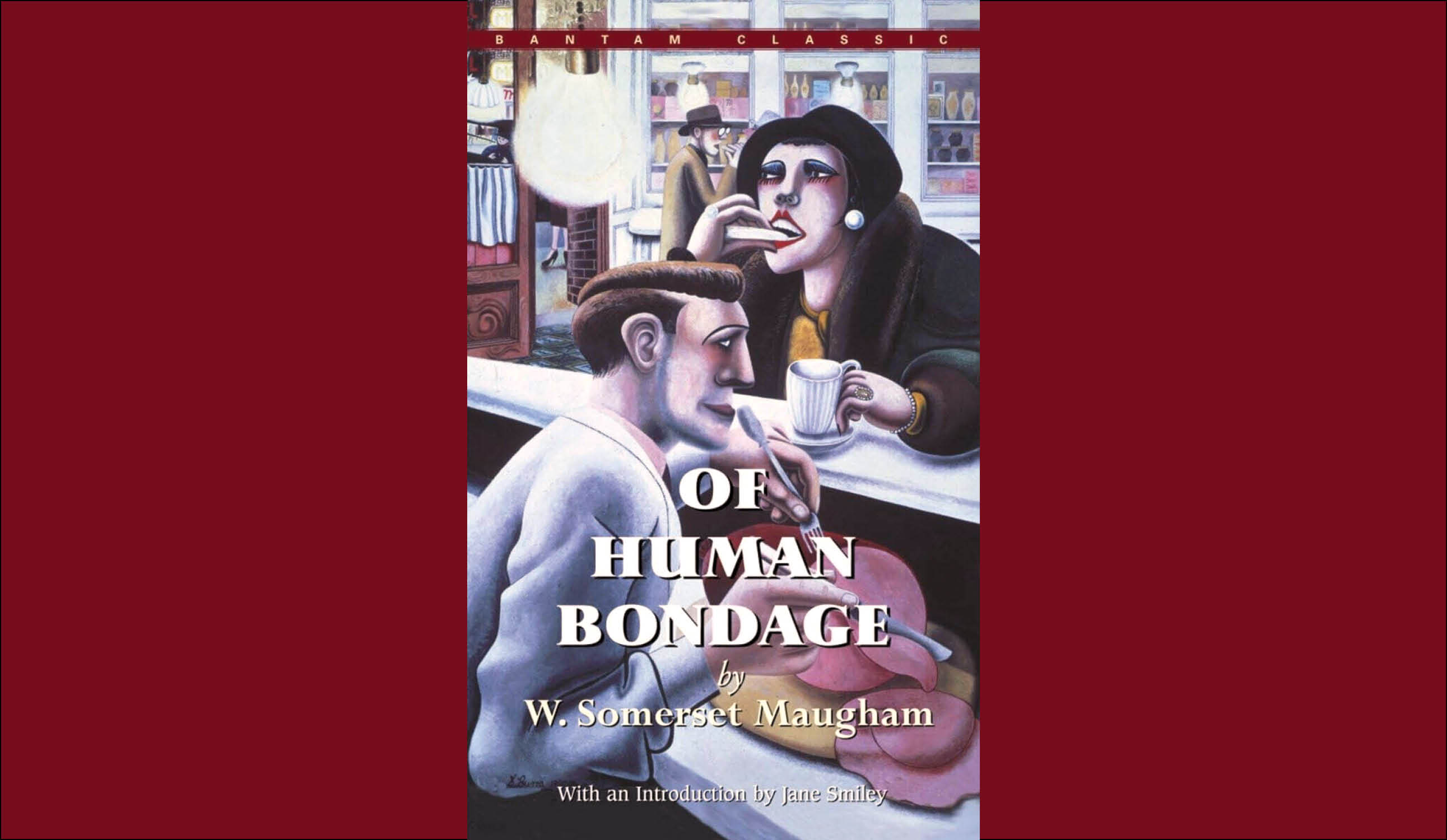
I first read W. Somerset Maugham’s 1915 novel Of Human Bondage when I was twenty years old, in a deliciously compact red Bantam Classic paperback with small print crowded on the page. I remember reading this book mildly hung-over in a narrow airplane seat as I flew home to my parents, the summer before my senior year of college. I was adrift for the same combination of specific and universal reasons that many young people feel adrift: unhappy in love, rudderless at school, flooded with the energy of youth with no meaningful place to put it. My parents had recently divorced, and I was on my way to spend the summer awkwardly shuttling between their apartments, working a boring job to make enough money for cigarettes and beer, scheming to find romance and adventure.
Of Human Bondage follows an English boy named Philip Carey, widely understood as a stand-in for Maugham. Orphaned at a young age, Philip is sent to live with an aunt and uncle who have no idea how to interact with children, let alone a lonely boy with a clubfoot. We watch Philip leave this loveless home for an austere boys’ school, and then watch his fledgling efforts to go out into the world, educate himself, and make a living—as a student of German, a solicitor, an artist, a medical student, a department store worker.
The novel is probably best known for Philip’s debased love of Mildred, a waitress who tears his life apart. Mildred is a major narrative engine of the book, and twenty-year-old me was certainly acquainted with the mortification of being obsessed with someone horrible. But when I think about this novel now, twenty-two years later, what sticks with me are not Maugham’s descriptions of infatuation, but his descriptions of struggling to find your place in the world—and, crucially, the central role that work plays in this determination.
Philip exists in the stratified world of late Victorian England. Although marked as a gentleman by his family background and schooling, he is not rich and slowly whittles down his small inheritance in pursuit of experience, education—and yes, love. Throughout every stage of Philip’s journey into adulthood and self-sufficiency, Maugham provides an accounting of his swiftly dwindling finances. You almost feel like you’re doing your own panicked, messy math on the back of a receipt.
I always loved books, but Of Human Bondage is the book that marked the transition between child and adult reader. When I put myself back in that plane seat, I remember the sense of horrified recognition I felt for Philip, who conducts himself with a combination of willfulness and self-loathing that was deeply familiar at the time, even though I was living a very different life a hundred years in the future. I read the novel just before the moment when I would need to make decisions about my own adulthood. The next few years would be marked by personal and professional fumbling that, while less disastrous than Philip’s, was certainly as haphazard and sometimes as ill-considered.
Eventually, after many disparate jobs, and a combination of luck, work, and privilege, I found my vocation as a writer. And now Maugham haunts my work as a novelist, not only his careful attention to the texture of different jobs, the price tag of things, and the literal cost of our choices—but in showing that a person’s life, and a realist depiction of the world that surrounds them, is more than enough material for a story.
Comments
No comments yet.
Add a Comment