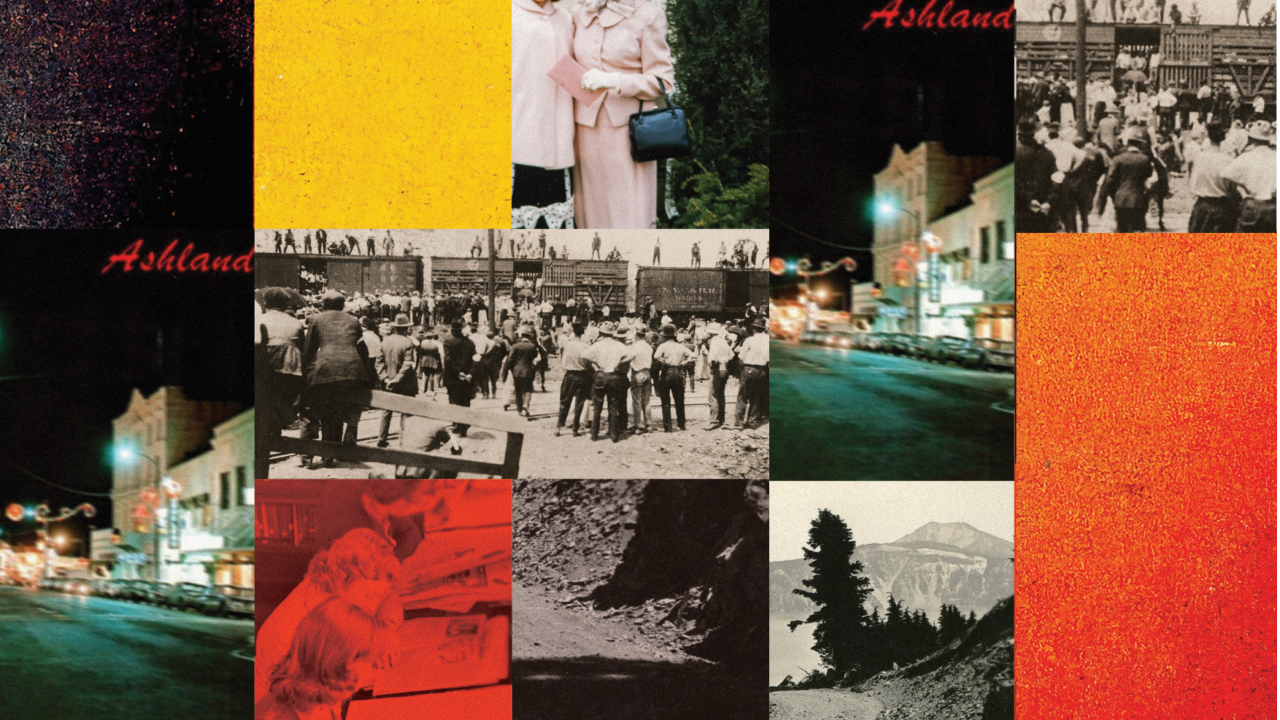
In 1956, celebrated newspaper columnist Faith McCullough warned her Ashland readers of the “brain-washing technique” carried out by communists that was “undermining American values, warping facts, and creating doubts in the minds of youth.” For two decades, McCullough wrote for the Ashland Daily Tidings and Medford’s Mail Tribune, Southern Oregon’s leading newspapers, but I never heard of her in history class at Ashland High School. Nor, until accidentally finding her name in the archives at the Southern Oregon Historical Society, had I ever considered what the Red Scare looked like in Ashland, Oregon. This question would lead me to a history of local fascism—one that remains obscured to this day.
McCullough, who arrived in Ashland in 1947, was not a fringe voice in the anti-communist crusade—she was highly regarded, embedded within what Karl Marx might call Jackson County’s bourgeoisie. By 1971, McCullough was considered important enough within the community that the Ashland City Council passed a resolution “commending [her] for her years of faithful service in reporting the news of the City of Ashland.” But as I would find out, her legacy was not confined to fighting communism. Prior to living in Oregon, McCullough actively promoted Nazism, and for decades, she would use the fear of communism as a vehicle for fascist organizing in and around Ashland.
I am not a professional historian, but a poet and community storyteller. I’m also an anarchist and an antifascist, and I grew up going to a summer camp run by Wavy Gravy, the hippie clown who, in 1968, ran a pig for president alongside Abbie Hoffman to protest the Vietnam War. My parents aren’t anarchists, but my mom turned me on to reading Beat poets and took me to my first anti-war protest when I was in elementary school. My family moved to Southern Oregon when I was thirteen, back when Lithia Park was full of people smoking pot. It was 2004, just a few months after police attacked and tear-gassed protesters in Jacksonville during George W. Bush’s reelection campaign visit. For the past year, I’ve been working on a series of poems about Ashland that combines local history with my personal experience of coming of age during the so-called war on terror. When I first encountered McCullough’s name, I didn’t think much of it—maybe I would find an idea for a poem. There is no biography of her available online, and that absence of easily accessible information sent me looking through the archives, where I would discover painful yet important truths about Ashland’s past.
Typing Faith McCullough’s name into various search engines, the only substantive hits I found were online indexes of the Los Angeles Community Relations Committee (CRC) archives, which are housed at California State University, Northridge, in the library’s special collections. Before the United States joined World War II, the CRC was a Jewish defense organization funded by Hollywood executives to infiltrate and disrupt Nazi organizing in Los Angeles, and McCullough was one of the many people they investigated. CRC’s history is documented in several books, including Hollywood’s Spies by Laura Rosenzweig and Hitler in Los Angeles by Steven Ross. I wanted the source material, so I wrote to the university and requested their folders on McCullough, which they digitized and sent to me via email.
In a CRC report from 1938, a woman named Leslie Fry is described as “the most active fascist in Southern California.” Rosenzweig’s book identifies Fry as “a paid Nazi propaganda agent who had been sent to the United States by the Third Reich to promote Nazism in the United States” and to unite different fascist movements, including the Nazis and the Ku Klux Klan. The archival CRC reports reveal that Faith McCullough, who sometimes operated under the alias Frances Maxey, was Leslie Fry’s secretary.
Skilled at public relations, McCullough was noted for “her technique of shrouding everything behind the word ‘Christian.’” In the late 1930s, she and Fry ran an American branch of the Militant Christian Patriots, an antisemitic organization, and published the Christian Free Press, which historian Steven Ross describes as “an anti-Semitic newspaper modeled after Germany’s infamous Der Stürmer,” a tabloid that peddled hate in Nazi Germany.
Communism was a natural enemy for Nazi agents like Fry, who thought of “the Jews” and “the communists” as one and the same—a conspiracy theory known as “Jewish Bolshevism.” This belief led Fry and McCullough to encourage the House Committee on Un-American Activities, also known as HUAC, to investigate alleged Jewish communists. The CRC documents include transcripts of Fry and McCullough strategizing about what information to provide to HUAC in 1938, well before Senator Joseph McCarthy became the face of anti-communist activity in the US government. As was the case at many of the meetings documented in the CRC archives, the women did not realize that an antifascist infiltrator was recording their private conversation while they discussed how to smear the local chapter of the Anti-Nazi League, Hollywood film directors, and Jewish community leaders.
By the late 1930s, HUAC was investigating alleged Nazis as well as communists. Fearing repression, Fry fled the country. Records show that she eventually returned to the US, but was interned on Ellis Island for the duration of World War II and was indicted, though not convicted, in a pre-war plot to overthrow the US government.
As the US entered the war, other aspects of the CRC’s work continued, but their infiltration program was deprioritized. Nazis were now official wartime enemies of the United States, and McCullough was scared. A report from January 1942 describes a conversation McCullough unknowingly had with an infiltrator, in which she expressed panic about communist takeovers and secret agents, and rambled about a naval intelligence agency that was coordinating political repression of fascism. “We must have a counter revolution to save the nation,” the notes quote her as saying. “A leader must rise, now there is nothing to do but wait.”
It’s unclear from the records why McCullough and her husband moved to Ashland five years later. Southern Oregon had for decades been home to laws and practices that allowed racial exclusion and promoted White supremacy. Many of the area’s Shasta, Takelma, and Latgawa people were forcibly relocated from their ancestral lands during the 1850s. The gold rush and railroad booms attracted larger populations of Black, Chinese, and Jewish people to Jackson County, but those populations had mostly declined a few decades later. By 1950, Southern Oregon historian Kay Atwood reports, there were only twelve Black people and five Chinese people living in Jackson County.
When McCullough arrived in Ashland, she was stepping into a town that had its own long history of radical organizing and an equally long history of suppressing it.
In the 1890s, a nationwide agrarian populist movement called the People’s Party, which was influenced by a number of socialist ideas, developed a significant following in Southern Oregon. Along with a progressive income tax and publicly owned utilities, socialists on the West Coast often advocated White supremacy—a history told in Gia Vogerl’s book Deconstructing Settler Socialism—and the People’s Party platform included an anti-Chinese ban on “alien ownership of land.”
In 1912, the small town of Talent, located directly north of Ashland, elected Oregon’s first socialist mayor, William H. Breese. At the same time, members of a much more radical group of socialists and anarchists called the Industrial Workers of the World (IWW), also known as the Wobblies, were being highly repressed. The diaries of prominent Talent resident Willis John Dean—who was friends with Breese—provide an example of how the IWW was viewed. As transcribed on local historian Ben Truwe’s website, “Southern Oregon History, Revised,” Dean wrote in 1917 that “the worst menace we have at home is the I.W.W. . . . shoot ’em on the spot when caught should be the rule.” [Author’s italics.]
Formed in Chicago in 1905, the IWW was active in multiple countries and supported numerous liberation movements, including the Mexican Revolution, where the union was aligned with the anarchist Magonistas. In addition to miners and timber workers, the IWW welcomed unemployed people into its ranks and provided a revolutionary political platform for freight-hopping hoboes. Once the Southern Pacific Railroad arrived in Ashland in 1887, thousands of hoboes began passing through, and the town worked to discourage their presence, alternating between voluntary and forced overnight housing, arrest, displacement, and forced labor. By organizing hoboes, the IWW posed a political threat to towns like Ashland.
If an IWW member was arrested somewhere for public speaking, Wobblies from across the West Coast would travel to the location to initiate mass civil disobedience. In 1911, for instance, two hundred IWW members hopped a freight train from Portland to join a free-speech fight in Fresno, California, but were kicked off the train in Ashland. Facing confrontations with the police, the group decided to walk to California, crossing Siskiyou Pass during a snowy February winter.
Wobblies around the country were also targeted for being conscientious objectors during World War I. After the war ended, a 1919 editorial in the Jacksonville Post declared that IWW members should be “round[ed] up” and deported en masse, adding that “the people of Jackson County may indeed be grateful for the absence of such scum from our precincts.” The IWW weren’t the only ones experiencing repression at this time; nationally, thousands of radicals were arrested between 1919 and 1920, when more than five hundred anarchists and leftists were deported during the Palmer raids.
Like many Western states, Oregon passed an anti-syndicalism law targeting the IWW. According to the Oregon Encyclopedia, “the state laws sought to silence dissenters, punish agitators, and destroy radical organizations.” In Oregon, the law effectively made it illegal to distribute IWW literature. In 1934, local and state law enforcement raided the office of the Cannery and Agricultural Workers’ Industrial Union in Medford, a group police alleged had ties to Russian communists as well as the IWW. Police confiscated the union’s literature and membership lists. The union “unless stepped upon at the start will spread rapidly, and be a constant source of trouble,” reported the Mail Tribune. After reviewing the membership lists, the Tribune declared: “The Jackson County court . . . [will] strike from its relief lists all members of any communistic organizations engaged in activities having as a purpose the attempted overthrow of the American form of government, or creating of labor discord.” A few months later, the Tribune reported that another alleged union organizer, Kyle Pugh, was arrested for distributing leftist pamphlets while in possession of IWW membership cards.
Fear of dissidents led to the persecution of another group in Southern Oregon: Jehovah’s Witnesses, the millenarian Christian sect that also practiced conscientious objection. In 1918, the Ashland Daily Tidings reported that Medford’s mayor had banned a preacher named Pastor Taliaferro and ordered him out of the city. Taliaferro fled to Ashland with a local mechanic named George Maynard, but a mob of seventy-five vigilantes hunted them down. The mob dragged Maynard to a local baseball park, intending to tar and feather him. When they couldn’t find tar, they covered him in printer’s ink instead. “Leaders of the vigilantes are reported to have said that their work had only just begun,” reported the Tidings. “All disloyal citizens had better walk chalk and be good.” Perhaps it is no wonder that Faith McCullough’s anti-communist editorials were welcomed by the paper three decades later.
While living in California, McCullough advocated for fascists to organize under a “cell plan . . . no one except the leader should know who is in the organization.” Snippets of Faith McCullough’s activities were recorded due to the CRC’s efforts to infiltrate and expose her, but no such records exist from her time in Oregon.
As I talked about McCullough to staff at the Southern Oregon Historical Society and Jackson County Library Services, I found that no one knew much about her. The research librarians in Ashland located obituaries and genealogical records for Faith (Hawk) McCullough and her husband, which showed that the couple married in Illinois before moving to the West Coast. Once in Ashland, the McCulloughs lived on Church Street. Faith was the society editor of the Ashland Daily Tidings from 1951 to 1960, and worked as the Ashland correspondent for the Mail Tribune until her retirement in 1973. She died in 1979. Her husband, William Brownlee McCullough, was Deputy Jackson County Assessor; he retired a year before his death in 1962. The Tidings described him as a “respected member of this community.”
I found more information on McCullough, including copies of her columns, in the newspaper archives held by the University of Oregon and Southern Oregon University. In 1959, her Ashland Daily Tidings column—which focused on everything from traffic and juvenile delinquency to the scourge of communism—won first place for editorials in the Oregon Press Women awards. The Tidings reported that she won Ashland’s Woman of the Year award, presented by the American Association of University Women, in the early 1960s. Both Faith and William were leaders in the First Presbyterian Church of Ashland, where the pastor, George M. Shuman, preached about the evils of communism.
The Tidings gave significant press coverage to McCullough’s local speeches, which had titles like “The Biblical Basis for the Constitution” and “The Menace of World Government.” During a 1953 talk at the Soroptimist club, recounted in the Tidings, McCullough said she became aware of communism in 1930 and had since spent “all of her time and effort” combatting the Red Menace. In 1957, she declared in her column that “the United States has alternatively coddled and condemned Communism while the red control swallows nation after nation and takes millions into slavery.”
From the material in the CRC archives, it’s clear which political groups McCullough opposed in Los Angeles, as she discussed her communist enemies with Leslie Fry and others. Her anti-communist rants in Ashland, however, are surprisingly vague as to who—if anyone—McCullough thought was involved in local leftist politics. Perhaps she considered herself more of a watchdog, preventing communism from returning to Southern Oregon after the first Red Scare.
The Daughters of the American Revolution (DAR), which openly promoted McCarthyism through their “national defense” committees, provided a major platform for McCullough. She worked her way through the organization’s ranks, first joining in 1923 before holding leadership positions in the Hollywood chapter and serving as California’s state chairwoman of national defense. She continued on in Ashland, serving as regent from 1952 to 1956, and later as first vice regent.
The Southern Oregon Historical Society has a box of archival materials dedicated to the Mt. Ashland chapter of the DAR, complete with newspaper clippings, member lists, and a lot of anti-communist literature. While the staff made photocopies of these documents for me, we wondered together about their significance and found numerous items bearing McCullough’s handwriting, name, and initials.
One particular document in the collection stood out: a single typed sheet of paper labeled “books available for chapter circulation,” which lists seventeen titles, many of them typical 1950s anti-communist texts. Three of the listed books, however, were written by Lothrop Stoddard, an American eugenicist and member of the Ku Klux Klan whose writing influenced the German Nazi party. Two books were written by Nesta Webster, the conspiracy theorist who believed that Jewish communists were part of a centuries-old plot backed by the Illuminati to take over the world.
Founded in 1890, the Daughters of the American Revolution does not identify as a fascist organization. In order to join the group, each member must prove they descend from a “patriot” who served in the American Revolutionary War. The Mt. Ashland chapter of the DAR was founded in 1920, and its members included some of Ashland’s most prominent families, including the daughter of Captain John McCall, who founded the Ashland Daily Tidings. A major focus of the DAR was whitewashing the genocidal history of Ashland’s settlers. Their events often included speeches about these settlers, and multiple written accounts of colonization—told from the perspective of the settlers—are held in the Southern Oregon Historical Society’s DAR collection.
“America’s founders were rugged individualists of deep religious convictions willing to risk lives and fortune to gain their ideal of freedom under God,” McCullough wrote in 1957. But she worried this history was being suppressed by communists, claiming young, presumably White people were being “deprived of their rightful heritage.”
Through the DAR and the Tidings, McCullough was able to position herself in direct relationship to Ashland’s past. She used the rhetoric of Christianity to promote Nazism during her time in Los Angeles, and in Ashland she used Christianity to write propaganda for colonization. “The covered wagon pioneers of a century ago took with them not only their choicest material possessions but their cherished Christian faith,” she wrote in a 1952 full-spread article for the Tidings commemorating Ashland’s earliest churches.
As I read these lines from McCullough, I thought about the words of historian David G. Lewis, who is a member of the Confederated Tribes of Grand Ronde. His essay “Settler Colonization in the Oregon Territory,” published on his Quartux Journal blog, describes how the genocide of Native Americans—during which an estimated ninety million people were killed—was enabled by Christian rhetoric. “Most settlers were Europeans, and were Christians in some form,” Lewis writes, “aided in their righteous war on Native peoples by their religion and religious interpretations of natural laws.”
McCullough’s story also points to a historical bridge between colonization and fascism. As described by artist Gord Hill, an anarchist and a member of the Kwakwaka’wakw nation, in his Antifa Comic Book: “Fascism is ultimately a product of European colonialism and imperialism, its roots stretching back as far as the Roman empire. . . . Its world view and culture [are] shaped by centuries of war, patriarchy, and white supremacy.”
It was common during the Red Scare of the 1940s and ’50s for artists and playwrights to be accused of communist connections. Surprisingly, McCullough wrote glowing reviews of the Oregon Shakespeare Festival (OSF)—one of Ashland’s most beloved cultural institutions—and her obituary reported that she “actively worked” for the organization.
In the 1950s, the festival collaborated with the Daughters of the American Revolution and with Voice of America, a government-sponsored shortwave radio program disseminating American propaganda into communist countries during the Cold War. At one point, McCullough declared that OSF founder Angus Bowmer had “done for Oregon what no printed propaganda could ever hope to do.”
But the Oregon Shakespeare Festival was a contested space. Ashland was still a sundown town in 1950, when a Black college student from California named Patricia Tatum (née Norman) was cast as a courtesan in an OSF production of The Comedy of Errors. The clearest record I’ve found of her time here is an audio recording on OSF’s YouTube channel featuring the voice of Carl Ritchie, a company member at OSF.
Unable to rent a room due to racial discrimination, Tatum lived in the dorms at Southern Oregon University. Because she faced racist violence from local townspeople, an ad hoc group of OSF actors, including Ritchie, served as Tatum’s bodyguards when she traveled through town. “We had to fight our way out of these situations,” Ritchie explained. It was a social struggle fought by “the nobody kids from out of town” who came to Ashland as theater actors. OSF did not intervene, according to Ritchie, because Bowmer believed “if he took this thing up as a racial cause . . . it would only darken the festival’s position in the town.” If McCullough noticed that this was going on, she didn’t mention it in her positive review of The Comedy of Errors.
I don’t know the politics of Patricia Tatum, Carl Ritchie, or the other young actors who fought alongside Tatum in Ashland. But they took an approach often used by antifascists called “direct action.” Rather than waiting for an institution, the police, or the government to “fix” the problem, the youth formed an autonomous security team, taking personal responsibility for Tatum’s safety. Today this type of community defense is represented by the popular leftist slogan “We keep us safe.”
It might be tempting to think Faith McCullough used subterfuge to sneak her way into the elite corners of Ashland. I’m not convinced. I think people like McCullough are bound to rise to power in a town—and a nation—built on colonization and White supremacy. If Faith McCullough were alive today, I imagine she’d be ranting about the threat of “antifa,” which is short for antifascist. She would welcome the National Security Presidential Memorandum-7, last year’s executive order labeling “antifa” as a domestic terrorist organization.
As was true during the Red Scare, there are many misconceptions about radical politics today. I would never claim to be an authority on anarchy. For me, anarchism means a world without empires and their endless wars, but I don’t have a step-by-step process for revolution. I’m just a poet in a small Oregon town who thinks politicians aren’t going to save us; a better world is something we have to imagine and create through grassroots community. I support efforts that encourage mutual aid, collective organizing, and returning land to Indigenous peoples, also known as the Land Back movement. Writing can be an antifascist act, and the path to becoming an anarchist—if that’s what you want to do—can be as simple as volunteering at a community meal or helping support our neighbors when they’re being targeted by deportations or racist violence.
History, to paraphrase the Irish author James Joyce, is a nightmare from which we are trying to awake. By learning about Ashland’s past, I hope we can find our way to a different future.

Derek DeForest is a writer and community organizer based in Southern Oregon. He was a 2023 Oregon Humanities Community Storytelling Fellow writing about people’s experiences of voices and visions. Derek is currently working on a series of poems about Ashland.
Comments
2 comments have been posted.
This is an incredible article & most of us have never heard of this awful woman. I qualified for a DAR scholarship many decades ago , ironically 3 Muslim brothers from Turkey, who settled in NJ are my connections to DAR. I refused their scholarship as I have no love for this organization that only shames our relatives who fought bravely in the American Revolutionary War! I remember seeing old photos of the shameful KKK marching through downtown Ashland in their robes & hoods. I came to Ashland in 1978 & believe that the sundown laws were still in effect in Oregon then. Thank you for a very eye opening article!
Peggy Wallar | August 2026 | Ashland, Oregon
Hi Derek, I got a lot out of your article. Somewhat long for some folks. I have had long interest in IWW and labor organizing especially in Oregon and NW. Certainly we all know about the KKK history in southern Oregon. But your history of fascist organizing is something that few people know about My spouse and I moved to Ashland in 85 and both of us are involved in local organizing. I have been a long member of Democratic Socialist of Americal New chapter is getting going I was hoping you might write some more about how the history you have descriped connects to the anti facsicst work in Oregon and southern Oregon.
Rich Rohde | August 2026 | 97520
Add a Comment