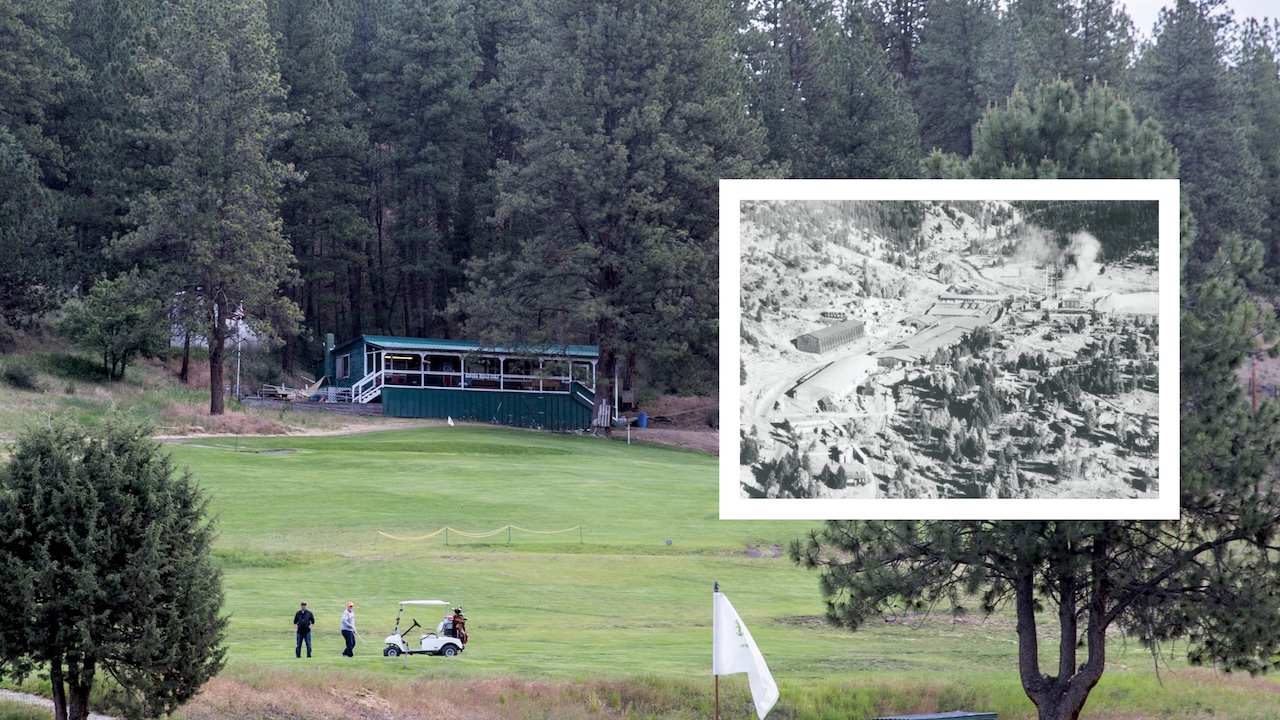
It’s May 17, the day of the season-opening Kickoff Scramble at the Kinzua Hills Golf Club, and the rain is coming down in buckets. A handful of people have gathered in the rustic clubhouse, tucked into an out-of-the-way corner of Wheeler County, for a pre-tournament breakfast of biscuits and gravy.
One of them is Tom McNeill, board president of the nonprofit that owns and operates the golf course. He’s seated at a table near the door with the tournament sign-up sheet by his elbow, his arms folded across his chest and a contented smile on his face. He doesn’t seem too worried about the weather.
The door bangs open as a big man walks into the room and stops to stand in front of McNeill.
“We golfing today?” he asks.
“Doesn’t look like it,” the club president replies, still smiling.
“That’s okay,” the big man responds, setting the fifty-dollar check for his entry fee on the table. “It’s all a donation anyway.”
The scene repeats itself again and again as the tournament’s scheduled start time comes and goes. Golfers wander into the wood-paneled clubhouse, shake the rain off their Gore-Tex parkas or buffalo-plaid wool shirts, hand over their entry fees, and sit down to a plate of biscuits and a cup of coffee. This is supposed to be the dry side of Oregon, and it’s the first time anyone can remember the annual tourney being rained out, but nobody seems to mind—the atmosphere is relaxed and the conversation flows freely.
Kinzua Hills is an Oregon oddity: Rather than the regulation eighteen holes, it only has six. In fact, it’s the only six-hole golf course in the state, and one of just forty-one nationwide. For many years the club has claimed the distinction of being the only six-hole course west of the Mississippi that’s sanctioned by the United States Golf Association, the sport’s governing body. (Sadly, that’s no longer the case—a USGA official says the Creek 6, a six-hole course in Sparks, Nevada, that opened in 2020, has recently been rated by the organization.)
It’s also a historical relic, the last remaining vestige of the former lumber company town of Kinzua, which flourished on this site for half a century before the owners closed it down in 1978, in the waning days of Oregon’s timber boom.
And for many in this remote, rural corner of the state, it’s a living link to a happier, more prosperous past.
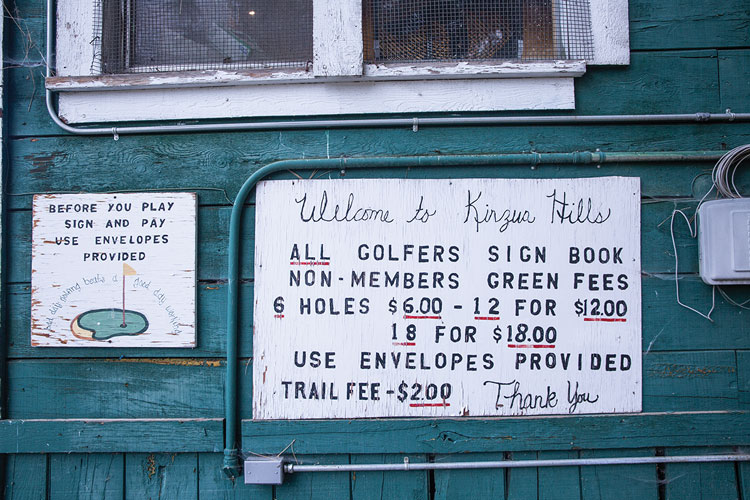
Kinzua Hills Golf Club. Photo by Joni Kabana
The townsite of Kinzua (it’s pronounced KIN-zoo; the a is silent) is located about ten miles east of Fossil, the seat of Wheeler County, in a small valley near the head of Thirtymile Creek, about 3,400 feet up in the pine-clad ramparts of the Blue Mountains. It was founded in 1928 by E. D. Wetmore, a Pennsylvania lumberman who had bought up fifty thousand acres of prime timberland around the West to serve as headquarters for his business, the Kinzua Pine Mills Company. The name Kinzua, also an import from Pennsylvania, originated in a Seneca word meaning “fish speared there.”
Wetmore started out by building a sawmill on the site, but he quickly realized he needed housing for his workers, and a town soon sprang up around the mill. Kinzua Pine Mills was a major operation, with a log pond, carriage-fed band saw, planer, green and dry chains, kilns for drying lumber and a warehouse for storing it, covered loading docks, administrative offices, equipment sheds, repair shops, and a power plant. There was also a glue room, for finger jointing small pieces of scrap wood into usable lumber, and a factory for fabricating door and window frames, porch and lawn furniture, trim molding, and other finished goods.
The company specialized in ponderosa pine and proudly labeled all its products with its distinctive circle-K Kinzua brand. Much of the wood came from the firm’s privately owned and independently certified tree farm, although it also bid on timber sales in the surrounding national forest lands.
Kinzua Pine Mills employed its own logging crews, who worked out of a series of camps in the woods around the town, and sometimes used independent contract workers known as “gyppo loggers.” (Coined by the Industrial Workers of the World during the Pacific Northwest loggers’ strike of 1917–18, the term was originally a slur against nonunion workers.) To get the freshly felled trees to the mill, the company set up what it called a “dual logging system,” with a fleet of log trucks, a network of logging roads, and its own standard-gauge railroad. Mechanized equipment was used to drag the logs out of the woods and load them on semitrailers and railroad cars.
To get the finished lumber to market, Kinzua Pine Mills constructed its own short line railroad, the twenty-four-mile-long Condon, Kinzua & Southern, which connected to the transnational Union Pacific rail network at Condon. The CK&S started out using steam engines and eventually upgraded to a seventy-ton diesel locomotive. In addition to hauling logs, the line also offered mail and passenger service by means of a self-propelled railbus nicknamed “The Goose.”
The same level of planning, organization, and care went into the layout and development of the company town of Kinzua. By all accounts, the homes erected for workers and their families were well-built, modern, and comfortable. Rent was modest—less than a hundred dollars a month for a four-bedroom home as late as the 1970s. Water, electric, and garbage service were provided free of charge. Bunkhouses offered accommodations for single men.
Kinzua had its own post office, which opened in 1928, the same year as the mill. It had its own school, which looked after the education of employees’ children through the eighth grade; older kids rode the bus into Fossil, where they attended Wheeler High School. (Kinzua School closed in 1964; after that, all the town’s children were bused to Fossil for their schooling.) A first-aid station, staffed by a full-time nurse, handled most of the community’s medical needs.
Like other company towns, Kinzua had a company store, where residents could buy just about anything they needed, from groceries to household goods, clothing, and even furniture. Workers could charge their purchases against their wages, putting them on what the company called a 2-B account. The balance was deducted from their next paycheck.
That pretty much covered the basics, but there was much more to Kinzua than the basics. It had its own church. A building known as the Pastime housed a café and a tavern. There was a community hall that was used for meetings but could be, and frequently was, pressed into service as a dance hall, movie theater, and roller-skating rink. There was a library, a telephone exchange, a hotel, a barbershop, and a beauty parlor.
Nor did the company neglect the recreational needs of its workers and their families. There were fishing ponds stocked with trout, a Scout camp, a gun club, a small ski area. At one point, the town had its own semipro baseball team, which traveled the sandlot circuit to compete against other squads from around the region.
And, of course, there was the golf course.
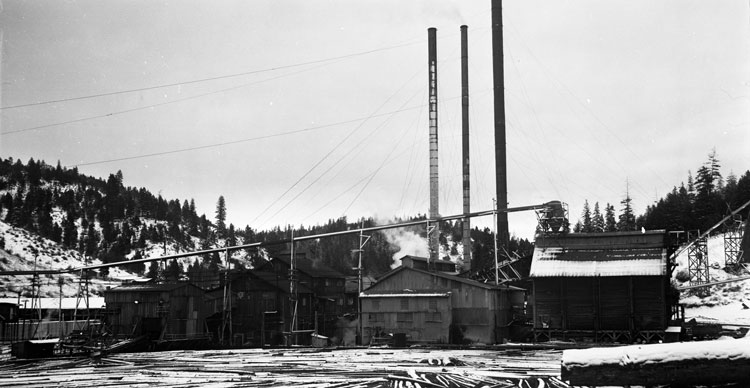
Kinzua Pine Mills. Photo by Jerry Lamper
By any ordinary metric, Kinzua Hills is a very small golf course.
Sited alongside Thirtymile Creek, the course fills a short section of narrow valley bottom and climbs partway up one steep hillside, fringed by mature ponderosas and the occasional juniper. The clubhouse, perched above the sixth green and the first-hole tee box, has a comprehensive view of the course—you can see almost all of it from the porch.
With only six holes, players have to make three circuits to complete a regulation eighteen-hole round of golf. The first hole also serves as the seventh and the thirteenth; the sixth doubles as the twelfth and eighteenth. To mix things up, players use the long tee boxes on the first and third go-rounds, shorter ones on the second. Played this way, the course is 4,232 yards with a par of sixty-five for eighteen holes.
It has just two sand traps, each roughly the size of a backyard sandbox, and a single water hazard, a pond that supplies the irrigation system. The club doesn’t own any golf carts, although members—there are about ninety at present—can store their personal carts on-site, and a few will rent theirs out to visiting golfers. Annual dues are $150 for an individual, $250 for a family. Greens fees are a dollar a hole, and everything’s on the honor system—just leave your money in the box mounted on the clubhouse wall.
The season generally runs from April through October, depending on the weather. If you’re playing midweek, you might not see any other golfers, although you might have to share the fairways with deer or elk. Occasionally cattle from a neighboring ranch will find their way in, and once in a while a bear will amble through.
Kinzua Hills Golf Club members are proud of their compact little course, with all its quirks. As the rain continues to fall on Kickoff Scramble day, they share some of their favorite stories
in the pine-paneled clubhouse.
There are no scratch golfers among the membership, although there are a handful with handicaps in the single digits, but Kinzua Hills has humbled its share of visiting hotshots.
“We had an incident a few years ago,” McNeill begins. “We had a scratch golfer come in here. He hit two shots out of bounds. He went home! He had enough. It’s a challenging course.”
That gets a laugh out of Pat Hyatt, the club’s secretary and treasurer. She’s a Kinzua lifer—her family moved there when she was two years old. She grew up in the town, met her future husband there, and worked for the company as an accountant for forty years. She moved to Heppner in 1975, when the company shifted some office operations to its mill there, and was still in the job when Kinzua was shut down and busted up three years later.
“That was my boss from Heppner,” she crows, grinning at the memory. “Let me tell you, I ribbed him big-time!”
Tom Edmunson looks up from his breakfast to add his two cents.
“I think this golf course has the toughest par 3 in the state,” he declares.
That would be the twelfth hole. On the first and third times around the course, when it serves as the sixth and eighteenth hole, respectively, golfers use the long tees and play it as a fairly manageable 219-yard par 4. Played from the short tee as No. 12, the hole is reconfigured as a 196-yard par 3. The distance is not particularly daunting for a strong driver—but the hole climbs steeply from tee to green, making it extremely tough to finish in just three shots. Bogeys abound on the twelfth hole.
Larry Smith describes another of the course’s unexpected pitfalls: “It takes out a lot of golfers because the greens are so small.”
It’s true. Due to the limited available real estate at Kinzua Hills, its greens are tiny—smaller than the tee boxes at a lot of fancier courses.
Then there’s No. 1, which doubles as Nos. 7 and 13 and hugs the creek bank along one edge of the course. Everything left of the fairway is out of bounds.
“About five years ago, my son and grandson came out,” recalls Ben Massey, the greenskeeper at Kinzua Hills. “My grandson went walking down the creek. He found forty-two golf balls.”
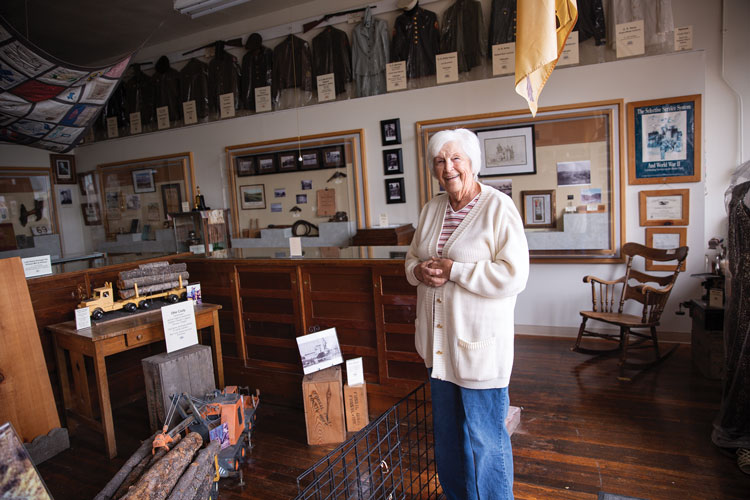
Pat Hyatt at the Fossil Museum. Photo by Joni Kabana
In its heyday, Kinzua was the most populous community in Wheeler County, with as many as 700 residents in 1965. Today, according to the most recent estimates, the whole county has a population of just 1,483; the largest town is Fossil, with 450 residents.
When Kinzua shut down in 1978, it didn’t come as a surprise—but it was still a shock. Even though no one had started talking about the northern spotted owl, Oregon’s timber industry was already starting to decline. The Condon, Kinzua & Southern Railroad, the Kinzua mill’s economic lifeline, was badly in need of repair, and the state had ordered the town to replace its antiquated septic tanks with a modern sewer system—both ruinously expensive undertakings. Meanwhile, the company had already shifted some operations and personnel to its recently acquired mill in Heppner.
Company officials gave employees plenty of notice of their intention to shut down the mill at Kinzua and break up the town, making the announcement a full year ahead of time. Still, when the last board came off the saw and all the remaining families had to leave, it felt like a punch to the gut.
Pat Hyatt recalls a jarring sense of dislocation.
“When we moved out to Heppner, I found out there were two classes of people. In Heppner we were the mill people, and the city people didn’t like the mill people,” she says today.
“It was scary,” she adds. “I had never lived where I didn’t know everybody. It was a real transition.”
“It was like your family died,” says Marilyn Garcia, who was born in Kinzua in 1939, the daughter and granddaughter of Kinzua Pine Mills employees. Although she never worked at the mill herself, Garcia spent much of her childhood in the company town and recalls her time there as nothing short of idyllic. She remembers fishing in the creek and catching crawdads with her friends, roller-skating on Fridays and going to the movies on Saturdays, the way the whole town would turn out for school events.
“It was like an extended family,” she recalls. “Everyone knew everyone.… If you got in trouble, somebody wouldn’t mind swatting you.”
Today Garcia is one of the dedicated volunteers who maintain the Fossil Museum, where a whole room is devoted to Kinzua artifacts and memorabilia. When the town broke up and all those families scattered, Garcia says now, the impact was felt throughout Wheeler County.
“It was devastating.… A whole way of living changed for the entire area,” she says. “There was all kinds of businesses here, all the lodges were active, the booster club.… In the space of ten years, probably, everything faded away.”
“It was hard on businesses in Fossil,” agrees McNeill. Like Hyatt and Garcia, he grew up in Kinzua, and worked there for nine years until the mill shut down.
“There used to be three grocery stores in Fossil,” he adds. “There used to be three or four gas stations, three car dealerships. Now it’s just a ranching and retirement community, pretty much.”
Jerry Luther’s ties to both Kinzua and its golf course run deep. Growing up in the company town, he joined the golf team in high school and lettered in the sport. After pursuing his education at Blue Mountain Community College, he came back and was hired on at the mill.
“I graduated on a Thursday at Pendleton in diesel mechanics and went to work at Kinzua on Monday,” he says with pride.
He started out working in the truck shop as a mechanic in 1971, then became a log-truck driver. But just seven years later, Kinzua’s magical ride came screeching to a halt. Luther was there at the end.
“I come over here and hauled the last of the lumber out of here,” he recalls.
And just like that, he was out of a home and out of a job, another economic refugee cast adrift by the Oregon timber industry’s changing fortunes. For a while he was able to follow the work around the state, hauling logs to Prineville and other mill towns, but the jobs got scarcer as more and more mills closed their doors, shuttered by shrinking timber supplies, industry consolidation, and other market forces.
But eventually, like so many other former Kinzua residents, he found his way back to the area, settling in Fossil, where he worked for the city and then for Wright Chevrolet. He retired from the dealership in 2014—and promptly got a job at the golf course, where he worked as the greenskeeper from 2015 until 2023.
He likes to tell visitors about the history of the golf course, which was built in the 1930s with sand instead of grass for the greens. For a time it was taken over as a playing field for the baseball team until being converted back into a golf course in 1951. In 1978, when the town broke up, the course was left to the care of the golf club, although it took some years of fundraising and wrangling with the land’s new owners before the deed was handed over.
Improvements were made over the years—real grass for the greens, a flush toilet to replace the outhouses on the fourth hole, an updated sprinkler system. And when improvements were made, it was always local volunteers leading the way.
“It was created by the people who lived here,” Luther says.
Many of the former residents are gone now, and time is slowly catching up with the rest. But Luther is hopeful about the course’s future, in part because of the “hill people”—retirees and weekenders from the Bend area who have discovered the magic of Kinzua and built cabins in the hills above the course.
“If it wasn’t for the hill people,” Luther muses, “we probably wouldn’t have a golf course. They donate so much. And they bring all the people from Bend with ’em.”
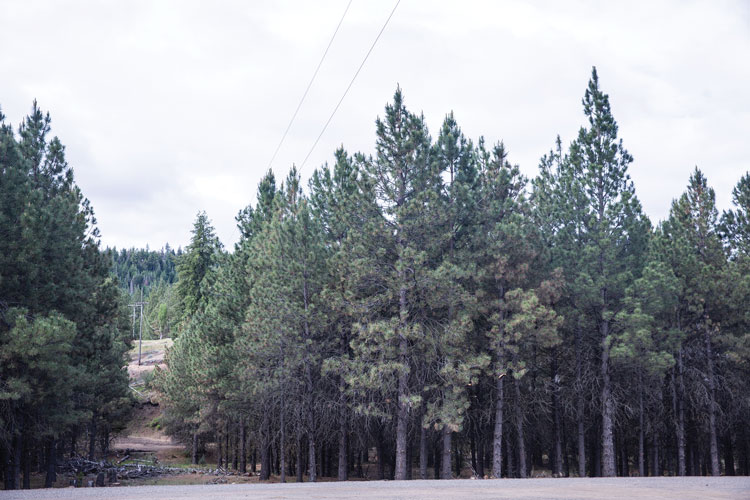
Near the Kinzua townsite. Photo by Joni Kabana
If you go looking for the townsite of Kinzua today, you’ll have a hard time recognizing the place.
After the mill shut down and the last load of lumber was hauled off in 1978, the company allowed residents to buy the homes they’d been living in for a token amount. Some were moved to new locations; others were disassembled, cannibalized for building materials. One by one, all the houses that once made Kinzua a community were removed from the site.
A contractor was brought in to take apart the big industrial buildings and scrap the equipment. While that work was underway, a fire broke out and burned virtually every last structure to the ground. The blaze was widely believed to be arson.
In 1982 the former townsite was planted with forty thousand trees, mostly ponderosa pine, which have not been thinned since. The trees grew close-packed and scraggly. Today they cover the former logging company town in a shaggy dog-hair forest that would make any self-respecting timber cruiser shake his head.
One original building still stands, a metal-walled structure that once housed the glue room.
Aside from that, the only thing that remains is the golf course. Its connection to Kinzua’s past is one thing that keeps McNeill coming back. At Kinzua Hills, he can be around some of the other old-timers, people who still remember the company town where they lived and worked and made memories together. In that sense, the golf course itself is a kind of community.
“It really is,” he says. “That helps.”
Thinking about the history of the place, he grows philosophical. “One thing about golf, you come out here and you forget about everything else—I’m sure that’s the way a lot of people feel,” McNeill reflects.
“When I was working, that was always on my mind,” he continues. “But when I come out here, I don’t have to think about that. And I don’t—I just come out here and have a good time. Play a round of golf.”
Company Towns of Oregon
At one time or another, Oregon was home to around three dozen company towns, nearly all of them associated with the timber industry. While similar planned communities in more heavily industrialized parts of the country were often geared toward controlling an unruly workforce, those in Oregon primarily seem to have been a response to the isolated locations of the logging and lumbering operations they supported.
Most of Oregon’s company towns came into existence in the first half of the twentieth century, and none survived in that form into the twenty-first. Some live on as more conventional communities today—Seneca, Hines, Westfir, and Brookings were all created as workforce housing for timber company employees.
Others, like Kinzua, were completely dismantled after logging and milling operations shut down, their former residents scattered to the four winds. That was the case with communities such as Valsetz in Polk County, Wendling in Lane County, and Dee in Hood River County.
SHEVLIN
Shevlin, another long-gone lumber town, occupied at least four different locales during its brief span of existence. Established around 1931 in Deschutes County by the Shevlin-Hixon Company of Bend, by 1932 it had moved to a new site in northeast Klamath County. All
of the town’s buildings were designed to be transported by rail. Once the standing timber around the town was logged out, the company would load the worker housing and other structures onto flatcars and move them
to a fresh field of operations. Shevlin-Hixon moved its rolling log camp at least three times before calling it quits and scrapping the town in 1951.
PONDOSA
Pondosa, near Medical Springs in Union County, is now a virtual ghost town, although a sign advises motorists passing through on Oregon Route 203 that the former company town sits at the geographic center of the United States (with Alaska and Hawaii factored in).
MAXVILLE
Maxville, in Wallowa County, was abandoned in 1933 after the Bowman-Hicks Lumber Company halted local operations in the grip of the Great Depression, but the company town’s unique history has kept its memory alive. Bowman-Hicks was headquartered in Missouri and imported workers from the South, including forty to sixty African Americans—Wallowa County’s only Black residents at the time. Employees and their families were segregated by race in Maxville, with separate schools, housing, and baseball teams, although Black and White loggers sometimes worked alongside one another in the woods, and the baseball teams
occasionally joined forces to compete against rivals from other counties. Today, the nonprofit Maxville Heritage Interpretive Center in Joseph works to preserve the history of the vanished timber town.
GILCHRIST
The last of Oregon’s company towns was Gilchrist. It was founded in 1938 by the Gilchrist Lumber Company, which continued to look after the basic needs of its employees and their families—from housing to shopping, education, and entertainment—until 1991, when the mill was sold to Crown Pacific, which laid off the entire workforce. Some of the former employees stayed in town and purchased their homes from the new owner. In its heyday, Gilchrist was home to about six hundred people. The community is still there, straddling Highway 97 in northern Klamath County, but today it has only about half as many residents.
BATES
Some logging towns fell off the map, then reemerged in a brand-new form. Bates, located on the Middle Fork of the John Day River a mile west of Austin Junction in Grant County, got its start in 1917 as the home of an Oregon Lumber Company sawmill. Within two years, the fledgling company town built to serve the mill was home to about four hundred people—loggers, mill workers, and their families. The operation and its timber holdings were sold in 1960 to the Edward Hines Lumber Company, which by then also had company towns at Hines and Seneca.
Bates was a thriving community for nearly sixty years, but it abruptly ceased to exist in 1975, when the company shut down the mill and broke up the town. Residents were allowed to buy their homes for a dollar apiece. Many of the structures were dismantled for building materials, but some were transported to new locations and a few are still standing today. One of the old Bates buildings was moved to the grounds of Prairie City School; it was recently refurbished and now provides classroom space for preschool students and houses a community health clinic.
The 131-acre former townsite was purchased by a neighboring landowner, then changed hands a couple more times before being acquired by a nonprofit entity formed by Grant County, which sold the land to the state in 2008. Today the defunct logging company town of Bates is enjoying a second life as Bates State Park. The old log pond on Bridge Creek is now a nine-acre fishing pond, with passage for salmon and steelhead to reach their upstream spawning grounds. A modern campground offers twenty-eight sites for tents or RVs, plus a designated camp for hikers and bikers. Three miles of walking trails wind through hills covered in second-growth forest, with interpretive signs that give glimpses into the lives of timber workers who once earned their livings and raised their families there.
Comments
2 comments have been posted.
Two of my childhood friends had parents who worked and lived in Vlasetz. As the mill wound down operations, the community members were given six-months notice. As Trent and Sam's parents left Valsetz, they knew how important it would be for their families to hold onto a sense of continuity, and were fortunate to find homes near one another. Trent and Sam's parents were long time neighbors in Valsetz, and remained neighbors in Dallas, OR well into the 2010s. The power of connectivity and community were vital for those families. That connection helped Trent and Sam's families to navigate the closure of the mill in Valsetz, and later in Dallas.
Justin Chin | September 2025 | Eugene, OR
Wauna and Bradwood are also former lumber company towns, both long since removed. Houses at Wauna were distinguished by diamond-shaped windows. There is a small book about Bradwood, which was a few miles downriver from Wauna. Much of the town of Wauna remained after Wauna Lumber Company went out of business. When Crown Zellerbach built its paper mill at Wauna all vestiges of the town were removed. I rode CK&S from Condon to Kinzua shortly before cessation of rail service. Took some photos of a southbound train.
David Astle | August 2025 | Salem
Add a Comment