The first and only time I saw Portland’s Christmas tree lighting ceremony was as a young girl, some twenty years ago. Even then it was by accident. My mother and I were running errands downtown when we heard music coming from Pioneer Courthouse Square and noticed cars lining the streets. We were curious and abandoned our responsibilities to see what had drawn such a crowd. When we got to the square we saw a towering tree at its center, covered in thousands of ornaments and lights. A choir sang Christmas carols, and I sang along, proud to know some of the words, while my mother looked at me—bemused, silent, and perhaps a little surprised to see I was more American than she had realized.
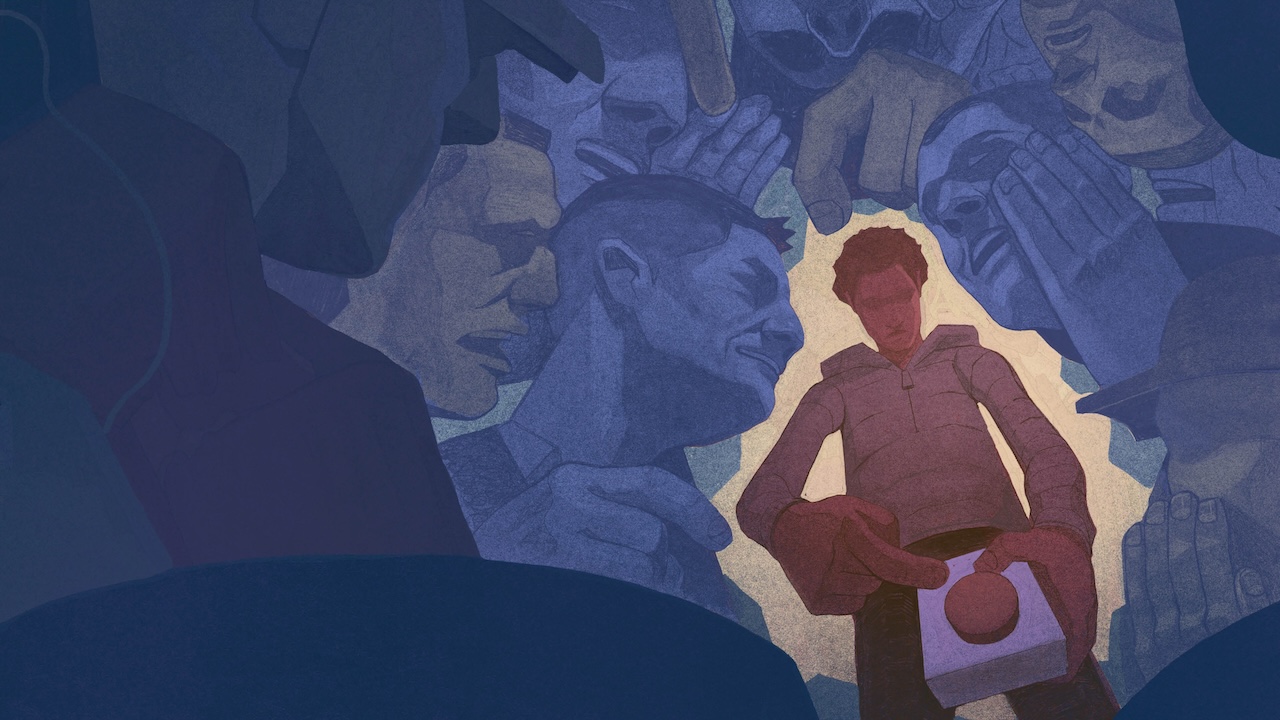
Ten years later, on November 26, 2010, a nineteen-year-old named Mohamed Mohamud was arrested near this same tree lighting ceremony after pressing a button on a cell phone that he believed would trigger a truck bomb, killing the thousands of people gathered in Pioneer Square. The detonator had been provided by two men, Youssef and Hussein, an al-Qaeda recruiter and an explosives expert. Or so Mohamed thought. The two men were actually FBI agents, only playing a role.
Court records describe the moment Mohamed discovers the charade. He’s with Hussein in a parking garage not far from the ceremony. Hussein hands Mohamed the cell phone and reads off the phone number that will detonate the bomb. It is 5:50 p.m. Mohamed punches the buttons on the phone and, when nothing happens, Hussein suggests they step out of the car for a better signal. This is in fact the arrest cue between the informant and the federal agents, who are piled in a van mere feet away. Mohamed exits the vehicle, and the parking garage is immediately flooded with officers. It’s a chaotic scene: Mohamed is thrown to the ground. Hussein yells in indignation, “Allahu Akbar!” Mohamed joins him. And then their chorus is interrupted by the sound of Hussein’s laughter. The scene turns joyous. The officers shake hands and pat each other on the backs, congratulating one another on a job well done. End scene.
Portland’s Pioneer Courthouse Square, also known as the people’s living room, spans an entire city block. In 1991, nearly fourteen thousand people filled the space to protest the Gulf War, the square’s largest gathering to date. I have attended movie screenings and concerts at the square, sat on its half-moon steps and people-watched, played chess with strangers to pass the time while waiting for a delayed train. During the tree lighting ceremony I attended with my mother, I remember how the space was transformed, how I hardly recognized it. I remember the outline of the tree—a towering Douglas fir, cast against the darkening sky—the collective countdown, and then an explosion of lights so fierce I had to blink several times to adjust to the brightness.
The Douglas fir is a hallmark of the Christmas season, a species native to and abundant in the Pacific Northwest. Despite its prevalence, botanists have long struggled to classify the tree. Known by many names, including Douglas spruce and Douglas pine (although it is neither spruce nor pine), it is a tree that defies easy categorization. It’s also resilient, able to grow in hostile environments, survive wildfires, and live for many hundreds of years, making it one of the forest’s most ancient inhabitants.
Recently, however, Douglas fir trees in southwest Oregon have begun to die by the thousands. A 2023 Oregon State University study attributes the primary cause of the die-off to record drought conditions. The second culprit is the flatheaded fir borer, an aggressive species of beetle scarcely the size of a grain of rice that can sense stress signals from trees in crisis. They don’t kill trees on their own, but rather exploit a tree’s existing weaknesses. Borer beetles leave no outward evidence of their wreckage, making early diagnosis nearly impossible. They burrow beneath the bark, and by the time the tree’s needles redden and the rot at its center is revealed, it is too late for it to be saved.
Mohamed Mohamud was born in Mogadishu in 1991, the same year the Somali state collapsed. Much of the reporting about the early years of his life centers around this fact, evoking images of a young boy growing up amid blood and bombs, indulging the Western impulse to trace one’s adult transgressions to the trauma of a volatile childhood. These stories also attempt to make sense of his life through the bureaucratic lens of citizenship and belonging, terms that not only demarcate a political or legal boundary, but also highlight the distance between the periphery and the center. He is a Somali national. He is a US citizen, but, the government is quick to point out, he is naturalized. He is an Oregon resident. He attended Oregon State University, but the university emphasizes that he was a non-degree-seeking student who dropped out during his sophomore year. In Corvallis, where the school is located, the imam of the masjid stressed that he was not a regular attendee. Two days after Mohamed’s arrest, the masjid was firebombed.
I won’t pretend to have known Mohamed well. We grew up in the same Oregon suburb. We went to the same masjid and overlapped at the same high school for a few years. I would greet his mother when I saw her around town and call her aunty out of respect. Our fathers worked for the same company. We were, and continue to be, bound by the concentric circles of our lives—with God and country at the center—even as they widened with time.
“How could this happen?” everyone asked, determined to find the origins of his radicalization.
A tree’s root system is responsible for maintaining the tree’s integrity, operating as both anchor and structure. The trunk transports water and nutrients from the soil to the branches, which in turn sustains the stems and leaves. Damage to the roots can be disastrous to the health of the branches. The place where a branch breaks off from the trunk, exposing the tree’s inner layers, is called a wound. If left untreated, a tree’s wounds leave it vulnerable to disease and even death.
Arborists once thought a tree’s rings only told its age. We now know that the stump of a tree holds the totality of its history. Tragedies and triumphs, seasons of want and seasons of plenty, years of drought and flood are etched into the wood.
In 2010, when Portland’s Somali community woke up to the news of Mohamed’s arrest, shock radiated through our masjids, our workplaces, our homes. We were tied together by this tragedy, even as it threatened to splinter us.
The year before his arrest, Mohamed was a freshman in college who planned to study engineering. He loved rap and writing poetry. Like most young people his age, he was trying to find his place in the world, testing boundaries, taking risks, and making decisions within the shrinking safety net of adolescence. He experimented with the usual things—sex, drugs, alcohol—but for him, these choices had a spiritual cost. His parents were in the midst of a contentious divorce, and with his central unit of belonging disappearing, he spent less and less time at home. True to his age, he was desperate to differentiate himself from his parents, and he began to develop his own religious identity, one that was often overzealous and veered dramatically from that of his family.
Seeking community, Mohamed found camaraderie in the dark corners of the internet, on message boards and in chat rooms that served as echo chambers for Islamic extremists, where, communicating through a sheen of anonymity, he could be whoever he wanted. He began using the name of a beloved Muslim warrior-scholar, Ibn al-Mubarak, who had forsaken a life of debauchery for one of spiritual discipline. It was these online activities, and his email correspondence with an alleged al-Qaeda affiliate who was under surveillance, that first brought him to the FBI’s attention. In one email the FBI obtained early in the course of their investigation, Mohamed complains to a friend about the racism and Islamophobia he experienced at London’s Heathrow Airport at the conclusion of a family trip. He wasn’t alone—since 9/11, Muslims around the world reported a sharp increase in racial profiling, harassment, and detainment at airports, all in the name of national security. Two years after this incident in London, Mohamed was placed on the No Fly List, a subset of the US government’s Terrorist Screening Database.
In 2009, the summer before starting university, Mohamed began expressing a desire to travel to the Middle East and study Islam. His father, Osman Barre, became concerned. There had been several recent high-profile cases of disenfranchised Somali boys being recruited to join overseas terrorist organizations. When he realized his son’s passport was missing, he called the FBI. It had become a common practice, post-9/11, for bureau officials to visit Portland mosques and speak with Muslim leaders about the need to work together, our shared responsibility to keep our communities safe. A few hours after he made the call, Barre was in a parking lot meeting with an agent from the Portland Joint Terrorism Task Force—a collaboration between local police and federal law enforcement often criticized for its secrecy and threat to Oregonians’ civil liberties. He was surprised to be met with this representative and wondered why they would assume his son was a terrorist. Was it because his name was Mohamed? Because he was Muslim?
That evening, Barre and his son had a heart-to-heart. He opened up about his own difficult childhood, shared his dreams for his son. Mohamed agreed not to leave the country and to attend university in the fall as planned. The next day, his father emailed the agent and told him that the situation was under control. He apologized for wasting the agency’s time. What the agent failed to mention at any point was that Mohamed was already on their radar; for months, they’d been scouring his communications through warrantless overseas wiretaps. This would become a point of contention between the government, the defense, and leading civil rights groups when the case eventually went to trial. More than anything, what these communications seemed to reveal was a young man in crisis. The FBI file on him from that time period described him as a “pretty manipulable, conflicted kid.”
That winter, a few months into his freshman year of college, Mohamed wrote on one of the message boards he frequented: “I swear by Allah I have become lost…. Being in University and living on campus hasn’t helped…. All I need is some soft words to help my heart.” Around this time, Mohamed received an email from an informant named Bill Smith. He didn’t take the bait. A few months later, the FBI escalated their probe, determined to find out whether this restless college kid posed a genuine national security threat. He was first contacted by Youssef in June 2010, and this time the email was carefully crafted to sound authentic and maximize the possibility of a response.
Kayse Jama, an Oregon state senator, has long taken issue with the practice, common after 9/11, of relying on paid informants and elaborate sting operations to suss out suspected terrorists. At the time of Mohamed’s arrest, Jama rebuked the government’s use of informants to infiltrate Muslim communities: “When people assume that one of their community members could be an informant for the government, that creates a ripple effect. They can’t trust the people at their mosques. They can’t trust anyone. They … can’t speak freely.”
Liban, one of Mohamed’s former friends who asked to be identified by a pseudonym, says his own relationship to the mosque changed after Mohamed’s arrest. Mistrust was high. “Sometimes a man we had never seen before would approach a group of us young guys and ask us how we felt about jihad.” He laughs as he tells the story. We’re sitting across from each other in a café not far from the mosque where the three of us—myself, Liban, and Mohamed— came of age. “What did they expect us to say?”
It was not just strangers we distrusted, but each other. We did not know who the mole among us was, who might overhear an innocent comment and report it to the feds for a quick buck. Liban tells me, “We felt so paranoid, like someone was always watching or listening.” Our already insular community grew even more isolated.
Musse Olol, the executive director of the Somali American Council of Oregon, a nonprofit that was formed in response to Mohamed’s case, remembers the fear that plagued the community in the days, weeks, and months following the high-profile arrest. It was reminiscent of the uncertainty many Muslims felt post 9/11, when extremism and Islam were collapsed into a singular and indistinguishable identity, and hate crimes against Muslims increased drastically. “My mom and dad and so many other members of our community were victims of hate crimes,” Olol says. “My dad stopped wearing his traditional clothes for fear of being targeted.” His first reaction to hearing the news about Mohamed was a question: “What’s going to happen to our people?”
Olol knew Mohamed and his family well and had helped them adjust to life in Oregon when they first arrived. He didn’t recognize the monster the media made Mohamed out to be. “The media focused on the negativity. They never mentioned he was a good kid. They didn’t care who Mohamed was. They never went to the community and said, ‘Tell us about your friend, your son, your brother.’ They didn’t interview the kids he grew up with.”
Olol says he read every article written about the case and then the comments, usually inundated with people calling Muslims terrorists and demanding their deportation. “Mohamed came here as a child,” he points out. “He went to school here. He is a product of America.”
As Black Muslims, Somali Americans occupy a complex space at the crossroads of race and religion, in a country that prefers neat demographic boxes. To Olol, Mohamed’s arrest exposed how thin the safety net was for Oregon’s Somali community. There were no established culturally specific resources or youth programming, no crisis teams or mental health experts. The community was simultaneously invisible and hypervisible. That dichotomy often left Mohamed and other young people our age with few places where we truly belonged. In the absence of strong community leaders or advocates, local imams held press conferences and rushed to handle the heightened attention. But their ad hoc efforts underscored a terrifying reality—if we were scrambling to respond to a crisis that none of us had seen coming, how could we prevent a future one from occurring?
An engineer by trade, Olol reluctantly became an impromptu community leader. He pushed back against the one-dimensional portrait of Mohamed and of Oregon Somalis, reminding the media that it was Mohamed’s own father who, desperate for help, first called the FBI. “He was a father who wanted to save his son. He had nowhere else to turn.”
Mohamed’s first in-person meeting with the man known as Youssef took place on July 30, 2010, in the lobby of an Embassy Suites hotel. Mohamed asked to meet at the mosque, but Youssef declined, stating that he wanted to meet privately. It was at this meeting, prosecutors alleged, that Mohamed first mentioned the idea of setting off a bomb, giving the FBI the pretext they needed to justify a full-scale investigation and sting operation. Conveniently, the digital recorder meant to capture that exchange lost power during the meeting, leaving the single most pivotal conversation in the case without even a second of audio evidence.
In the weeks that followed, Mohamed grew close to Youssef. In his book Uncovering a Terrorist, Bryan Denson writes: “Their friendship, forged by the trickery of the FBI sting operation, was as counterfeit as their bomb.” On August 19, Youssef introduced Mohamed to Hussein, who he said was an al-Qaeda bomb expert. It was Ramadan when the three of them met in person for the first time, breaking their fast together over food they picked up from a Lebanese restaurant.
Denson details the encounter, writing how Mohamed sounded like “an eager teen at a job interview,” clearly wanting to impress the two men. The undercover operatives claimed to be interviewing people across the US and Canada to join their religious council, a small network of only the best and brightest. They told Mohamed he was a “jewel in the rough” and that he had come highly recommended. They gave him a series of tasks: Buy a burner phone; identify potential parking spots near Pioneer Square to set off the explosion; secure a storage space where they would build the bomb. They instructed him to purchase bomb components, to move into an apartment of his own, and they gave him enough money to do both. (The FBI did not want him to have any roommates because it would disrupt their surveillance efforts.) Soon after, he moved out of the apartment he shared with friends and into a studio, spending more time with these two men, whom he had begun to think of as older brothers. He was lost, and they gave him purpose; he dreamed of paradise, and they offered him the path.
Two weeks before the tree lighting ceremony, Mohamed met with the men at a Starbucks in Corvallis to finalize their Thanksgiving day plans. Afterward the three of them drove to the countryside and set off a small test bomb. According to court documents, Mohamed called the small explosion beautiful. Next they drove to Mohamed’s apartment, where Youssef and Hussein pressured him into recording a video manifesto. He was hesitant at first, but they were insistent. “For as long as you threaten our security, your people will not remain safe,” Mohamed declares on the tape. In the video he wears a camouflage jacket and a
long white robe, determined to look the part, like all good method actors, and not the nineteen-year-old boy he actually was.
From the time of Mohamed’s initial meeting with Youssef that summer, a rotating cast of FBI agents had tailed his every move, sketching a double portrait: one of a boy who prayed, studied, played basketball with his friends, phoned his mother; and another with a secret big enough to swallow him whole. Daylight and surveillance blurred the border between the two. On the day before Thanksgiving, Mohamed went shopping with his friends at Washington Square mall and the big outlet mall in Woodburn. He was laughing and singing, hugging his friends, appearing to have a great time. Who was the real Mohamed, and who decided where the fiction ended and the truth began?
Today his friend Liban says it still doesn’t feel real. To him, Mohamed was “just one of the boys.” They spent time working out together, talking about girls, complaining about their families, sharing their boyhood dreams.
In a press conference after Mohamed’s sentencing hearing, his mother, Mariam Barre, stood outside the Portland courthouse and made her first and last public statement. It was October 2014, four years after her son’s arrest. The weather was unusually warm, and a crowd had gathered around the courthouse. Mariam looked tired, but she was emphatic:
A government should not be allowed to do what they did to my son…. A government should not take someone’s son and isolate him for two years and put ideas in his mind…. The government should not tell [a child] don’t tell your parents anything…. A government should not give a young teenager money…. This is my son, who I put in college…. A government that we trust should not betray us…. A government should not entrap young boys…. A government should not teach a young boy how to build a bomb.
In the aftermath of the thwarted Christmas tree bombing, the FBI insisted that no one who attended the event in Pioneer Square was ever in any real danger. There was no battlefield; there was only an American city, only the gray concrete slabs of the parking garage and the gray November sky. There was no explosion ripping through the night, only a seventy-five-foot Christmas tree adorned in lights, and thousands of people who returned home to the news of the terrible fate from which, they were told, they had all been saved.
There was no secret plot, only the manufacturing of fear and consent. There was never a terrorist; there was only ever a nineteen-year-old boy, caught between faith and doubt, typecast in a script he did not write.
For years, the prevailing opinion in the scientific community was that trees were individualistic, in constant competition with one another over resources. Researchers have now learned that for trees, much like for humans, survival is a collaborative effort. Through mycorrhizal networks, trees can pass water, nutrients, and messages to one another. They warn each other of impending drought, of disease. There are even studies indicating that plant roots grow toward the sound of running water, in the direction of life. Musse Olol says Osman Barre’s family, fleeing war to settle in Oregon, followed that same instinctive tug toward survival and belonging.
Trees have a sense of kin and relationality, a belief that is still controversial among many in the scientific community. Before he was splintered from us, Mohamed was a son of Oregon’s Somali community, a community predominantly made up of refugees who have left their homes and histories behind. In Somali culture, as in many other Indigenous cultures, each child is the responsibility of the village. In the United States, our parents—both Mohamed’s and mine—found themselves facing the impossible task of raising children in the relational wasteland of this new country. There was no village; there was only a violence that threatened to unmake it.
Mohamed has spent nearly fifteen years in federal custody; he is now an inmate at FCI Sandstone, a low-security federal prison in Minnesota. His expected release date is in 2036. He is currently thirty-three years old, the same age his father was when he arrived at Portland International Airport in 1993.
“How do you think penguins survive the brutality of the North Pole? How do they protect and shelter their children? They huddle around them,” Musse Olol says. We’re sitting in his office in Southeast Portland. He says that the story about our community has been overshadowed by the hardships we’ve faced, but that Mohamed’s case was a call to action. Our community’s history in this state is still being written. We are not beholden to the scripts that we’ve inherited about our place in the world. We’re learning as we go, although I’ll be the first to admit that the price has been too high.
I watch a group of elementary school girls run around the lobby of the building we’re in. Their laughter softens the silence between us. They’re playing tag now, running around the office in a blur of bright dresses.
“What do you know now that you wish we had known back then?” I ask Musse. He pauses for so long I think he hasn’t heard me.
It is hard to look at the past from where we stand in the future. We have no power to travel back in time, to change history, to stop a war before it starts, to save a troubled boy from the violence of his dreams.
“We cannot abandon each other,” he finally says. We couldn’t even if we wanted to.
Jamila Osman is a Somali writer, multimedia artist, and educator. She has taught creative writing from Portland to Palestine, from summer camps to juvenile detention facilities, and holds an MFA from the University of Iowa’s Nonfiction Writing Program, where she was an Iowa Arts Fellow. Her work has appeared in numerous literary journals, magazines, and anthologies. She is the author of the chapbook A Girl is a Sovereign State (Akashic, 2020) and is a 2025 Oregon Humanities Community Storytelling Fellow
Comments
2 comments have been posted.
When I was in college I lost my virginity to a young boy. This young boy was so young that he could not be held accountable for his young boy actions. As a young woman, I should’ve known better than to beguile this young boy with my seductive ways. I actually didn’t want to lose my virginity to this young boy, but he held me down and forced me. This young boy was my age. To refer to a college aged male as a young boy is deceptive and to try to excuse that person by only blaming a coercive government- which is very complicit - but then ignoring the fact that this supposed young boy was very much wanting to kill thousands of people and raised in a religion that demands the destruction of infidels and pretty much treats women as garbage. I just can’t sympathize with this author’s argument.
Stephanie | October 2025 |
Response by Zakia Mumin As a young African Somali Muslim woman, a mother, and a community member who came to this country for opportunity, I read this story with both sorrow and clarity. Opportunities shape us differently — some know how to receive them, some know how to fight for them, and others struggle to hold on. But behind every choice, the resources we have, the connections between home, faith, and community, determine the outcome. If Mohamed’s father had a trusted place to turn, or if there had been a faithful and strong community connection, his story might have carried a different ending. Too often, parents arrive in this country already traumatized, without tools, resources, or systems to help their children. When faith, culture, community, and law pull in different directions, survival itself becomes fractured. Many young people then search for belonging in dangerous ways — through drugs, gangs, false promises, or even manipulated faith. All of these are symptoms of not having balance, guidance, or a safe place to stand. I know this pain personally. I was among the first to help support the Somali American Council of Oregon when it was being built, and I know its director, Musse Olol, who has worked tirelessly to hold our community together. I believe our shared responsibility is to build stronger, balanced resource centers — places where parents, youth, and families can turn before it is too late. I also want to thank Jamila Osman. Her writing is a gift — intelligent, resourceful, and deeply rooted in community care. Too often we fail to uplift our own voices. Her contribution reminds us that in this 21st century, in 2025, voices and connections matter more than ever. To Mohamed and to every young man searching for direction, I want to say this: never confuse your choices with your chances. If you only take chances without making clear choices, you risk losing your light. Your choices must be stronger than your chances. This story is a tragedy, but it is also a call. We cannot abandon each other. We must build the community, the balance, and the faith connections that save our children — so no mother has to cry alone, and no father’s desperate call for help becomes the beginning of his son’s downfall. — Zakia Mumin
Zakia Mumin | August 2025 | PDX
Add a Comment